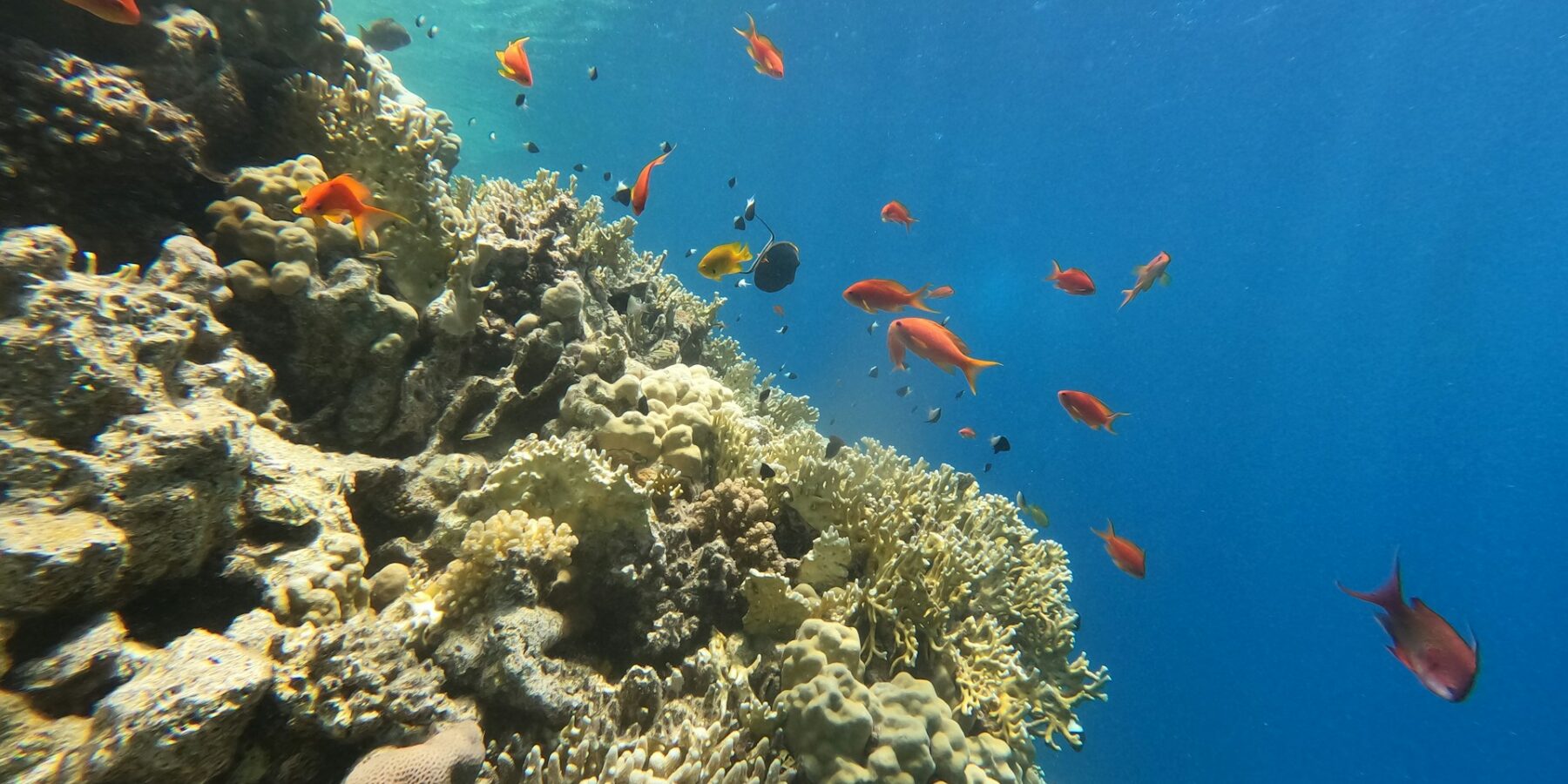
Panorama Reef is the largest reef off Safaga, a long wall whose sides drop to 400 meters. In the north you find giant sea fans and a resident Napoleon wrasse; in the south, a crack full of glassfish. It is Safaga's signature dive.
Why dive Panorama Reef?
- The largest reef in Safaga, with walls dropping to 400 meters
- The north plateau: acropora tables, giant sea fans and a big resident Napoleon wrasse
- The south plateau, its sea fan crack full of glassfish, then Anemone City
- Tuna, trevallies, barracudas and sometimes sharks in the blue
- Middle Reef, its southern neighbor, and its caves of light
What will you see at Panorama Reef?
Panorama Reef draws reef fauna and open-sea fauna alike, and that mix makes the site. On the north plateau, a big resident Napoleon wrasse greets dive groups above the acropora tables and sea fans; in the blue, trevallies, barracudas and dogtooth tuna patrol, sometimes with a whitetip reef shark, and hammerheads have been spotted off the point. The south plateau belongs to bluespotted ribbontail rays, scorpionfish, morays, parrotfish and triggerfish; a crack there shelters superb sea fans and glassfish, and farther on, potato groupers and peacock groupers hold the plateau. Anemone City, finally, lines up its magnificent anemones and their clownfish, and eagle rays and turtles pass along the walls.
| Species | J | F | M | A | M | J | J | A | S | O | N | D | Note |
|---|---|---|---|---|---|---|---|---|---|---|---|---|---|
 Napoleon wrasse | peak season | peak season | peak season | peak season | peak season | peak season | peak season | peak season | peak season | peak season | peak season | peak season | the guardian of the north plateau, a big resident that comes to check out dive groups |
 Dogtooth tuna | possible | possible | possible | possible | possible | possible | possible | possible | peak season | peak season | peak season | possible | in the blue, off the plateaus |
 Bigeye trevally | possible | possible | possible | possible | possible | possible | possible | possible | peak season | peak season | peak season | possible | in the blue, off the plateaus |
| Barracudas | possible | possible | possible | possible | possible | possible | possible | possible | peak season | peak season | peak season | possible | in the blue, off the plateaus |
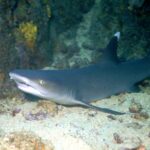 Whitetip reef shark | possible | possible | possible | possible | possible | possible | possible | possible | possible | possible | possible | possible | sometimes at the edge of the north plateau |
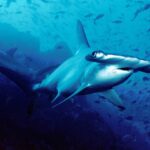 Scalloped hammerhead | rare | rare | rare | rare | possible | possible | possible | possible | rare | rare | rare | rare | spotted off the north plateau, rare, mostly in summer |
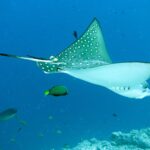 Spotted eagle ray | possible | possible | possible | possible | possible | possible | possible | possible | possible | possible | possible | possible | passing along the walls |
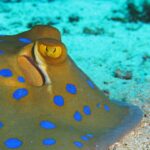 Bluespotted ribbontail ray | peak season | peak season | peak season | peak season | peak season | peak season | peak season | peak season | peak season | peak season | peak season | peak season | on the sand of the south plateau |
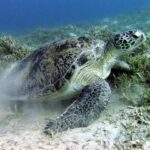 Green turtle | possible | possible | possible | possible | possible | possible | possible | possible | possible | possible | possible | possible | on the plateaus, passing through |
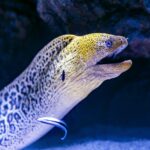 Giant moray | peak season | peak season | peak season | peak season | peak season | peak season | peak season | peak season | peak season | peak season | peak season | peak season | in the crack on the south plateau |
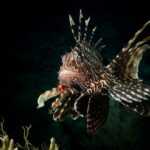 Lionfish | peak season | peak season | peak season | peak season | peak season | peak season | peak season | peak season | peak season | peak season | peak season | peak season | under the table corals and in the crack |
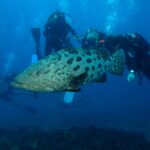 Potato grouper | peak season | peak season | peak season | peak season | peak season | peak season | peak season | peak season | peak season | peak season | peak season | peak season | on the south plateau |
| Peacock groupers | peak season | peak season | peak season | peak season | peak season | peak season | peak season | peak season | peak season | peak season | peak season | peak season | on the south plateau |
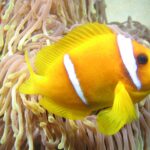 Clownfish | peak season | peak season | peak season | peak season | peak season | peak season | peak season | peak season | peak season | peak season | peak season | peak season | by the dozens in the anemones of Anemone City |
peak seasonpossiblerare
What is diving like at Panorama Reef?
The reef is long, just awash, and its sides drop straight into 400 meters of water. You dive it from its two plateaus: in the north, entry by zodiac and a drift along a wide plateau covered in acropora tables and sea fans, between 18 and 30 meters, with the blue in view; in the south, a dive from the anchored boat onto a more sheltered plateau, around 20 meters, with its sea fan crack and Anemone City to finish. The current is sometimes strong, especially in the north, and the dive usually ends away from the reef, under an inflatable buoy that shows the boat where the divers are. Dive centers ask for experienced divers, comfortable at 40 meters and in drift; visibility of 20 to 30 meters helps.
When to dive Panorama Reef?
idealgoodnot recommended
The reef is dived all year. The water drops to 22°C in February and March, when a 5 mm wetsuit is welcome, and rises to 29°C in August; visibility holds between 20 and 30 meters, often more on an offshore reef like this one. The winter north wind kicks up the sea on the crossing and sometimes makes the north point undivable: dive centers then switch to the more sheltered south plateau, or to Middle Reef. From March to November, conditions are the most consistent.
How to get to Panorama Reef?
Panorama Reef lies off Safaga, fifty kilometers south of Hurghada and 45 minutes by road from its airport. Dive centers in Safaga and Soma Bay go there on day trips, less than an hour at sea, for two dives: at Shams Safaga, the boat day costs €58, tank and weights included, plus €8 for the permit, and ten dives over five days cost €248 to €270; liveaboards from Hurghada or Safaga stop here, often with Middle Reef, its southern neighbor. Hurghada has direct flights from France; the full visa, US$25, is available on arrival or online.
Stay in Safaga
Where to find a dive guide in Panorama Reef?
Guided tours you can book online, ranked by number of reviews. These are affiliate links: if you book, you support us at no extra cost.

 Viator
Magic Red Sea Discovery - Discover Scuba Diving Marsa Alam
5.0 (13 reviews)View and book Viator
Scuba Diving in Hurghada _ 2 Stops Dive With Equipments & Lunch
4.9 (12 reviews)View and book Viator
Intro Diving 2 Stops For Beginners, Cruise With Lunch - Hurghada
5.0 (10 reviews)View and book Viator
Red Sea Open Water Diver Course in Marsa Alam
5.0 (10 reviews)View and bookWhere to stay near Panorama Reef?
Hotels, apartments and rooms around Safaga, with current prices.
Which hotels to choose near Panorama Reef?
How big is Panorama Reef off Safaga?
Safaga, a former fishing port turned dive resort, is lucky to have a string of isolated reefs offshore that boats reach in less than an hour. Panorama Reef is the largest: a long wall, just awash, bathed in turquoise water, whose sides drop to 400 meters. It owes its name to the view from the boat over the whole reef and, underwater, over its dizzying coral-covered walls. Dive centers usually do one dive on the north end and another on the south end.
What can you see on the north plateau of Panorama Reef?
The dive starts by gliding over a wide plateau covered in acropora tables and sea fans, where a big Napoleon wrasse acts as guardian. At the edge of the plateau, your eyes turn to the blue: trevallies, barracudas, tuna and sometimes a whitetip reef shark cruise there, and hammerheads have been seen at the site. You reach this part of the reef by zodiac, and the dive often ends as a drift along the wall, sea fans within reach.
What is on the south plateau of Panorama Reef?
More sheltered, the south plateau is dived from the anchored boat. You see stingrays, scorpionfish, morays, parrotfish, Napoleon wrasse and triggerfish; a crack shelters superb sea fans and a cloud of glassfish, and farther along the plateau, groupers and morays make their home. The site is also known for its Anemone City, a sanctuary of anemones and clownfish, where you end the dive in the shallows. Here too, glance at the blue now and then: the current and the lush marine life sometimes draw bigger predators.
Is Middle Reef worth diving after Panorama Reef?
Farther south, Middle Reef is a big mushroom-shaped reef where boats anchor in calm water and which offers drift dives. Its plateaus covered in hard corals, its coral gardens among the finest in the Red Sea and, to the south, a maze of caves, tunnels and coral heads make it the natural complement to Panorama. Tuna and barracudas patrol in schools among turtles and eagle rays, one coral head is home to a multitude of glassfish, and a small cave puts on a light show at the end of the dive.
Our tip
Do the north plateau as your first dive, drifting from the zodiac, when the pelagics are at the edge. Save the more sheltered south plateau for the second, and explore the sea fan crack slowly, light in hand.
Other dive sites nearby
 EgyptWreck
Salem Express wreck
Central Red Sea, Egypt EgyptReef
Giftun Islands
Central Red Sea, Egypt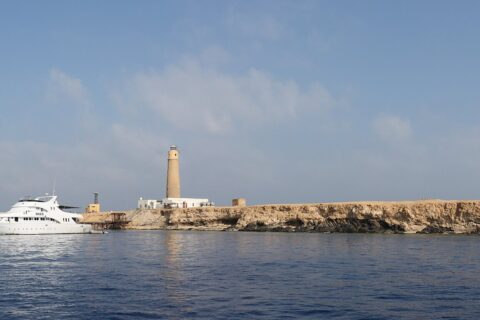 EgyptPelagic