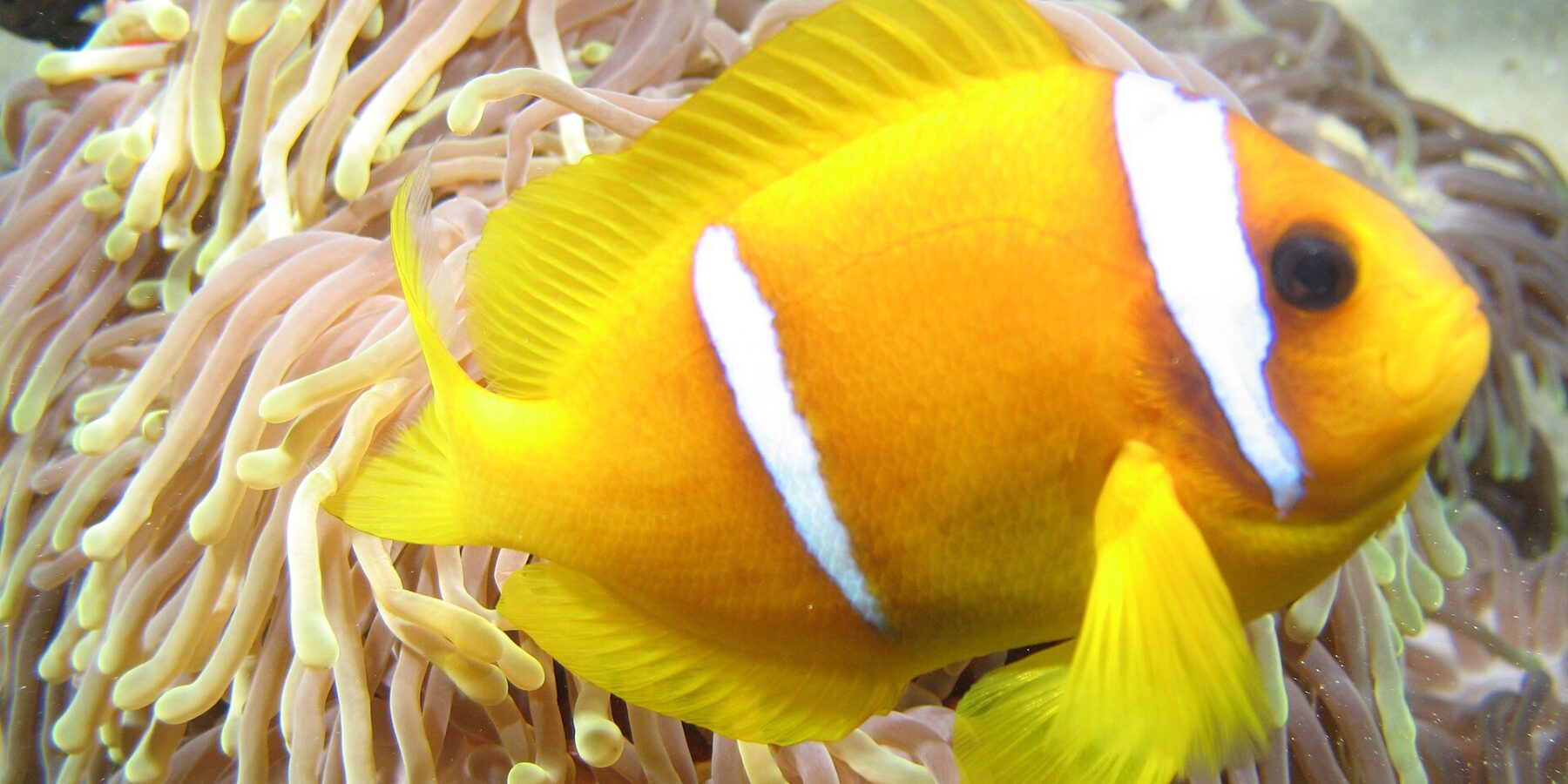
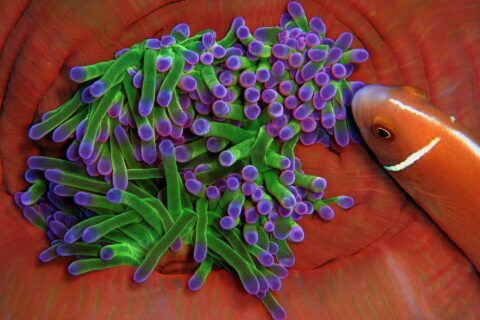
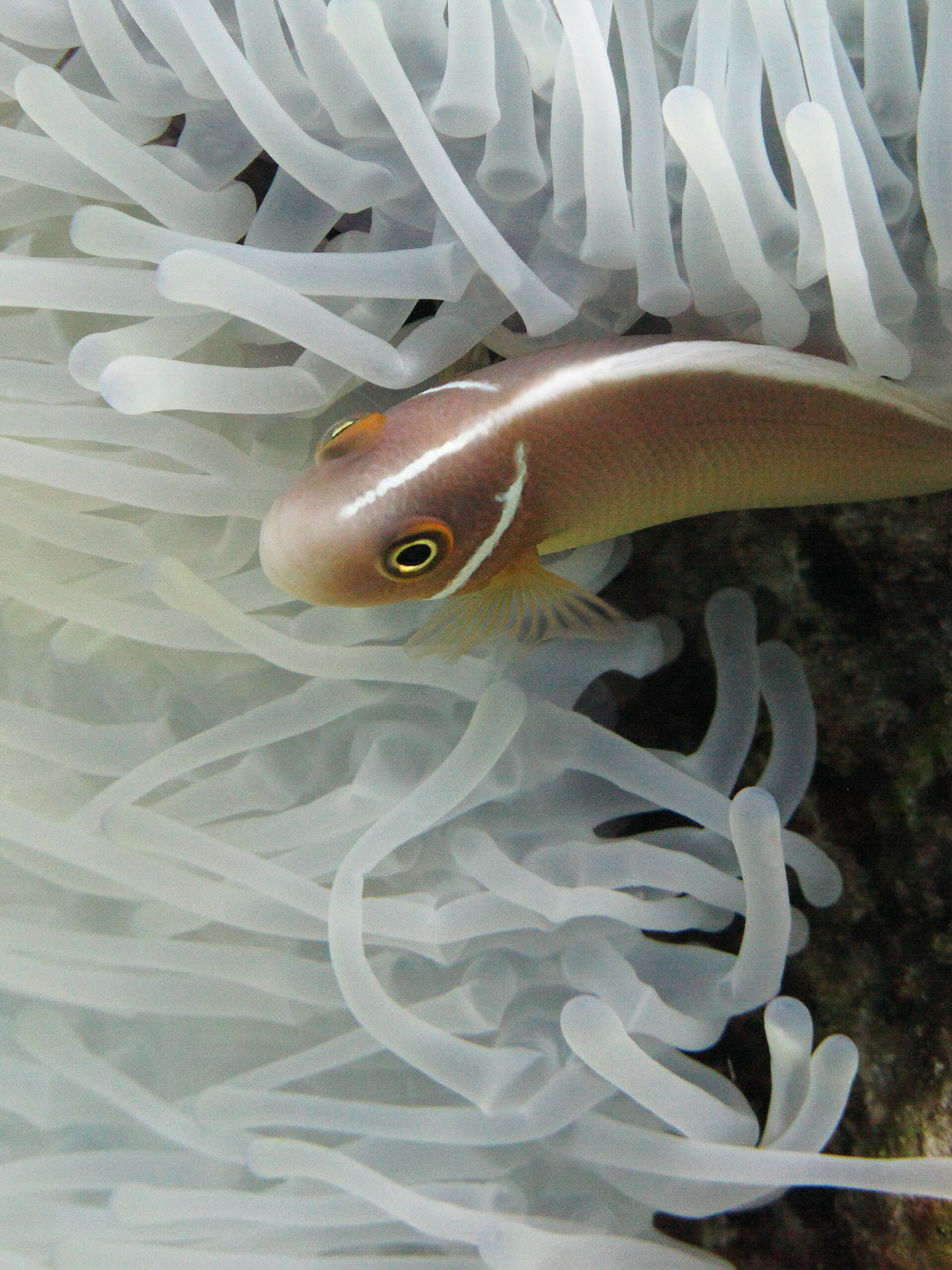
The clownfish lives in a sea anemone that shelters it, and each species has its own colors: orange-yellow with two white bands in the Red Sea, pink with a white stripe in the Gulf of Thailand. You see it all year at Panorama Reef, at Daedalus and on top of Chumphon Pinnacle.
Where to dive to see the Clownfish?
 ThailandPelagic
Chumphon Pinnacle
Gulf of Thailand: Koh TaoPeak season all year round: in the carpet of anemones on the top
 EgyptPelagic
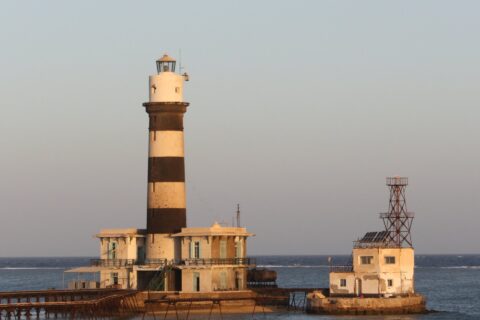
Daedalus Reef
Southern Red Sea, EgyptPeak season all year round: on the walls and at Anemone City
 EgyptReef
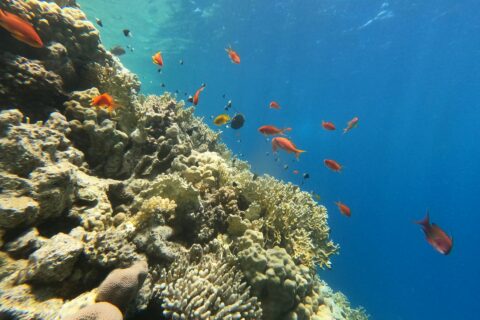
Panorama Reef
Central Red Sea, EgyptPeak season all year round: by the dozens in the anemones of Anemone City
How do you identify a clownfish?
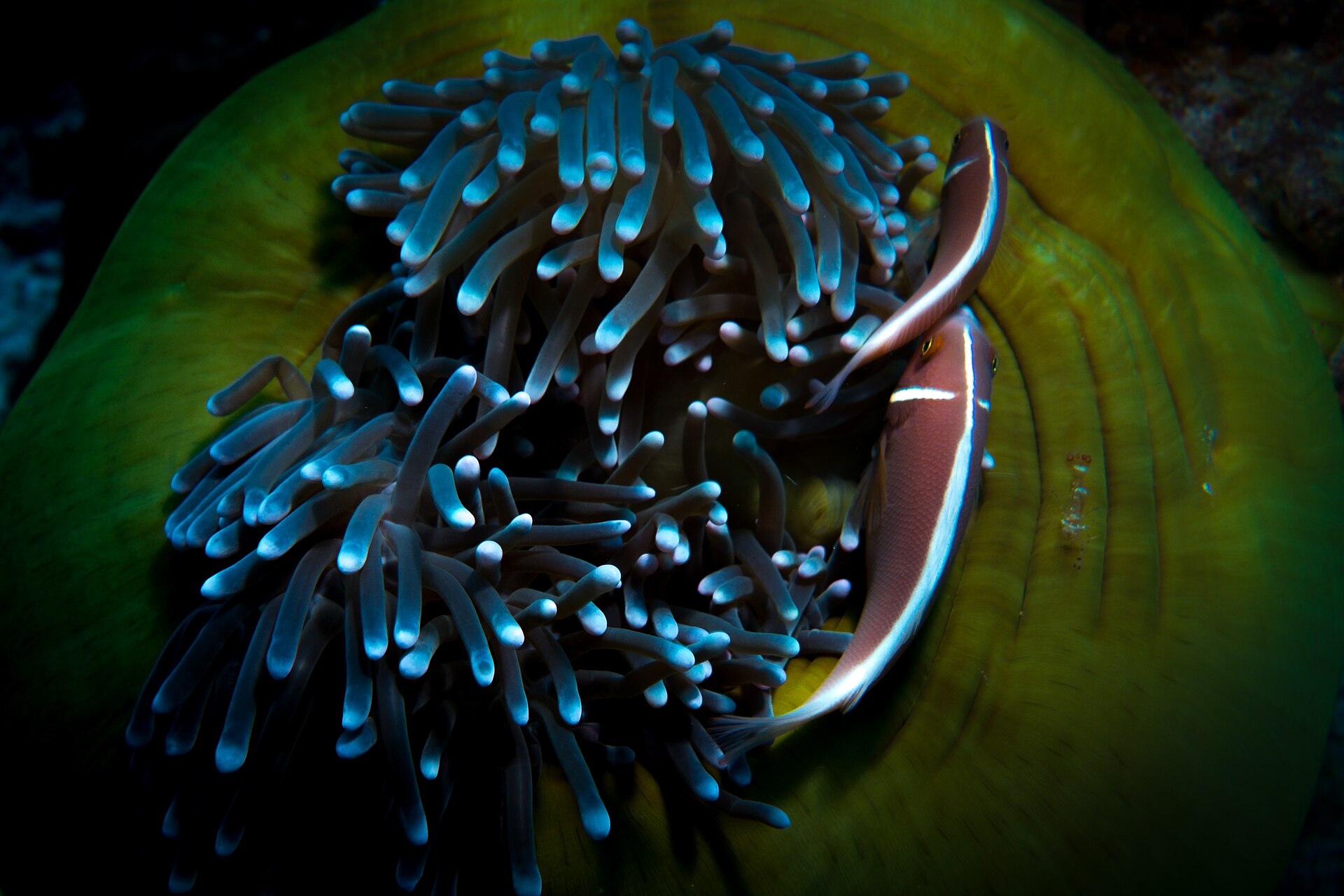
The clownfish is a small, stocky, colorful reef fish that measures 8 to 16 centimeters depending on the species. There are 29 known species, all in the genus Amphiprion, and each has its own colors, made of zero to three white bands on an orange, red, yellow, pink, brown or black background. In the Red Sea, the two-band anemonefish, Amphiprion bicinctus, is orange-yellow, with two black-edged white bands, one just behind the eye and the other from mid-back down to the belly; it reaches 14 centimeters. In the Gulf of Thailand, the pink skunk clownfish, Amphiprion perideraion, grows no larger than 10 centimeters. It is pinkish orange, with a thin white stripe running from the snout along the back and a white bar just behind the head.
Clownfish in pictures
How does the clownfish live?
The clownfish lives in the warm waters of the Indian Ocean and the western Pacific, from the Red Sea to French Polynesia and from Japan to Australia; it is absent from the Atlantic. It never strays from its anemone: ten species of sea anemone serve as hosts, and a mucus that mimics the anemone's own protects it from the stings. Each anemone shelters a small, strictly ranked group: the largest is the breeding female, the second the breeding male, and the others wait their turn. If the female disappears, the male becomes female and the largest of the non-breeders becomes male. The female lays her eggs on a rock at the foot of the anemone, and the male guards and cleans them. An omnivore, it feeds mostly on plankton: algae, copepods and tunicate larvae.
Where and when can you see clownfish in the Red Sea and Thailand?
You will find the clownfish at nine dive sites, always in its anemones. In the Red Sea, it is the two-band anemonefish. At Panorama Reef, off Safaga, it lives all year by the dozens in the anemones of Anemone City, where the dive ends in the shallows, and at Daedalus, Anemone City lines up its anemones and clownfish on the southern plateau all year. At Ras Mohammed, the Anemone City on the flank of Shark Reef lines up hundreds of anemones and their clownfish on a shallow plateau. In Thailand, the pink skunk clownfish occupies the carpet of anemones on top of Chumphon Pinnacle all year, along with anemone shrimp, and the anemones of Sail Rock, on the second dive. At Koh Tachai, anemones and their clownfish cover the 13-meter plateau, and Richelieu Rock is home to tomato clownfish, rare elsewhere in Thailand. In Indonesia, you meet it on the Crystal Bay wall, at Nusa Penida, and in the coral garden of the USAT Liberty wreck, at Tulamben.
Is the clownfish endangered?
Most clownfish are listed as Least Concern on the IUCN Red List, including the pink skunk clownfish and the Red Sea clownfish; only McCulloch's anemonefish is listed as Vulnerable. Their future depends on that of their anemones and reefs: ocean warming and acidification threaten them, as does collection for the aquarium trade.
Our tip
Approach the anemone slowly, from the side, and stay an arm's length away. Never touch the anemone: it shelters the whole group, and often a shrimp too. For photos, limit your flash and let the fish settle back into its tentacles between shots.