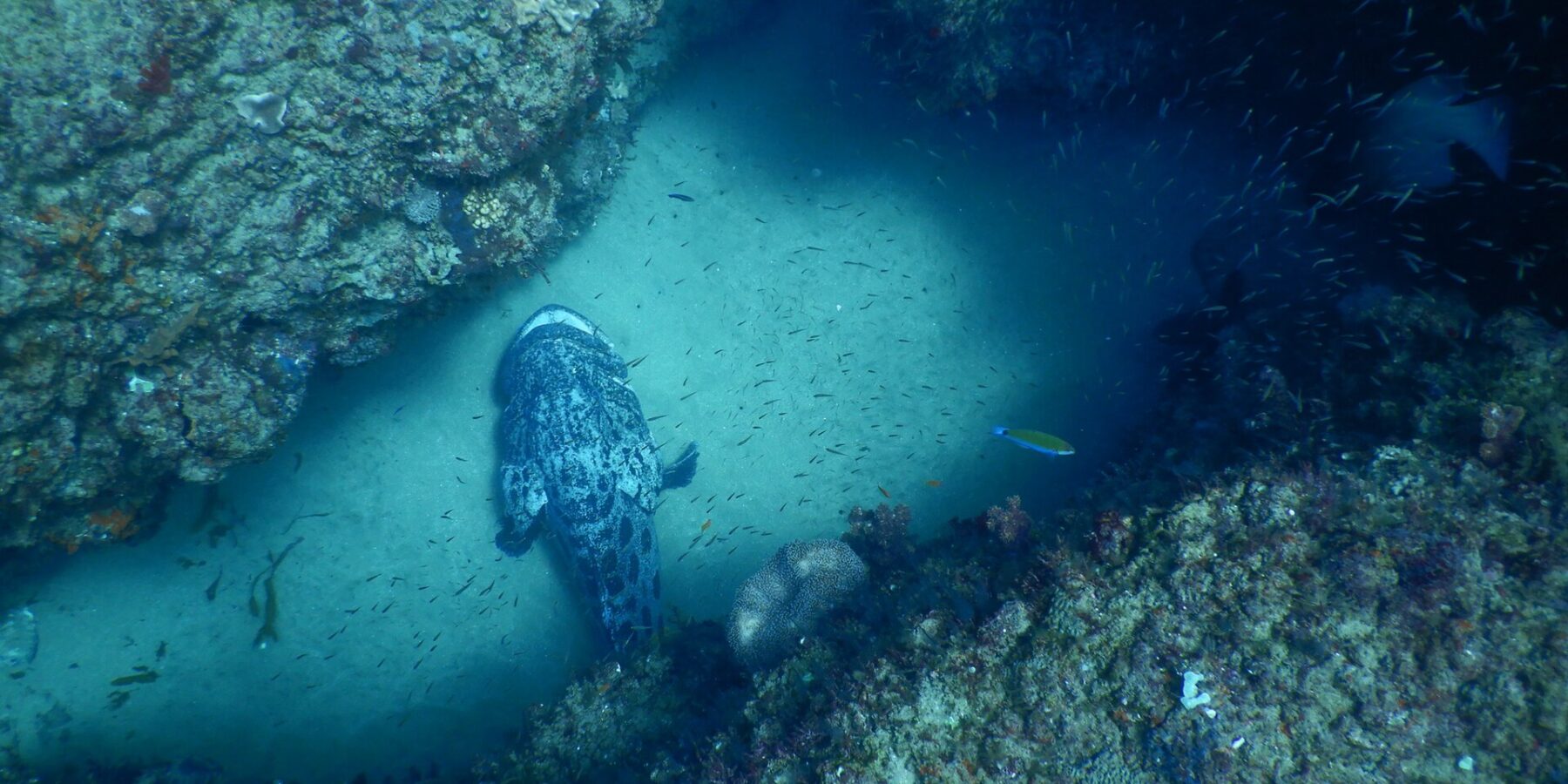
Kinasi Pass opens Chole Bay to the ocean, in Mafia Island Marine Park, and you drift it along two walls where schools of trevallies and barracudas cross paths with potato groupers. It is the signature dive of Mafia, ten minutes by boat from Utende.
Why dive Kinasi Pass?
- The Chole Bay pass as a drift dive: two walls, one from 20 to 26 meters, the other from 6 to 15, with caverns and overhangs
- Schools of trevallies, rainbow runners and barracudas that block out the light when the current comes in
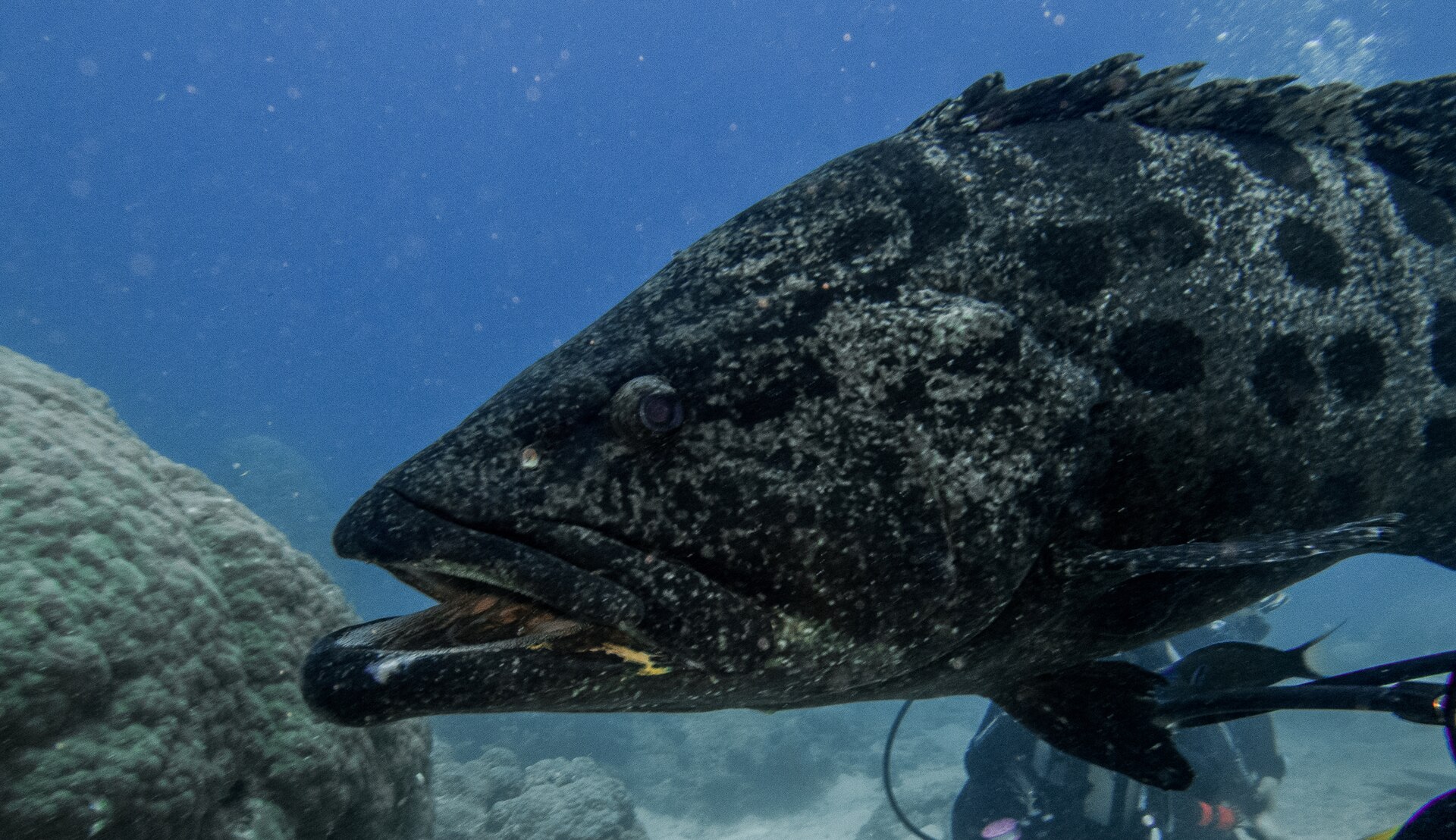
- The Pinnacle, a 12-meter coral spire at the mouth of the pass, with its resident potato grouper and moray
- A marine park created in 1995, with more than 400 fish species and some fifty coral genera in the bay
- Two dives for US$90, ten minutes by boat from a fishing village
Kinasi Pass in pictures
What will you see at Kinasi Pass?
Kinasi Pass is the fishiest site in Chole Bay, and the bay itself has more than 400 fish species and some fifty coral genera. In the pass, the show is the schools: clouds of juvenile and adult reef fish, and trevallies, rainbow runners and barracudas so dense they block out the light, along with parrotfish, big groupers, eagle rays and, with the tide, pelagics moving in and out. On the Pinnacle, at the mouth of the pass, live a very large potato grouper, a huge moray lodged in a hole in the rock spine, and a troop of large batfish. Along Kinasi Wall, on the second dive, hawksbill turtles graze on sponges, Napoleon wrasse cruise the wall, groupers hide in the caves and giant clams open between the sea fans. On the sand of the Coral Patches live hundreds of garden eels, and on the sand of the gardens, bluespotted ribbontail rays.
| Species | J | F | M | A | M | J | J | A | S | O | N | D | Note |
|---|---|---|---|---|---|---|---|---|---|---|---|---|---|
 Great barracuda | peak season | peak season | peak season | peak season | peak season | peak season | peak season | peak season | peak season | peak season | peak season | peak season | in a tight school in the current, above the deep wall |
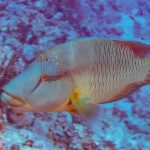 Napoleon wrasse | possible | possible | possible | possible | possible | possible | possible | possible | possible | possible | possible | possible | along Kinasi Wall, on the second dive |
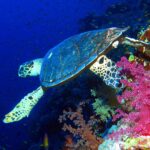 Hawksbill turtle | peak season | peak season | peak season | peak season | peak season | peak season | peak season | peak season | peak season | peak season | peak season | peak season | the most common turtle in the bay, on Kinasi Wall |
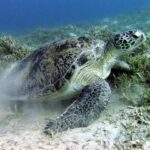 Green turtle | possible | possible | possible | possible | possible | possible | possible | possible | possible | possible | possible | possible | passing over the seagrass beds and coral gardens |
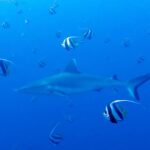 Gray reef shark | possible | possible | possible | possible | possible | possible | possible | possible | possible | possible | possible | possible | in the blue of the pass, with the incoming current |
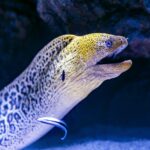 Giant moray | peak season | peak season | peak season | peak season | peak season | peak season | peak season | peak season | peak season | peak season | peak season | peak season | a very large resident in a hole in the Pinnacle |
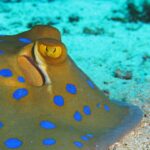 Bluespotted ribbontail ray | peak season | peak season | peak season | peak season | peak season | peak season | peak season | peak season | peak season | peak season | peak season | peak season | on the sand of the coral gardens and coral heads |
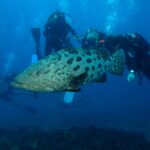 Potato grouper | peak season | peak season | peak season | peak season | peak season | peak season | peak season | peak season | peak season | peak season | peak season | peak season | a very large resident on the Pinnacle, others in the caves of Kinasi Wall |
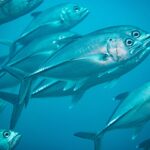 Bigeye trevally | peak season | peak season | peak season | peak season | peak season | peak season | peak season | peak season | peak season | peak season | peak season | peak season | in schools that block out the light, in the pass |
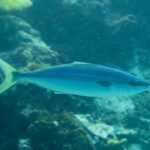 Rainbow runner | peak season | peak season | peak season | peak season | peak season | peak season | peak season | peak season | peak season | peak season | peak season | peak season | in schools that block out the light, in the pass |
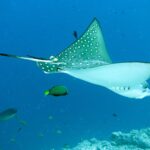 Spotted eagle ray | possible | possible | possible | possible | possible | possible | possible | possible | possible | possible | possible | possible | gliding through the pass, especially with the current |
| Batfish | peak season | peak season | peak season | peak season | peak season | peak season | peak season | peak season | peak season | peak season | peak season | peak season | large resident batfish around the Pinnacle |
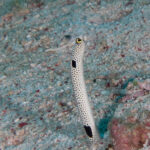 Spotted garden eel | peak season | peak season | peak season | peak season | peak season | peak season | peak season | peak season | peak season | peak season | peak season | peak season | by the hundreds in the sand of the Coral Patches, on the second dive |
| Humpback whales | rare | rare | rare | rare | rare | rare | possible | possible | possible | possible | rare | rare | seen from the boat, outside the bay, from July to October |
peak seasonpossiblerare
What is diving like at Kinasi Pass?
The pass is a drift dive. You first descend onto the Pinnacle, an old coral spire 12 meters high with its base at 24 meters, then move to the southwest side of the channel: first a deep wall, a stepped reef from 20 to 26 meters, then a second, shallower one from 6 to 15 meters, with small caverns and overhangs. The incoming current carries the group toward the bay. It can be strong, and the ascent is made in open water under a surface marker buoy, with the boat following the bubbles. At slack water, the pass is open to Open Water divers; in a steady current, dive centers ask for Advanced or real drift experience. Visibility depends on the tide: 10 meters on the ebb, 20 to 30 meters on the flood. The water is 26 to 29 °C: wear a 3-millimeter wetsuit. Tide tables set the boat time, and the bay stays diveable when the open sea is not.
When to dive Kinasi Pass?
idealgoodnot recommended
Chole Bay can be dived all year, because the islands of Chole, Juani and Jibondo close it off and keep it sheltered when the ocean is rough. The best period runs from October to March: calm seas, water at 27 or 29 °C, visibility of 10 to 30 meters depending on the tide. It is also whale shark season on the other side of the island, which you can combine with diving on the same trip. The sites outside the bay, the Dindini and Jina walls, only open during these months. The long rains from March to May cloud the water and cause canceled trips; the dry season, from July to October, brings water at 26 °C and humpback whales seen from the boat. Within the day, the tide is in charge: the pass is dived on the incoming tide, and departure times change every day.
How to get to Kinasi Pass?
Kinasi Pass opens on the east side of Chole Bay, ten or fifteen minutes by boat from the lodges of Utende, the village on the southeast coast where the marine park entrance and the dive centers are. At Big Blu, on Utende beach, a boat dive costs US$50, two dives US$90, ten dives US$380 and gear US$20 a day; the center goes out by dhow or by motorboat. Marine park entry, TZS 54,280 per adult per day, about US$23.60, is paid by card at the Utende gate. Mafia is reached by air: Coastal Aviation leaves Dar es Salaam every day at 9 a.m. and 3:30 p.m., a 30-minute flight for US$146 one way plus US$24 in taxes, and also flies from Zanzibar via Dar for US$209; Auric Air flies the same route. The ferry from Nyamisati, on the mainland, leaves at 4 p.m. and takes four and a half hours. From Kilindoni airstrip, the Utende lodges handle the road transfer. You need the US$50 Tanzanian visa and, since October 1, 2026, the US$44 mainland insurance.
Stay in Utende
Where to stay near Kinasi Pass?
Hotels, apartments and rooms around Utende, with current prices.
What is Mafia Island Marine Park, Tanzania's first marine park?
Chole Bay is a deep anchorage closed off by three islands, Chole, Juani and Jibondo, and open to the ocean through two passes, of which Kinasi is the main one. Around it, Mafia Island Marine Park, created in 1995 over 822 square kilometers, was the first in the country. It covers the southern half of the island and its reefs, and it is managed as IUCN Category VI, meaning that villages keep fishing there under conditions. Protection has had a measurable effect since its creation: blackspot snapper biomass is six to ten times higher inside the park, and fishers in neighboring areas catch more and bigger fish than before. The entry fee, paid by card at the Utende gate, funds the patrols, including the one Big Blu runs every day with the park.
How do you dive Kinasi Pass, step by step?
The dhow leaves Utende beach an hour before the incoming tide. The first descent is on the Pinnacle, at 7°57' south: a 12-meter column of old coral standing in the inner channel near the last rocky islet, with its base on the sand at 24 meters. You circle it, say hello to the potato grouper and the moray, then let the current carry you southwest along the side of the channel. The deep wall comes first, a stepped reef from 20 to 26 meters, then the shallow wall, from 6 to 15 meters, with its caverns and overhangs packed with sweetlips. It is on this second wall that the schools of trevallies and barracudas hold facing the current. The second dive, after the surface interval on the dhow, is on Kinasi Wall, an 800-meter coral bank that drops from 8 to 21 meters, or on the Coral Patches, three coral blocks from 9 to 17 meters separated by sand channels covered in garden eels.
What else can you do around Kinasi Pass and Chole Bay?
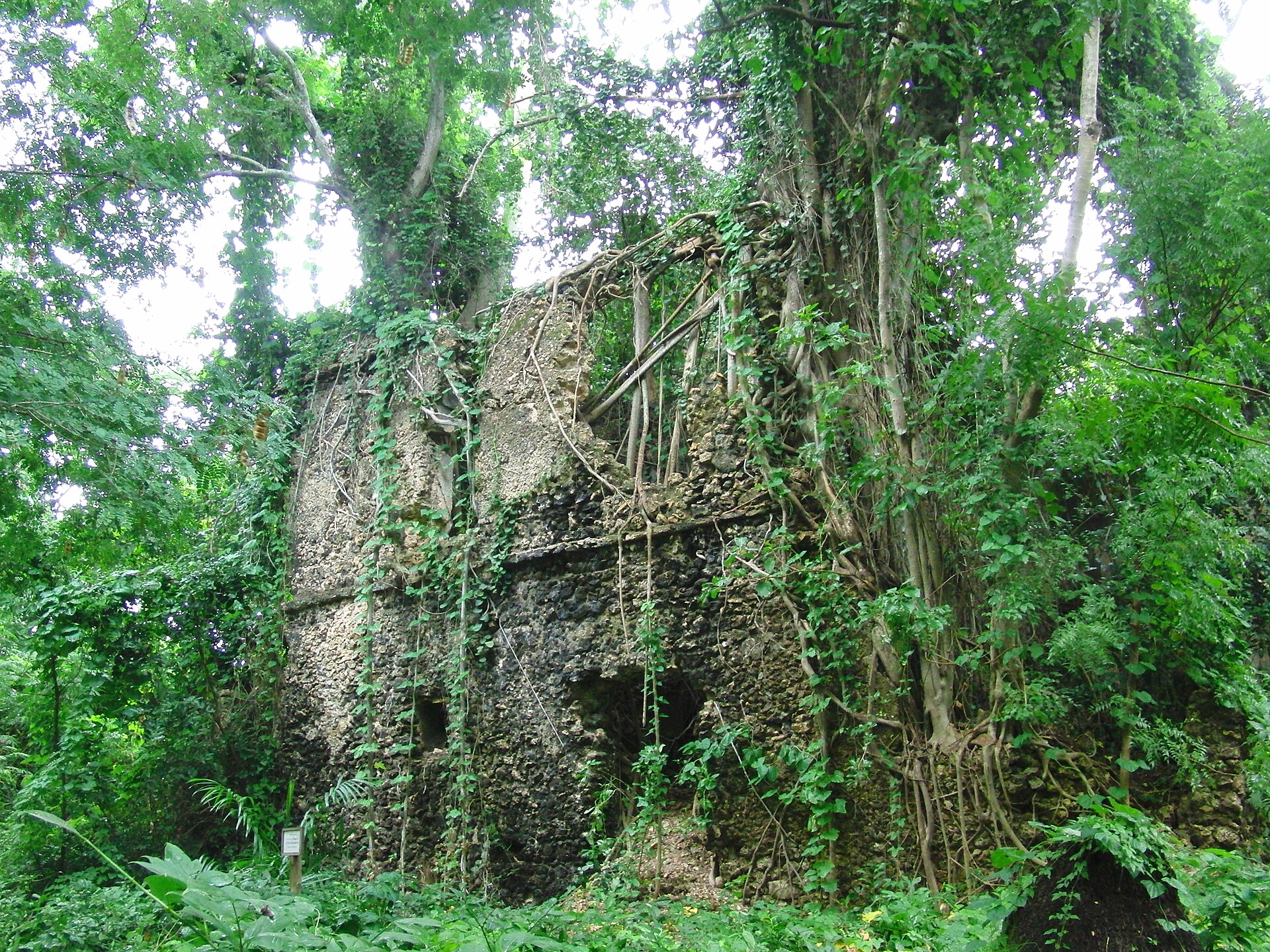
Opposite Utende, Chole island keeps the ruins of its old town, coral stone houses overrun by fig tree roots, ten minutes away by dhow: a one-hour walk between two dives. Mafia's dive sites owe their first descriptions to the Frontier Tanzania expeditions, whose island dive guide served as the basis for the bay's dive centers. Mafia gets fewer than a thousand visitors a year, and you often dive the pass with no other boat in sight. To round out the trip, the whale sharks are on the other side of the island, off Kilindoni, from October to March, for snorkeling.
Our tip
Dive on the incoming tide: visibility goes from 10 to 30 meters and the fish hold facing the current. Start with the Pinnacle, then follow the deep wall while looking out to the blue. If you have never done a drift dive, take your Advanced first or do a refresher dive.
Other dive sites nearby
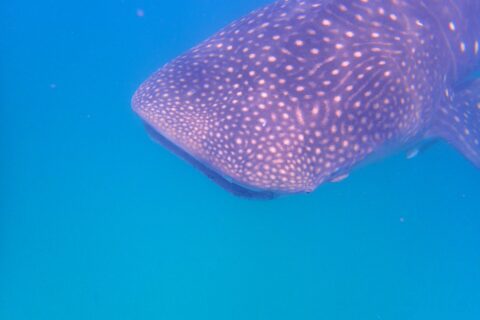
 TanzaniaPelagic
Mafia Island whale sharks
Mafia Island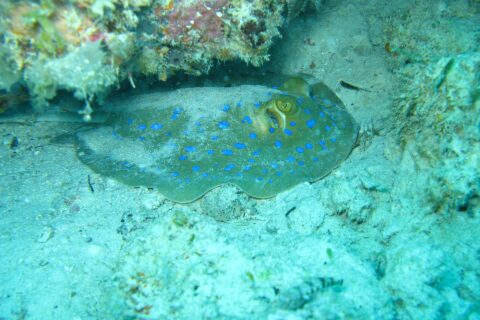 TanzaniaReef
Mnemba Atoll
Zanzibar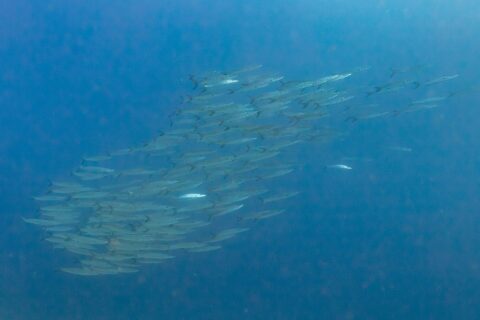 TanzaniaPelagic