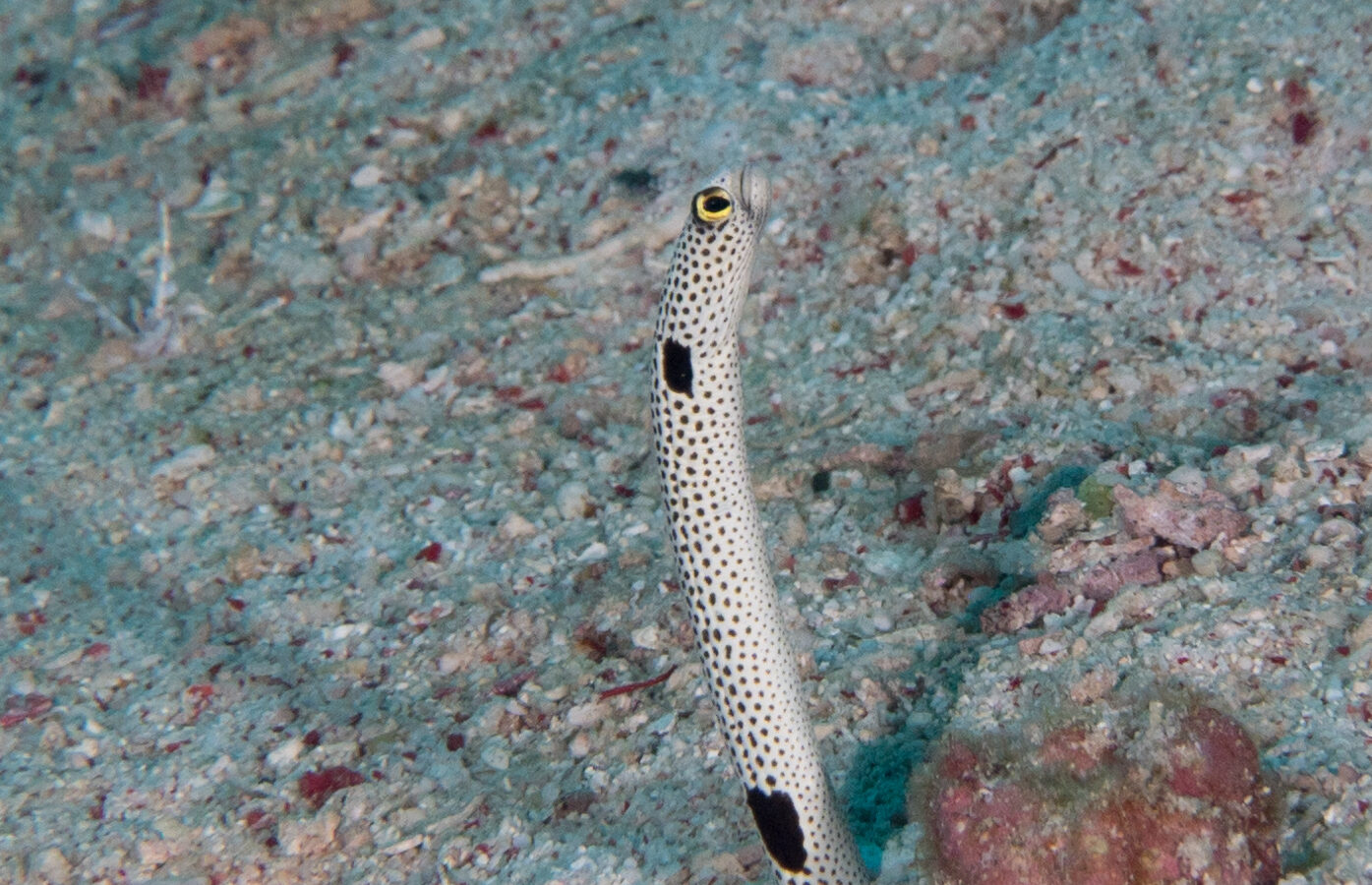
The spotted garden eel is a small white conger with black spots that stands upright in the sand, in colonies of several hundred, mouth into the current to snap up plankton. It pulls back into its burrow as soon as you come close. You can see it year-round at Kinasi Pass and Rasdhoo Madivaru.
Where to dive to see the spotted garden eel?
 Tanzania

 Maldives
How do you identify a spotted garden eel?
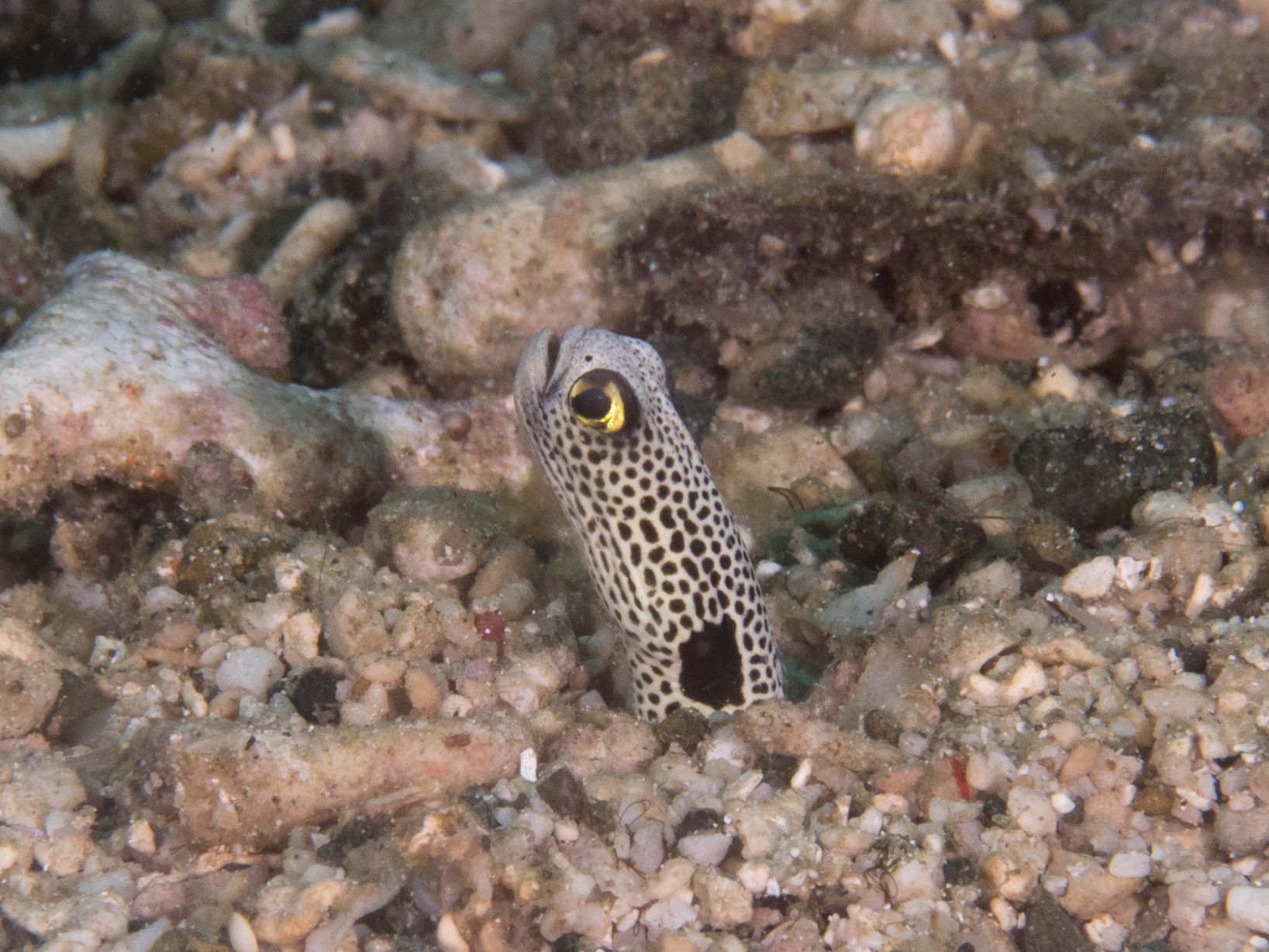
The spotted garden eel, Heteroconger hassi, is a small relative of the conger, in the conger eel family, Congridae. Its body is long, thin and round in section, 14 millimeters across on average, and reaches 40 centimeters in length; but you only ever see a third of it, the rest stays in the burrow. The base color is white, covered in countless small black spots, with three large black blotches: the first marks the gill opening and the tiny pectoral fins, the second the middle of the body, the third surrounds the anus. The head is short, with a big mouth right next to large eyes. Juveniles are all black and very thin.
Spotted garden eel in pictures
How do spotted garden eels live?
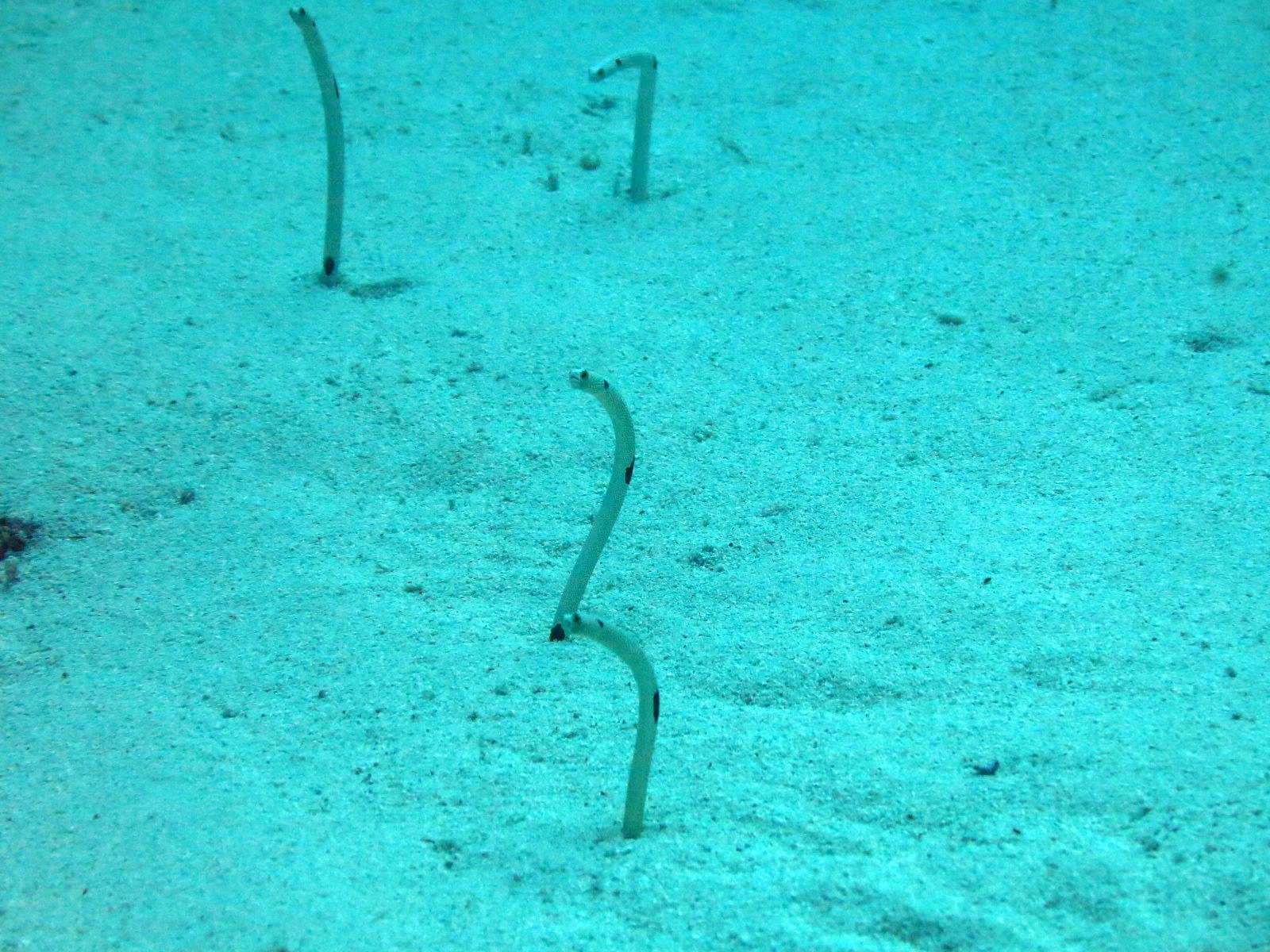
It lives in the Indo-Pacific, from East Africa and the Red Sea to Polynesia, and from southern Japan to New Caledonia and northwestern Australia, in water of 25 to 29°C. It lives only in colonies, from a few dozen to several hundred individuals, on sand slopes and sand flats exposed to the current, between 15 and 45 meters. Each one digs a burrow and leans about a third of its body out of it, mouth turned to the current, to snap up drifting zooplankton. In the breeding season, the burrows move closer together until partners can touch, and males guard their female fiercely. As soon as a diver approaches, it pulls back into its burrow.
Where and when can you see spotted garden eels?
Two of our dive sites have their own colony, visible year-round. At Kinasi Pass, on Mafia Island in Tanzania, there are hundreds of them in the sand of the Coral Patches, which the boats save for the second dive. At Rasdhoo Madivaru, in the Maldives, the colony covers the sand flats of Madivaru reef. In both places you spot them from afar, like a field of upright grass all leaning the same way, with the current.
How do you get close to spotted garden eels?
The spotted garden eel is harmless and listed as Least Concern by the IUCN; the only challenge is seeing it up close. It disappears into the sand the moment it senses movement, and a diver who arrives finning over the colony finds nothing but holes. The right method is the photographers' one: approach low along the bottom, facing the current, in stages, and stop a few meters away without moving. The heads come back out one by one, and the colony goes back to feeding. Don't touch the sand, don't blow bubbles over them, and leave the way you came.
Our tip
Approach the colony low over the sand, slowly, and end up motionless a few meters away: the heads come back out one by one. Keep your fins and hands out of the colony and don't blow bubbles above it. A long lens does better than a meter gained.