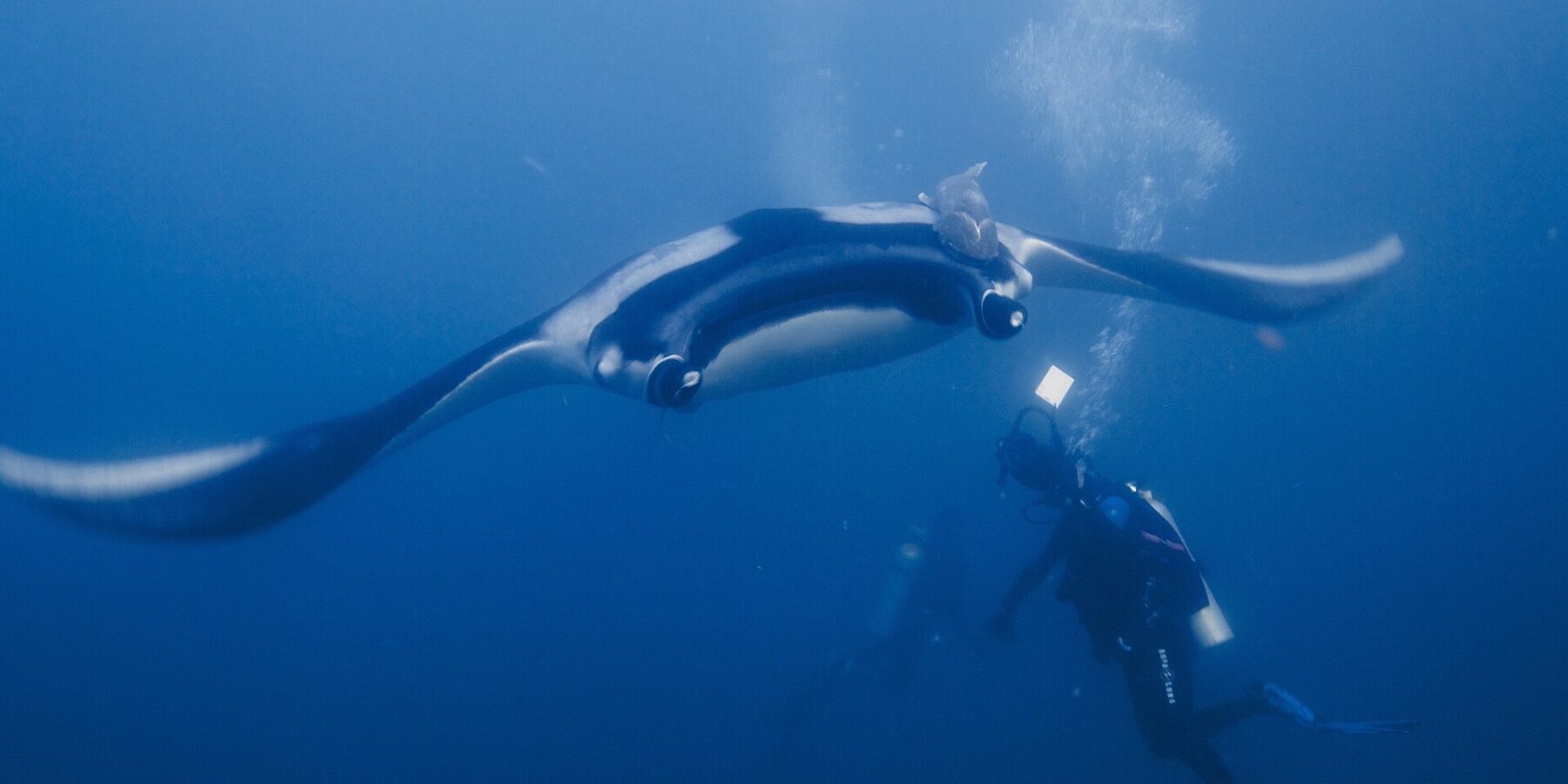
The Islas Catalinas are a volcanic archipelago 30 minutes by boat from Playas del Coco, with more than twenty sites open to Open Water divers. From December to April, cold, rich water brings oceanic manta rays to the cleaning stations.
Why dive the Catalinas?
- Oceanic manta rays, up to 7 meters across, at cleaning stations 30 minutes from Playas del Coco
- More than twenty sites from 10 to 30 meters, from the beginner plateau to the channels of La Punta
- Open to Open Water divers, with more demanding sites for experienced divers
- Eagle rays, whitetips, schools of jacks and mobulas over a volcanic bottom
- US$85 to US$145 for two dives, depending on the dive center
The dive site on the map
Base: Playas del Coco, 20 km as the crow flies.
See nearby dive sites on the mapThe Catalinas in pictures
What will you see at the Catalinas?
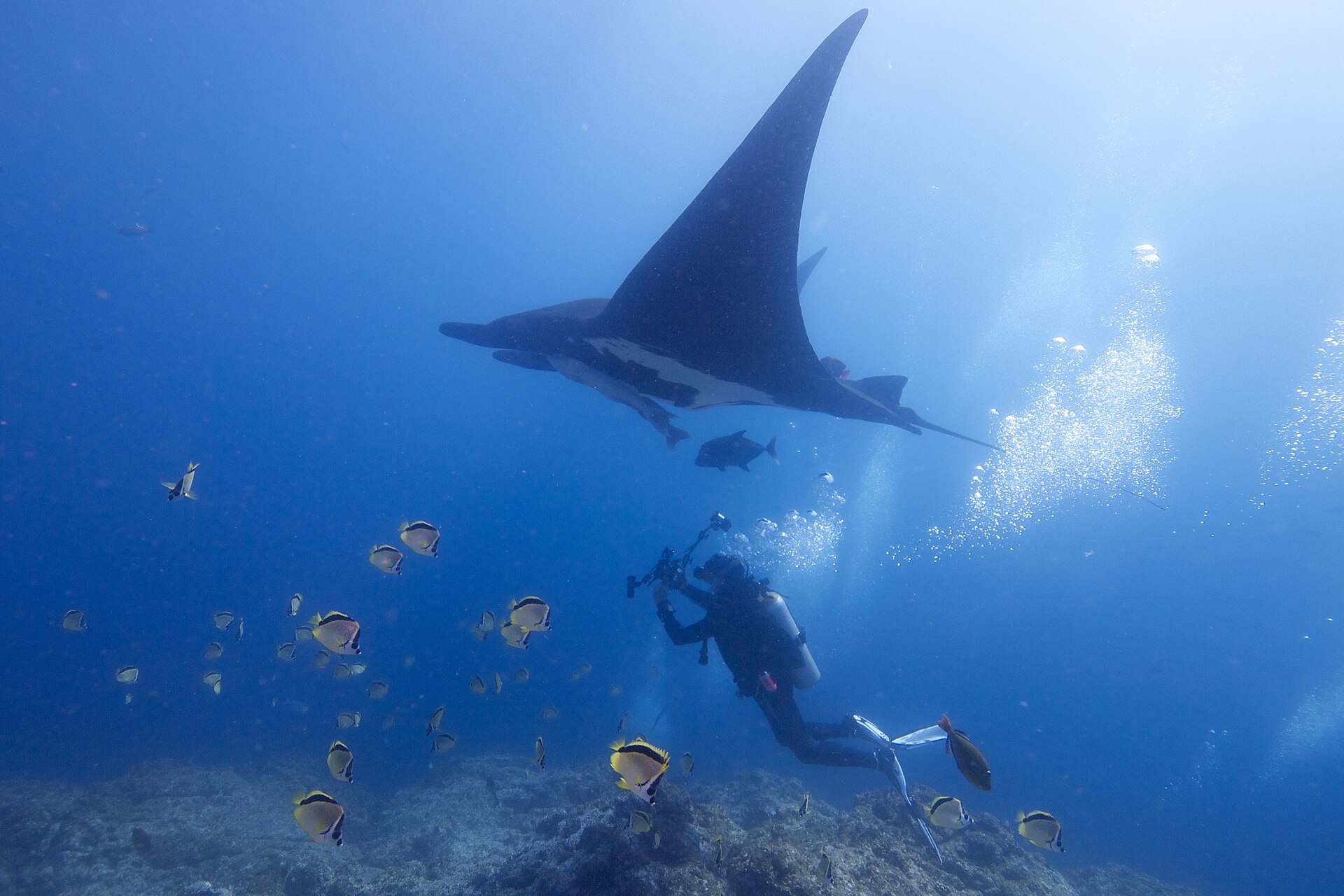
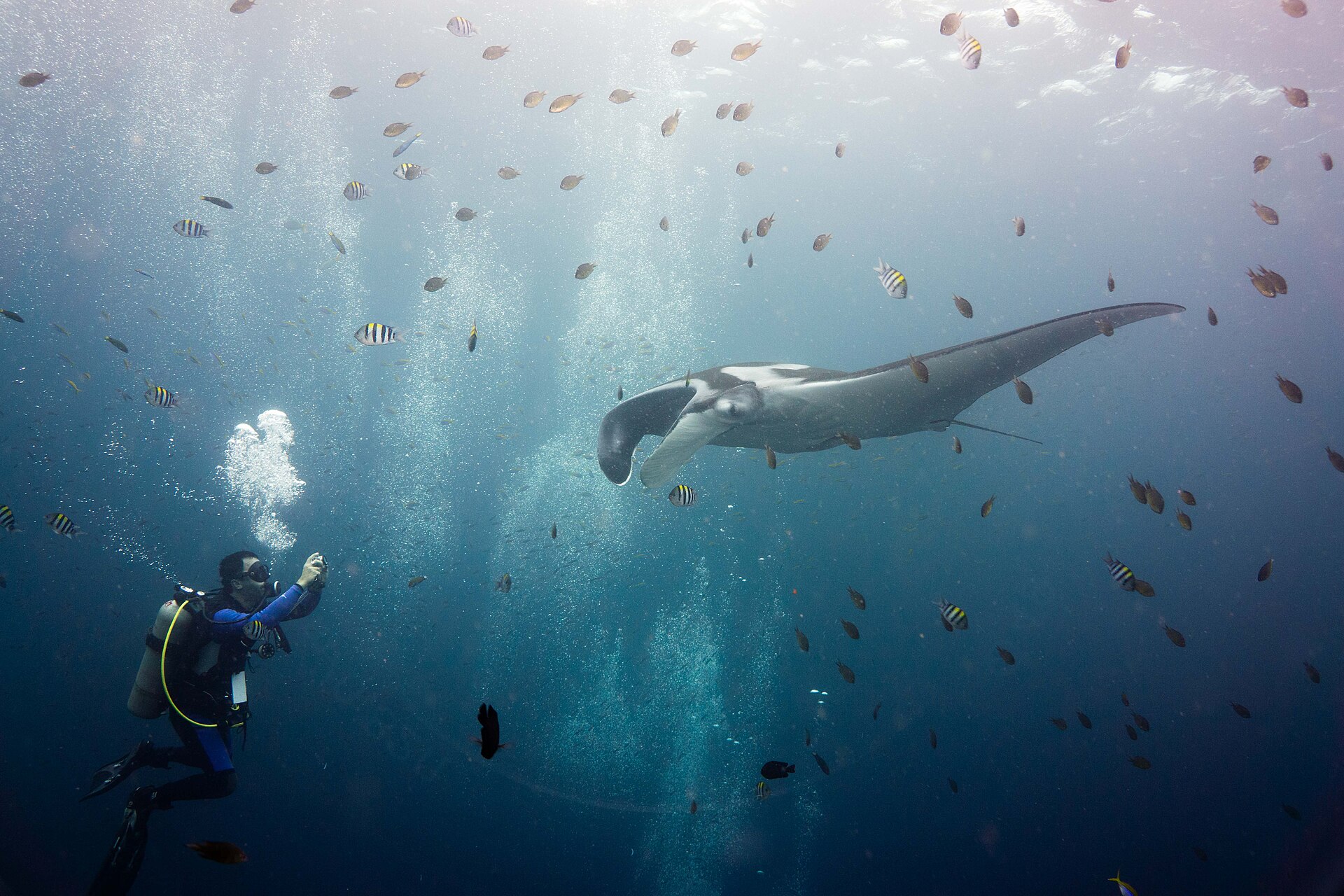
The Catalinas are Costa Rica's meeting point for oceanic manta rays. They come to be cleaned at the stations of La Punta, South Point and The Wall, with wingspans of up to 7 meters; you see them mostly from December to April, but they pass year-round and are never guaranteed. Schools of mobulas join them on some days. The rest is a fishy dive over a volcanic bottom: whitetip sharks under the overhangs, eagle rays and golden cownose rays in formation, schools of jacks, morays, octopus, pufferfish, turtles, and now and then a sea snake or a bull shark. In season, humpback whales show up from the boat. The cold, plankton-rich water of the dry season explains it all: it feeds the food chain and draws the mantas.
| Species | J | F | M | A | M | J | J | A | S | O | N | D | Note |
|---|---|---|---|---|---|---|---|---|---|---|---|---|---|
 Oceanic manta ray | peak season | peak season | peak season | peak season | possible | possible | possible | possible | possible | possible | possible | peak season | at the cleaning stations of La Punta, South Point and The Wall, mostly from December to April, never guaranteed |
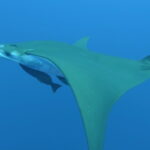 Sicklefin devil ray | possible | possible | possible | possible | possible | possible | possible | possible | possible | possible | possible | possible | schooling, passing through |
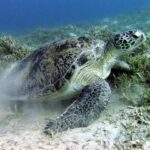 Green turtle | possible | possible | possible | possible | possible | possible | possible | possible | possible | possible | possible | possible | passing over the shallow sites |
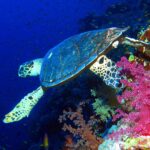 Hawksbill turtle | possible | possible | possible | possible | possible | possible | possible | possible | possible | possible | possible | possible | passing through, over the boulders |
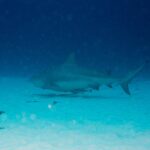 Bull shark | possible | possible | possible | possible | possible | possible | possible | possible | possible | possible | possible | possible | occasional, in open water |
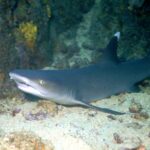 Whitetip reef shark | peak season | peak season | peak season | peak season | peak season | peak season | peak season | peak season | peak season | peak season | peak season | peak season | under the overhangs, year-round |
| Eagle rays and golden cownose rays | peak season | peak season | peak season | peak season | peak season | peak season | peak season | peak season | peak season | peak season | peak season | peak season | in formation above the sand |
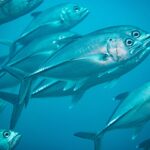 Bigeye trevally | peak season | peak season | peak season | peak season | peak season | peak season | peak season | peak season | peak season | peak season | peak season | peak season | around the pinnacles and the wall |
| Morays, octopus and pufferfish | peak season | peak season | peak season | peak season | peak season | peak season | peak season | peak season | peak season | peak season | peak season | peak season | in the boulders, on every site |
peak seasonpossiblerare
What is diving like at the Catalinas?
More than twenty sites are spread around the archipelago, between 10 and 30 meters, for all levels. East North and Los Sombreros, from 11 to 18 meters, suit an Open Water diver; El Clásico and Cuatro Piedras, down to 27 or 30 meters, an intermediate diver; La Punta, Las Pailas and Elefante, with their current, walls and deep channels, call for ease in the water and some experience. Current is the variable: weak on the sheltered sites, firm at La Punta, which takes the Pacific currents head-on. Thermoclines are the rule in the dry season: warm and clear at the surface, the water turns cold and murky a few meters down, and that is where the mantas are. A 3 millimeter wetsuit is enough most of the time, 5 millimeters from December to April. Dive centers do not require Advanced, but they pick the site to suit the group and the sea.
When to dive the Catalinas?
idealgoodnot recommended
The key to the Catalinas is upwelling. From December to March, the Papagayo winds blow hard, push surface water offshore and bring up cold, rich water: 19 to 25 °C on the dive, with thermoclines at 16 °C in January and February, reduced visibility below the thermocline, and mantas at the cleaning stations. That is the main season, from December to April. From May to November, the rainy season, the water warms back to 27 to 29 °C, the sea is flat in the morning, visibility improves, especially from September to November, and mantas become rarer without disappearing. At the surface, the sea ranges from 27 °C in February to 29.4 °C in May. Visibility runs from 6 meters on bad days to 24 meters on good ones.
How to get to the Catalinas?
The Catalinas are dived as a day trip from Playas del Coco, 30 minutes by boat, or from Playa Flamingo, even closer; Tamarindo and Playa Hermosa also send boats there. The trip includes two or three dives and leaves early in the morning, depending on the weather and the number of divers. In 2026, Rich Coast Diving, in Playas del Coco, sells the two-dive trip for US$145 taxes included and a three-day, six-dive package for US$355. Rocket Frog Divers, in El Coco, lists US$135 for two dives and US$205 for three Nitrox dives, excluding the 13% VAT, with full rental at US$30 and Nitrox at US$10 a tank; its Flamingo branch sells two dives for US$85 and three Nitrox dives for US$155, excluding VAT. Bill Beard's, in Playa Hermosa, requires a minimum of four divers. You arrive through Liberia airport, a 40-minute drive from Playas del Coco, or through San José, five hours away.
Stay in Playas del Coco
Where to find a dive guide in the Catalinas?
Guided tours you can book online, ranked by number of reviews. These are affiliate links: if you book, you support us at no extra cost.

 Viator
Two Tanks Scuba Diving Tour at Catalina Islands & North Island - CR
4.9 (451 reviews)View and book Viator
Fundive Catalina Islands (2 dives, only for certified divers)
5.0 (410 reviews)View and book Viator
Scuba Diving for Non-Certified Divers at Catalina Islands & North Island - CR
4.9 (240 reviews)View and book Viator
Catalina Island Diving Tour From Tamarindo - Certified Only
4.8 (127 reviews)View and book Viator
Fun dives Catalina Islands for Certified Divers
5.0 (30 reviews)View and bookWhere to stay near the Catalinas?
Hotels, apartments and rooms around Playas del Coco, with current prices.
Where are the Islas Catalinas, the volcanic islands off Flamingo?
The Islas Catalinas are a string of volcanic islets and rocks lying about ten kilometers off the Guanacaste coast, facing Playa Flamingo and south of Playas del Coco. There is no coral here: boulders, arches, tunnels, sand channels between big rocks, and water that the dry-season upwelling makes cold and nourishing. Dive centers from Flamingo, El Coco, Hermosa and Tamarindo have named more than twenty sites, from the southern point, La Punta, to the two emerged rocks of the Cupcakes, the southernmost site, with a plateau at 11 to 14 meters and an offshore face that drops beyond 27 meters. No protected area covers the archipelago, and no entry fee is charged.
Which Islas Catalinas sites suit your level?
La Punta, or South Point, is the manta site: cleaning stations between 20 and 30 meters, two deep channels between big boulders, and the current head-on. The Wall, the drop-off of the largest island, lines up whitetips and schools of fish, with mantas toward the point at the end of the dive. El Clásico is a chain of rocks from 11 to 30 meters, with moderate current; Las Pailas, the frying pans, is a drift along walls where bubbles rise from the volcanic bottom; Elefante has arches and tunnels between 12 and 27 meters; Cuatro Piedras, four rocks down to 27 meters, has weak current. Los Sombreros, from 11 to 18 meters, and East North, very shallow, welcome beginners and late-day dives.
How do you dive with the mantas at the Islas Catalinas?
A manta at a cleaning station loops over the rocks where small fish rid it of its parasites. A diver who fins toward it drives it away; one who settles in open water, a little back, and breathes calmly sees it return and pass overhead, sometimes within arm's reach. No touching, no chasing, and no going down onto the station itself. For photos, a wide angle and a low position, with the manta outlined against the surface, give the best images, especially from December to April when the morning light shines through the clear surface layer. Dive centers in the area run trips to the Catalinas year-round; in manta season, a second trip during the week doubles your chances.
Our tip
Book as soon as you arrive and keep a second day in reserve: the mantas are never guaranteed. Stay still in open water: the ray comes back on its own. From December to April, bring a 5 mm wetsuit, as the water drops to 16 °C at depth.
Other dive sites nearby
 Costa RicaPelagic
Bat Islands (Islas Murciélago)
Guanacaste and the North Pacific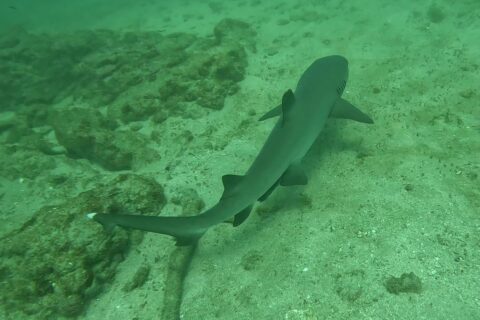 Costa RicaCave or cenote
Caño Island
South Pacific: Osa and Caño Island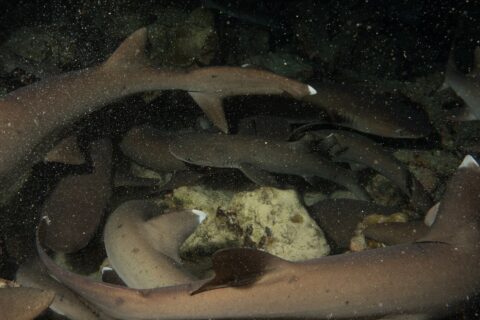 Costa RicaPelagic