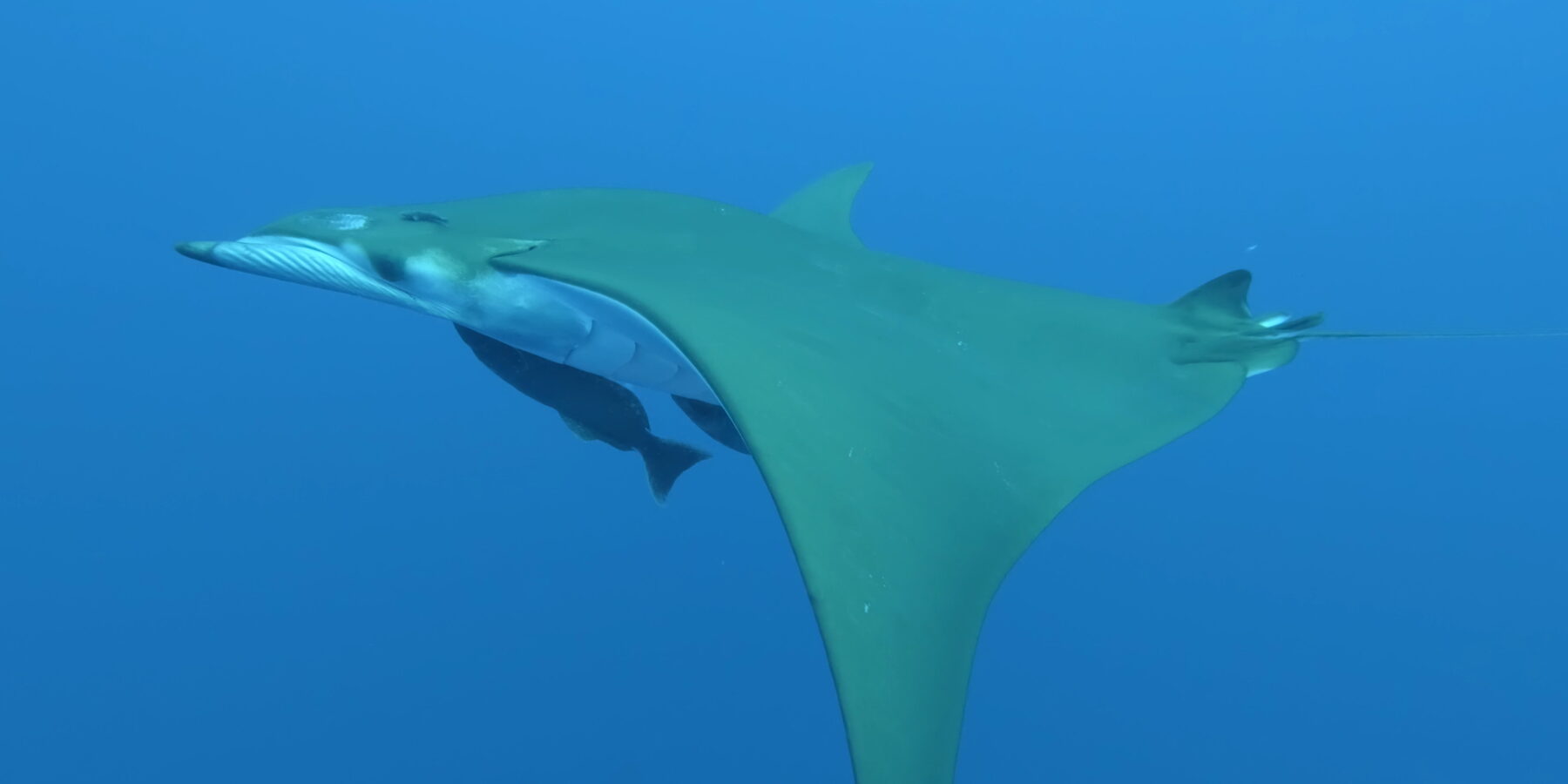
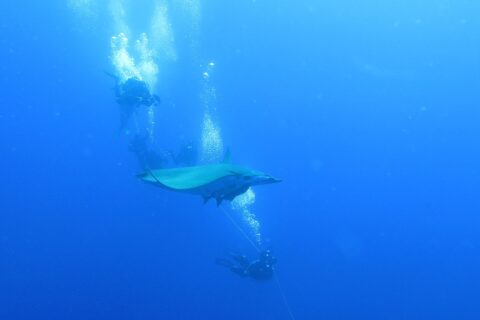
The mobula ray of the Azores, the sicklefin or Chilean devil ray, measures 2 to 3 meters across and has sickle-shaped wings. It dives to nearly 2,000 meters and comes up in summer to circle by the dozen above the seamounts. The species is Critically Endangered: let it come to you, and never get closer than three meters.
Where to dive to see the sicklefin devil ray?
 AzoresPelagic
Ambrósio
Santa MariaPeak season from July to September: by the dozens, up to hundreds, spiraling along the line between 5 and 15 m; peak in August and September
 AzoresReef
Baixa do Sul
Pico and FaialPeak season September: sometimes glides along the reef, mostly in late summer

 Costa RicaPelagic
Bajo Alcyone
Cocos IslandCan be seen all year round: schooling above the seamount, year-round
 MexicoReef
Cabo Pulmo
Sea of Cortez: La Paz and Cabo PulmoCan be seen all year round: schools leaping offshore, depending on the season
 Costa RicaPelagic
Dirty Rock
Cocos IslandCan be seen all year round: schooling off the pinnacle
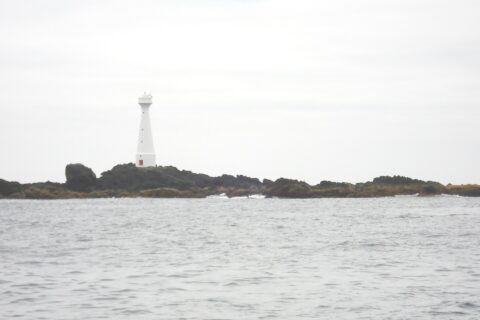 AzoresReef
Formigas and Dollabarat
Santa MariaPeak season from July to September: passing off the walls, less regular than at Ambrósio
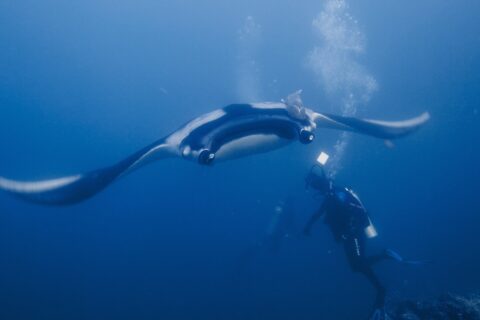 Costa RicaReef
Islas Catalinas
Guanacaste and the North PacificCan be seen all year round: schooling, passing through
 MexicoReef
Los Islotes
Sea of Cortez: La Paz and Cabo PulmoCan be seen all year round: schools leaping offshore during the crossing, depending on the season
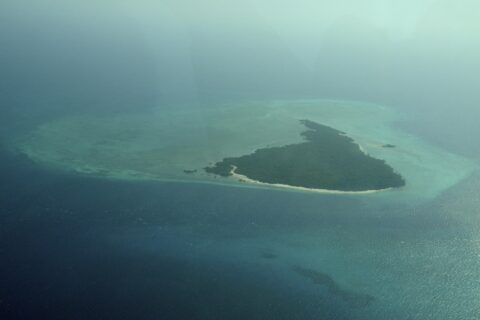
 TanzaniaReef
Misali Island
PembaCan be seen all year round: passing in the blue, with no clear season
 AzoresPelagic
Princess Alice Bank
Pico and FaialPeak season from July to October: by the dozens above the plateau, peak in August and September
How do you identify a sicklefin devil ray?
The mobula ray of the Azores is Mobula tarapacana, the sicklefin devil ray, also called the Chilean devil ray. The disc measures 2 to 2.50 meters across in adult males and 2.70 to 2.80 meters in females, up to 3.70 meters for the largest, and the weight reaches 350 kilos. The back is olive green to brown, the belly white to pale gray. The wingtips curve sharply backward, like a sickle, and the dorsal fin is plain, with no white tip. The tail is short and stiff, shorter than the width of the disc. Two rolled cephalic fins frame a terminal mouth. You tell it from the much larger oceanic manta ray by its size and its scythe-shaped wings, and from Mobula mobular by the lack of a dark band on the head and of a long tail with a spine.
How does the sicklefin devil ray live?
It is an offshore ray, pelagic and sometimes coastal, found in the tropical, subtropical and temperate waters of all three oceans. It filters plankton, small crustaceans and small fish through its gill plates. It is one of the deepest divers in the ocean. Tags have recorded descents to 1,896 meters, in successive steps of one to one and a half hours, and dives to 1,000 meters lasting eleven hours. A network of blood vessels, the retia mirabilia, warms its brain in cold water, and it spends at least an hour near the surface before and after each descent. Reproduction is slow: a single pup per litter, born with a disc of 1.05 to 1.40 meters, and a generation length of nearly thirteen years.
Where and when can you see sicklefin devil rays in the Azores?
Solitary the rest of the year, it gathers in summer on the seamounts of the archipelago to feed, get cleaned and court: at Princess Alice Bank, 45 nautical miles from Faial, and at Ambrósio, north of Santa Maria, from late June to mid-October, with a peak in August and September. Groups range from three to fifty rays and more. At Ambrósio, twelve to seventeen rays are the norm and forty to fifty regularly show up, spiraling up along the buoy line every fifteen to twenty minutes. It also passes over the Dollabarat and the shoals of the Faial-Pico channel. You can see it diving or snorkeling, since it comes right up to the surface.
Is the sicklefin devil ray endangered?
Fished for its gill plates, sold in Asia for traditional medicine, and caught in nets and on longlines, Mobula tarapacana has lost 50 to 79% of its numbers over three generations. The IUCN now lists it as Critically Endangered, after listing it as Endangered in 2019. It has been on CITES Appendix II since 2016 and on the Convention on Migratory Species since 2014. In the Azores, the Manta Catalog Azores project identifies each ray by the spots on its belly, from divers' photos, to understand where, when and why the rays gather on the seamounts.
Our tip
Slip into the water quietly, ten meters from the rays, and stay still on the line: they swim in circles and end up passing a meter away. Never swim toward them, don't get closer than three meters and don't touch them: that is the Azores code of conduct. Photograph the belly, since the spots are used to identify them: the Manta Catalog Azores project takes your shots.