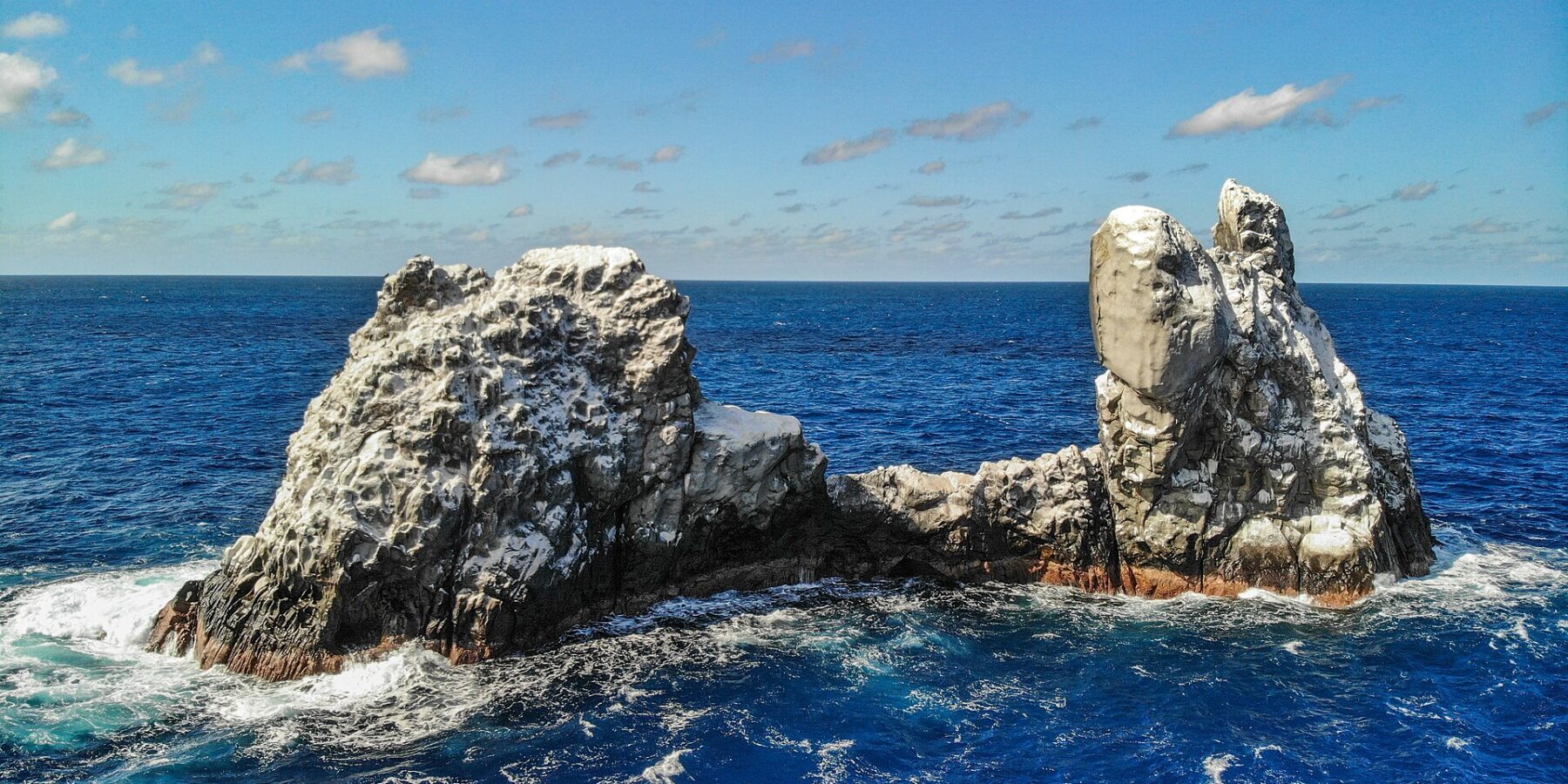
Roca Partida is a rock split into two peaks, alone in the Pacific about a hundred kilometers from Socorro, with walls that drop below 40 meters. Whitetip sharks pile up in the niches and hammerheads pass in the blue. You can only dive it on a liveaboard, with Advanced.
Why dive Roca Partida?
- A rock 100 meters by 8, with two peaks, alone in the ocean, with its own ecosystem
- Dozens of whitetip sharks stacked in the niches of the east face
- Schooling hammerheads in the blue, silky and Galapagos sharks along the walls
- Clouds of jacks and creolefish that surround divers at the safety stop
- Humpback whale song from January to March, and the comparison with Wolf and Darwin in the Galapagos
The dive site on the map
Base: San José del Cabo, 514 km as the crow flies.
See nearby dive sites on the mapRoca Partida in pictures
What will you see at Roca Partida?
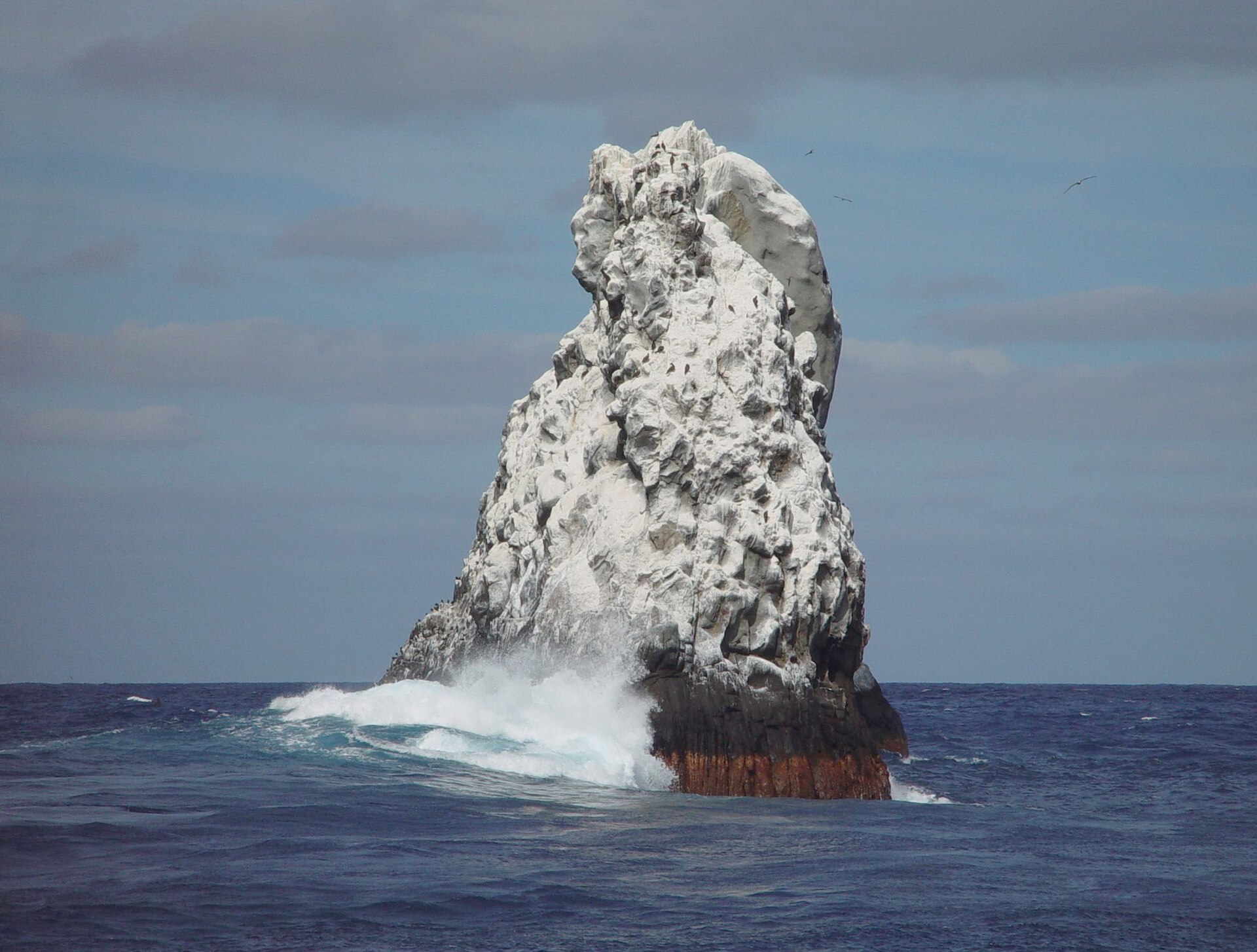
Roca Partida has no fresh water and no land animals, but the water around it teems with life. On the east face, several niches in the wall serve as dormitories for whitetip reef sharks, which hunt at night and pile up by the dozens during the day, sometimes until they spill over their ledge; spiny lobsters shelter in the same hollows. Silky and Galapagos sharks patrol along the walls, and in the blue, some distance from the rock, schools of scalloped hammerheads go by. Mantas come too, though less faithfully than at El Boiler, and tiger sharks are possible. In the shallows, clouds of creolefish and jacks surround divers at the safety stop, and tuna and wahoo cruise offshore, more numerous in May and June. From January to March, humpback whales, which winter in the archipelago, sing underwater and sometimes show themselves. Above the surface, the rock is a seabird colony: Nazca boobies, brown boobies, sooty terns and noddies, whose droppings whiten both peaks and whose smell reaches you in the tender.
| Species | J | F | M | A | M | J | J | A | S | O | N | D | Note |
|---|---|---|---|---|---|---|---|---|---|---|---|---|---|
 Scalloped hammerhead | peak season | peak season | peak season | peak season | peak season | possible | rare | rare | rare | rare | peak season | peak season | schooling in the blue, off the corners of the rock; move away from the walls to see them |
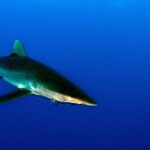 Silky shark | peak season | peak season | peak season | peak season | peak season | possible | rare | rare | rare | rare | peak season | peak season | always around, along the walls and under the boat |
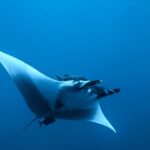 Oceanic manta ray | possible | possible | possible | possible | possible | possible | rare | rare | rare | rare | possible | possible | passing around the rock, less faithful than at El Boiler |
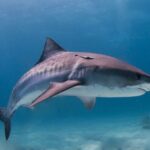 Tiger shark | possible | possible | possible | possible | possible | possible | rare | rare | rare | rare | possible | possible | possible, as anywhere in the archipelago; more regular at Punta Tosca |
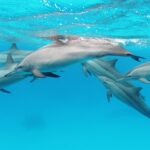 Spinner dolphin | possible | possible | possible | possible | possible | possible | rare | rare | rare | rare | possible | possible | groups offshore, seen from the boat; bottlenose dolphins sometimes approach divers |
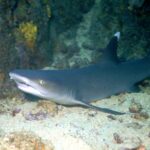 Whitetip reef shark | peak season | peak season | peak season | peak season | peak season | peak season | rare | rare | rare | rare | peak season | peak season | piled up by the dozens in the niches of the east face, where they sleep during the day |
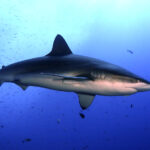 Galapagos shark | peak season | peak season | peak season | peak season | peak season | possible | rare | rare | rare | rare | peak season | peak season | along the walls, sometimes in numbers |
| Humpback whales | peak season | peak season | peak season | possible | rare | rare | rare | rare | rare | rare | rare | possible | song on every dive from January to March, underwater encounters in some years |
| Schooling jacks, tuna and creolefish | peak season | peak season | peak season | peak season | peak season | peak season | rare | rare | rare | rare | peak season | peak season | clouds of fish at the corners of the rock and in the shallows, with more tuna in May and June |
peak seasonpossiblerare
What is diving like at Roca Partida?
The rock is the tip of a seamount: its walls drop sheer below 40 meters, and you dive along a pinnacle small enough to circle, sometimes twice in the same dive. The current, from the east, is strong and constant. You drop in at the middle of the east face, where it splits and is at its slowest, then pick one of the two corners, where the current speeds up and the fish and sharks gather. For the hammerheads, you move a little away from the walls into the blue while keeping the rock in sight; for the whitetips, you follow the east face at the level of the niches. The safety stop is in the shallows, under the swell that pounds the peaks. Visibility is 25 to 40 meters and the water 21 to 26 °C depending on the season, with thermoclines. The park requires Advanced Open Water, and you need real experience with current and blue-water diving; an SMB and a whistle are mandatory on a site where the tender is your only land.
When to dive Roca Partida?
idealgoodnot recommended
Roca Partida is dived during the liveaboard season, from November to June, and only when the sea allows: the rock is exposed on all sides, and swell that is too strong makes the captain give up. From late January to early April, the water is 21 to 23 °C and the humpback whales are around; from November to January and in April and May, it rises to 23 to 26 °C, for the sharks and the mantas; May and June add the tuna. Visibility is usually 25 to 40 meters, sometimes lower in November and December. From July to October, there are no trips. The crossing from Socorro is done overnight, about a hundred kilometers to the west, and boats spend a day or two there, with three or four dives a day, never at night. It is often the high point of the week, and the one you miss when the weather turns.
How to get to Roca Partida?
You can only visit Roca Partida on a liveaboard from Cabo San Lucas, on a week that links San Benedicto, Socorro and the rock, one night's sailing west of Socorro. Solmar V sells eight nights with five days of diving for US$5,250 to US$5,750 per person depending on the cabin, for the January 13, 2026 departure. The Nautilus Explorer, through Diventures, sells nine days from May 26 to June 3, 2026 for US$4,980 to US$6,680, park fee and transfers included, with Nitrox at US$120 and tips at US$500 on top. The cheapest boats start at US$323 a day; Rocio del Mar, Nautilus Belle Amie, Nautilus Under Sea, Quino del Mar and Valentina also run the route. The Revillagigedo National Park fee, MXN 3,622 per dive day since January 1, 2025 and MXN 3,760 for the 2026 season, is collected by the boat. You reach Los Cabos airport, in San José del Cabo, via Mexico City or the United States; Manzanillo, on the mainland, is the second departure port, 60 hours away by sea.
Stay in San José del Cabo
Where to stay near Roca Partida?
Hotels, apartments and rooms around San José del Cabo, with current prices.
What is Roca Partida, the smallest Revillagigedo island?
Roca Partida, the split rock, is the smallest of the four Revillagigedo Islands, which belong to the state of Colima: 100 meters long, 8 wide, with two peaks of 25 and 34 meters separated by a saddle of bare rock, the higher one having lost a few meters since the 1953 measurements. It is the eroded remnant of a volcano, like its neighbors San Benedicto and Socorro, which erupted in 1953 and 1993; Roca Partida itself has no known eruption and no vegetation left. The Spanish expedition of Ruy López de Villalobos sighted it in November 1542 and gave it its name. Today it lies in a military zone, within the national park created in November 2017 and listed as a World Heritage Site since 2016, and only licensed liveaboards bring divers here.
What is a typical dive at Roca Partida like?
The tender drops divers at the middle of the east face, where the current splits. On the first dive, you go deep along the wall to circle the pinnacle at 30 meters and watch for sharks; you check the whitetip niches, look for spiny lobsters and spiral back up. The second dive faces the open ocean: you move a few dozen meters out into the blue, at mid-depth, to let the hammerheads, the silkies and sometimes a manta or a tuna come to you. The last minutes are spent in the shallows, in a cloud of jacks and creolefish, under the swell that breaks on the rock. With three or more boats on site, the park enforces a rotation of groups and dive times: each group waits its turn in the tender.
Why is Roca Partida compared to the Galapagos?
Roca Partida is an isolated oceanic island, swept by currents, where pelagics find the only structure for many kilometers: the same mechanism as Wolf and Darwin in the Galapagos, and the same density of sharks. Along with Clarión, 290 kilometers farther southwest, it is the most exposed site in the archipelago, which is why liveaboards only go there in the heart of the season, from November to May, and turn back as soon as the swell builds. The rock also has a downside: the current is constant, the tender is the only shelter, and every diver is solely responsible for their air, their SMB and their place in the group.
Our tip
Drop in at the middle of the east face, then pick your side. The current is strongest at the points: keep enough air to get back. Look for the hammerheads in the blue, without losing sight of the rock.
Other dive sites nearby
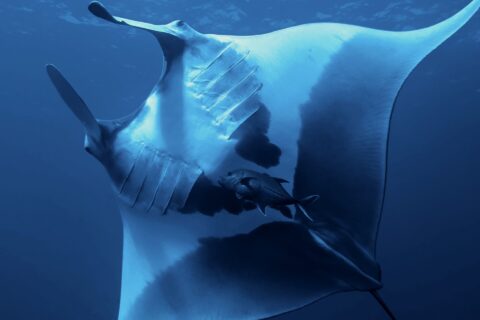
 MexicoPelagic
El Boiler
Revillagigedo Islands (Socorro)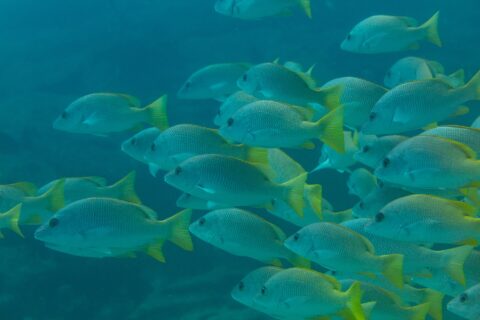 MexicoReef
Cabo Pulmo
Sea of Cortez: La Paz and Cabo Pulmo MexicoReef