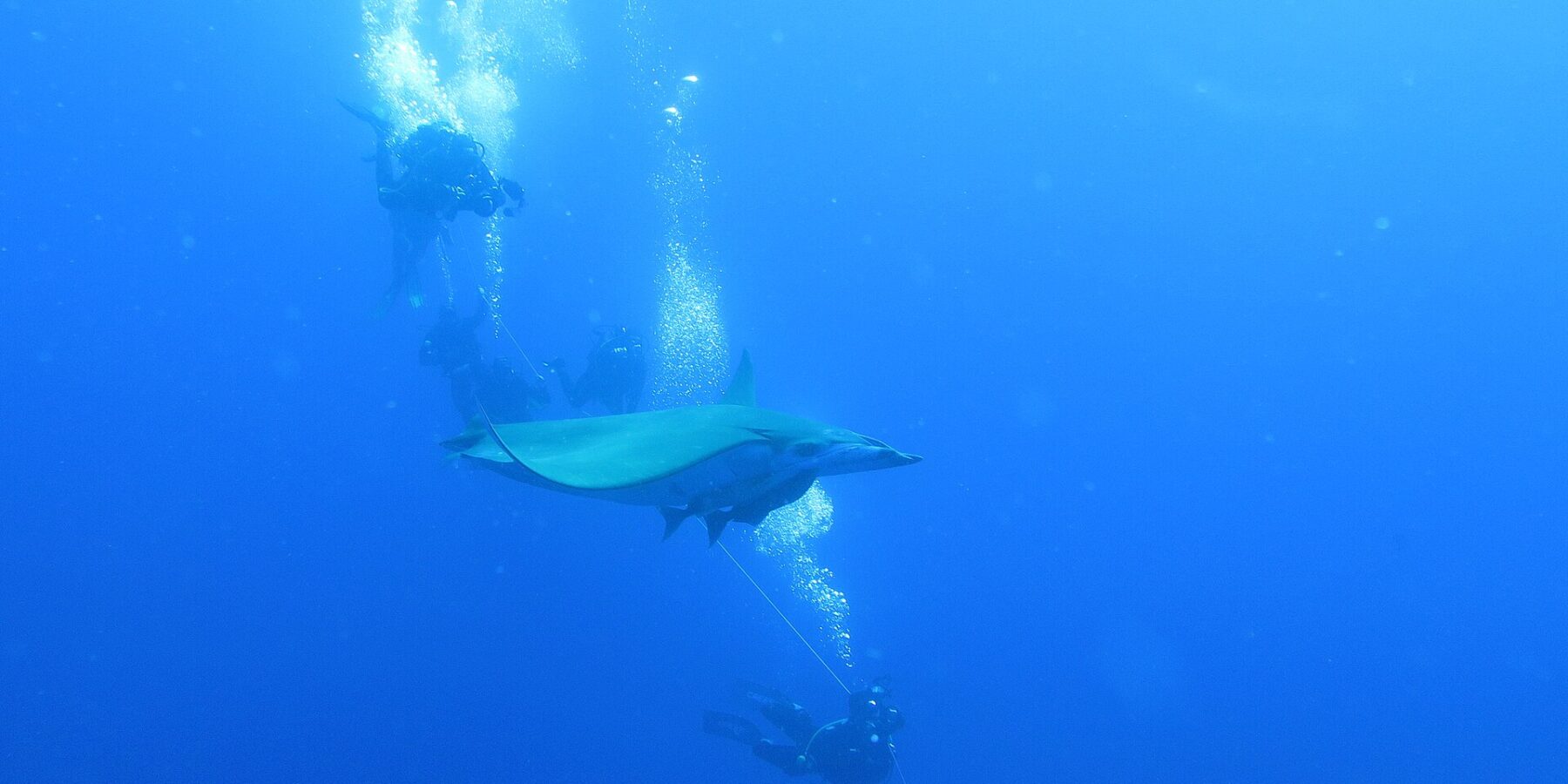
Princess Alice Bank is a seamount that rises from 1,500 m down to 30 m below the surface, 45 nautical miles southwest of Faial. From July to October, mobula rays circle there by the dozens in 40 m visibility, on a day trip from Madalena or Horta.
Why dive Princess Alice Bank?
- Mobula rays by the dozens above the plateau, especially in August and September
- An isolated seamount 45 nautical miles offshore that rises from 1,500 m to 30 m below the surface
- Open-ocean water with 30 or 40 m visibility
- Blue sharks, Galapagos sharks, oceanic manta rays and schools of tuna in the blue
- A site discovered in 1896 by the yacht of Prince Albert I of Monaco
The dive site on the map
Base: Madalena (Pico), 269 km as the crow flies.
See nearby dive sites on the mapPrincess Alice Bank in pictures
What will you see at Princess Alice Bank?
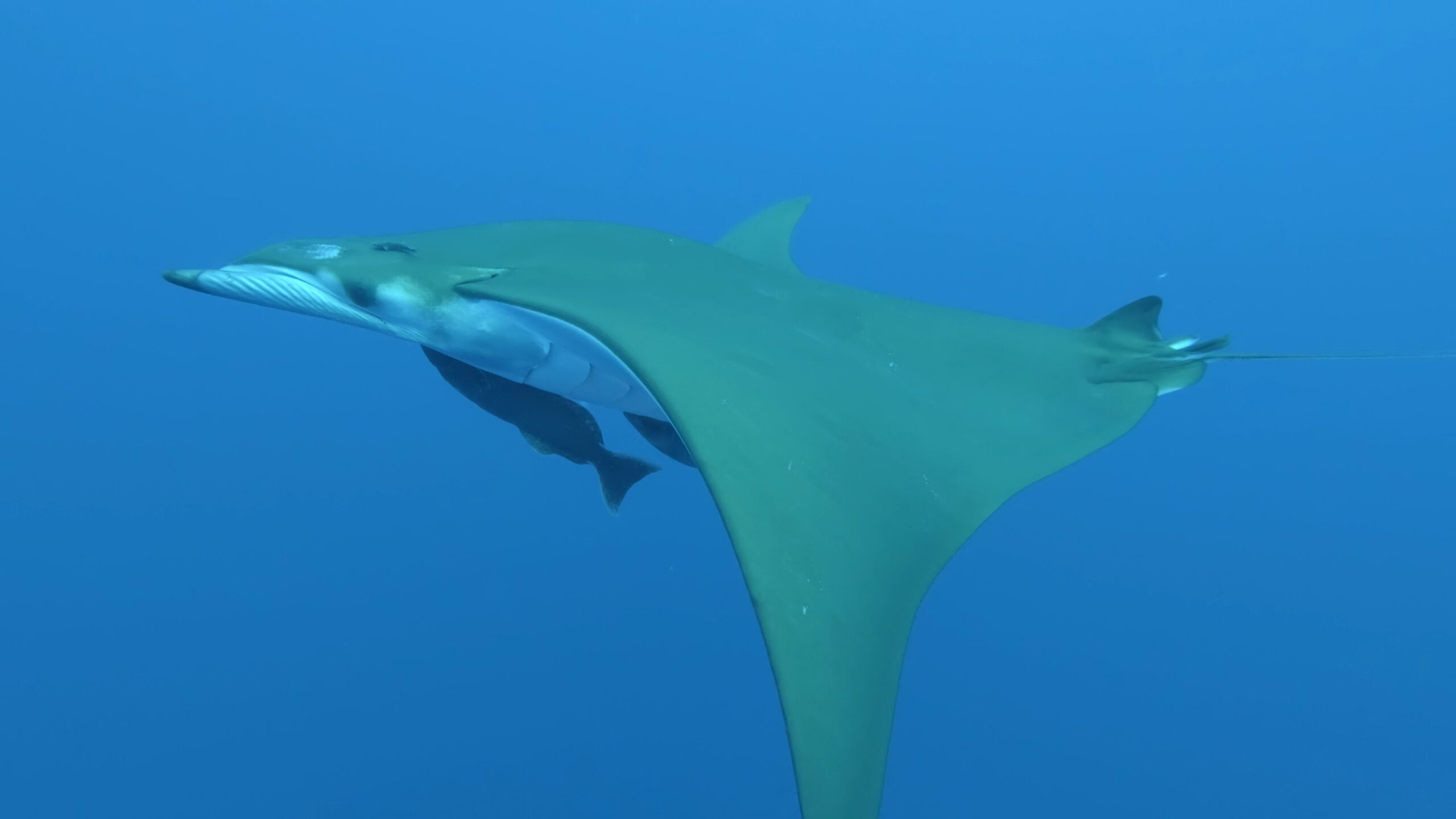
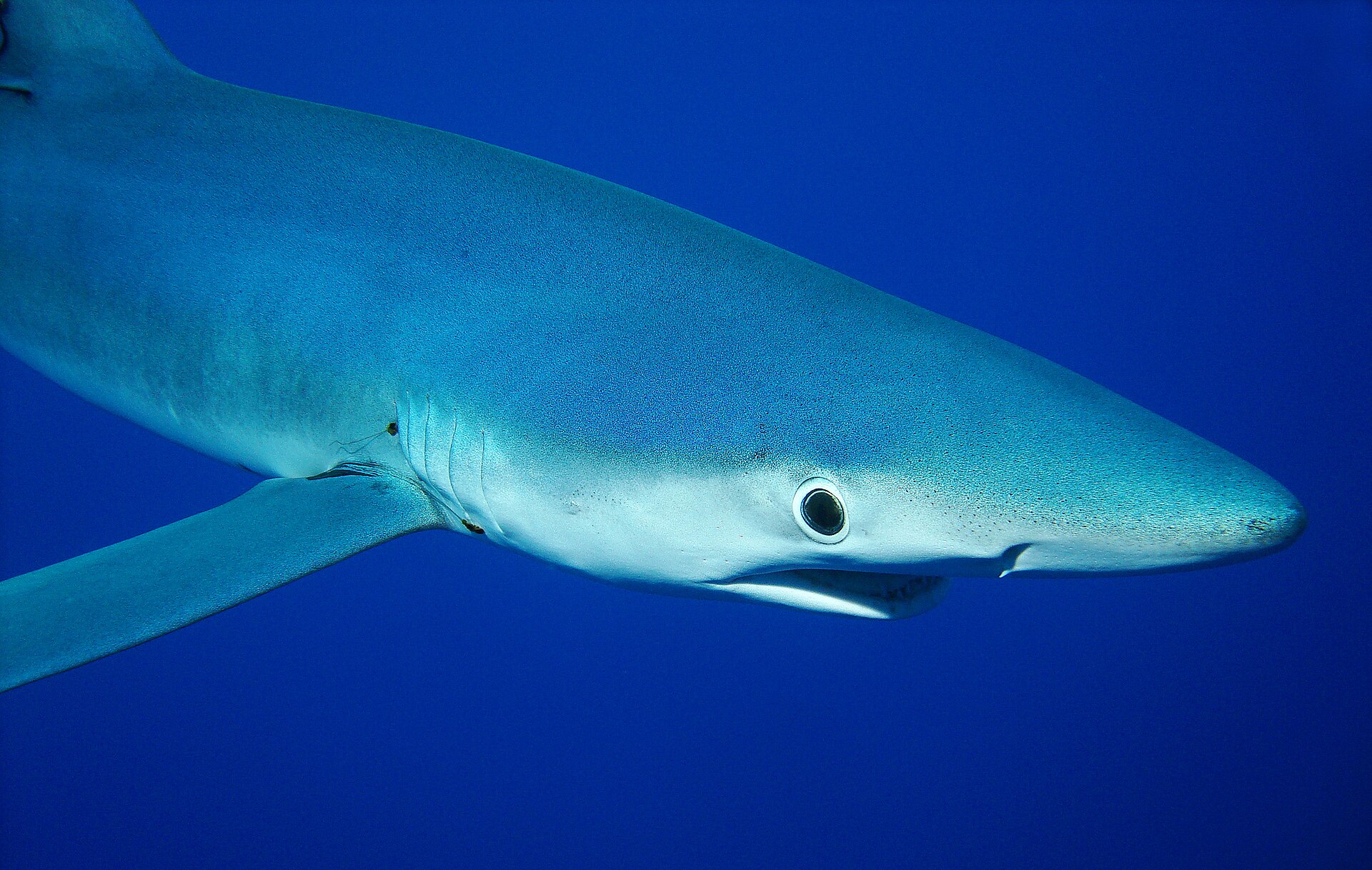
Princess Alice Bank is first of all a mobula ray station, for Mobula tarapacana: they rise from the depths to circle above the plateau in groups of three to fifty, sometimes more, mostly in August and September, and pass within reach of your mask along the line. The oceanic manta ray, Mobula birostris, also shows up, alone or in pairs, far more rarely. Blue sharks cruise in the blue and, at the edge of the plateau, the Galapagos shark. The rock at the summit, at 30 m, holds dusky groupers, wrasse, rainbow wrasse and combers, and the current brings schools of bonito, amberjacks, tuna and yellowmouth barracuda. The ride to the bank is part of the day too: sperm whales, dolphins and seabirds can be seen from the boat.
| Species | J | F | M | A | M | J | J | A | S | O | N | D | Note |
|---|---|---|---|---|---|---|---|---|---|---|---|---|---|
 Sicklefin devil ray | rare | rare | rare | rare | rare | possible | peak season | peak season | peak season | peak season | rare | rare | by the dozens above the plateau, peak in August and September |
 Oceanic manta ray | rare | rare | rare | rare | rare | rare | possible | possible | possible | possible | rare | rare | much rarer than the mobula, alone or in pairs |
 Blue shark | rare | rare | rare | rare | rare | rare | possible | possible | possible | possible | rare | rare | in the blue, around the line, from July to October |
 Galapagos shark | rare | rare | rare | rare | rare | possible | possible | possible | possible | possible | rare | rare | at the edge of the plateau, in the current |
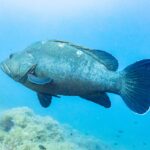 Dusky grouper | possible | possible | possible | possible | possible | possible | possible | possible | possible | possible | possible | possible | on the rock at the summit, with wrasse, rainbow wrasse and combers |
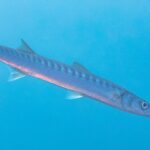 Yellowmouth barracuda | rare | rare | rare | rare | possible | peak season | peak season | peak season | peak season | peak season | possible | rare | schooling in the current above the plateau |
| Tuna, bonito and amberjacks | rare | rare | rare | rare | possible | peak season | peak season | peak season | peak season | peak season | possible | rare | hunting in the blue, all season |
peak seasonpossiblerare
What is diving like at Princess Alice Bank?
The top of the seamount is at 29 m on its western side, the plateau where you dive sits between 30 and 35 m, and the flanks drop to around 60 m, then to 190 and 1,500 m. The dive is therefore at the limit of recreational depth, twice in the day, with a one-hour surface interval on board; Nitrox helps. The boat's line, set on the plateau, is the backbone of the dive: you descend on it, stay within arm's reach and ascend on it. The current is moderate to strong and can pick up suddenly; let go of the line and within minutes you are out in the blue, far from the boat. Advanced Open Water and 50 logged dives are required, along with age 18, a DSMB and real ease in the blue, with no bottom for reference.
When to dive Princess Alice Bank?
idealgoodnot recommended
The bank is only dived in summer: the Madalena and Horta dive centers go there from July to mid-October, when swell and wind let a fast boat through for twelve hours. The mobulas are there from late June to mid-October, peaking in August and September, when an encounter is almost certain; blue sharks join them from July to October. The water is 20 °C in June and 22 to 24 °C from July to September. Visibility often exceeds 30 m and reaches 40 m at the end of summer. Each trip is confirmed the evening before: a week on site is the minimum to be sure of going, and you must have done your check dive on the coast before boarding.
How to get to Princess Alice Bank?
The bank lies 45 nautical miles southwest of Faial and 50 nautical miles from Pico, two and a half to three hours by fast boat each way. From Madalena, CW Azores leaves between 7 and 8 a.m. for two dives and returns at the end of the day: €250, tanks, weights, guide and picnic included, €175 for snorkeling, with a €55 check dive on the coast beforehand. From Horta, Norberto Diver runs the same day from 7:30 a.m. to 7 p.m., with three hours of travel, two dives and a snack in between, for at least six people, from July to September, with full gear rental at €20 a day. You reach Pico and Faial via Lisbon with Azores Airlines or via Ponta Delgada with SATA Air Açores; Pico airport is 8 km from Madalena, Horta's about ten kilometers from town, and the ferry links the two harbors.
Stay in Madalena (Pico)
Where to stay near Princess Alice Bank?
Hotels, apartments and rooms around Madalena (Pico), with current prices.
How was Princess Alice Bank discovered?
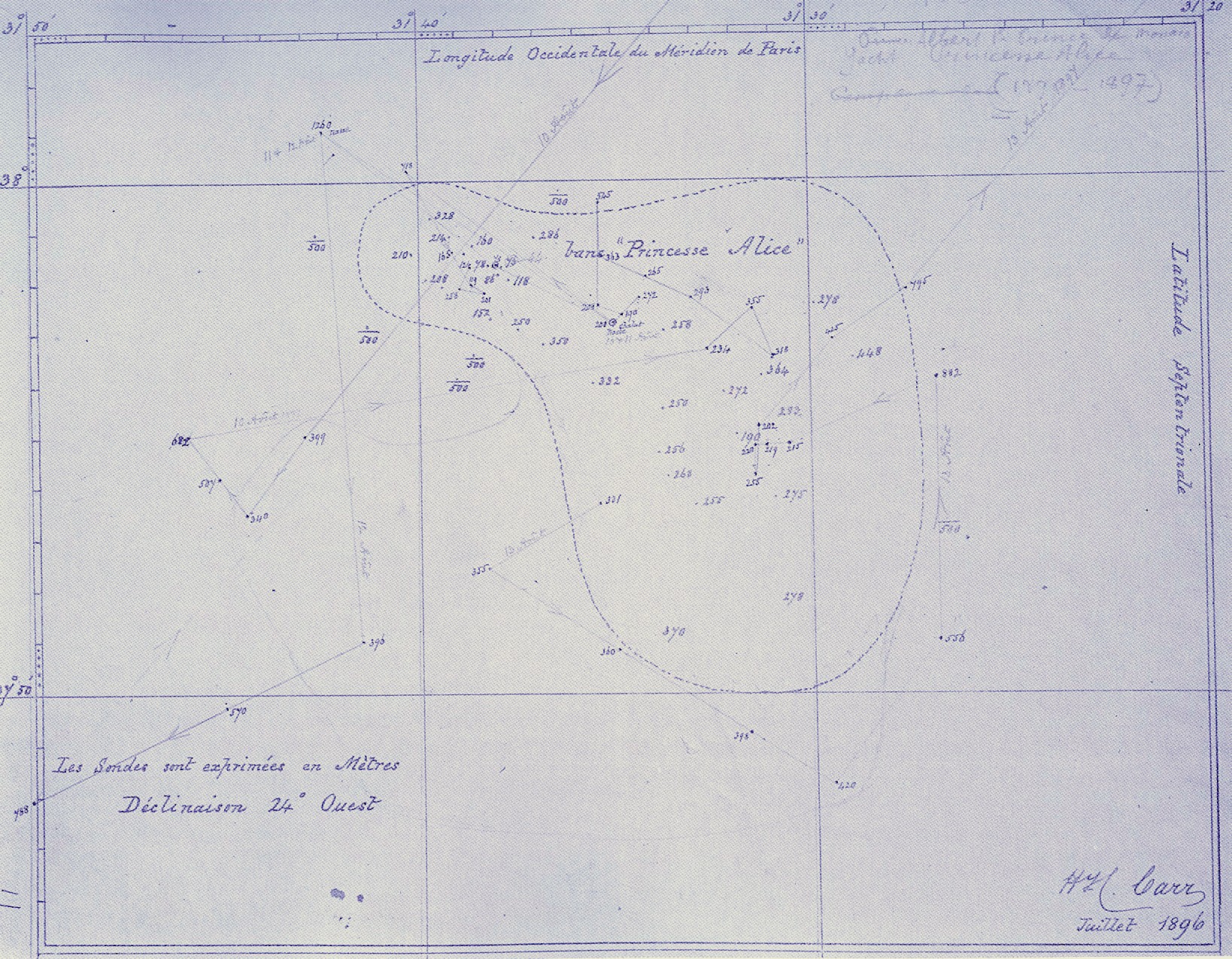
The bank is named after the yacht that found it: the Princesse Alice, the research vessel of Prince Albert I of Monaco. On July 9, 1896, during a sounding campaign around the Azores, Captain Henry Charlwood Carr noticed the bottom rising sharply under the hull, where the chart showed only the abyss. The first soundings found rocky ledges at 241 m, then peaks at 76 and 190 m; the survey, drawn in blue ink and signed by Carr, still survives. We now know that the seamount has a perimeter of about 55 km, stretches 70 km from northwest to southeast, and that its western part rises to 29 m below the surface, close enough to see the bottom from the boat in calm seas.
What can you see underwater at Princess Alice Bank?
The dive starts on the line the dive center sets on the plateau. You descend along it into blue with no visible bottom, until the rock takes shape at around 30 m: a plateau of boulders and slabs covered in wrasse and rainbow wrasse, guarded by dusky groupers and edged by walls that drop toward 60 m. The mobulas arrive from anywhere: from below, rising after their deep dives, or from the blue, in single file, and they swing in wide circles around the divers holding the line, sometimes a meter away. Blue sharks cruise higher, near the surface, and schools of bonito and amberjacks pass straight through. The second dive is like the first, with another group of rays, or the same one.
Why is Princess Alice Bank a marine reserve?
Princess Alice Bank sits on the edge of the 50-nautical-mile zone that the European Union reserves for Azorean fishermen, and it was long a point of friction between the Azores and Brussels. Since 2016, it has been one of the areas of the Azores Marine Park, listed as the Princess Alice Bank Marine Nature Reserve over nearly 370 km², protecting a pelagic habitat where open-ocean species gather and, rare so far from shore, coastal species too. In December 2019, the regional government added a fishing restriction zone to let blackbelly rosefish and blackspot seabream recover, as their stocks were at their lowest, on the model of Condor Bank, closed to bottom fishing since 2010.
Our tip
Plan at least seven nights on Pico or Faial, because the trip depends on the sea. Hold the boat's line on the way down and on the way up: the current sweeps you away fast. Keep air for the safety stop: the mobulas often pass under the boat.
Other dive sites nearby

 AzoresPelagic
Condor Bank
Pico and Faial AzoresReef
Baixa do Sul
Pico and Faial AzoresReef