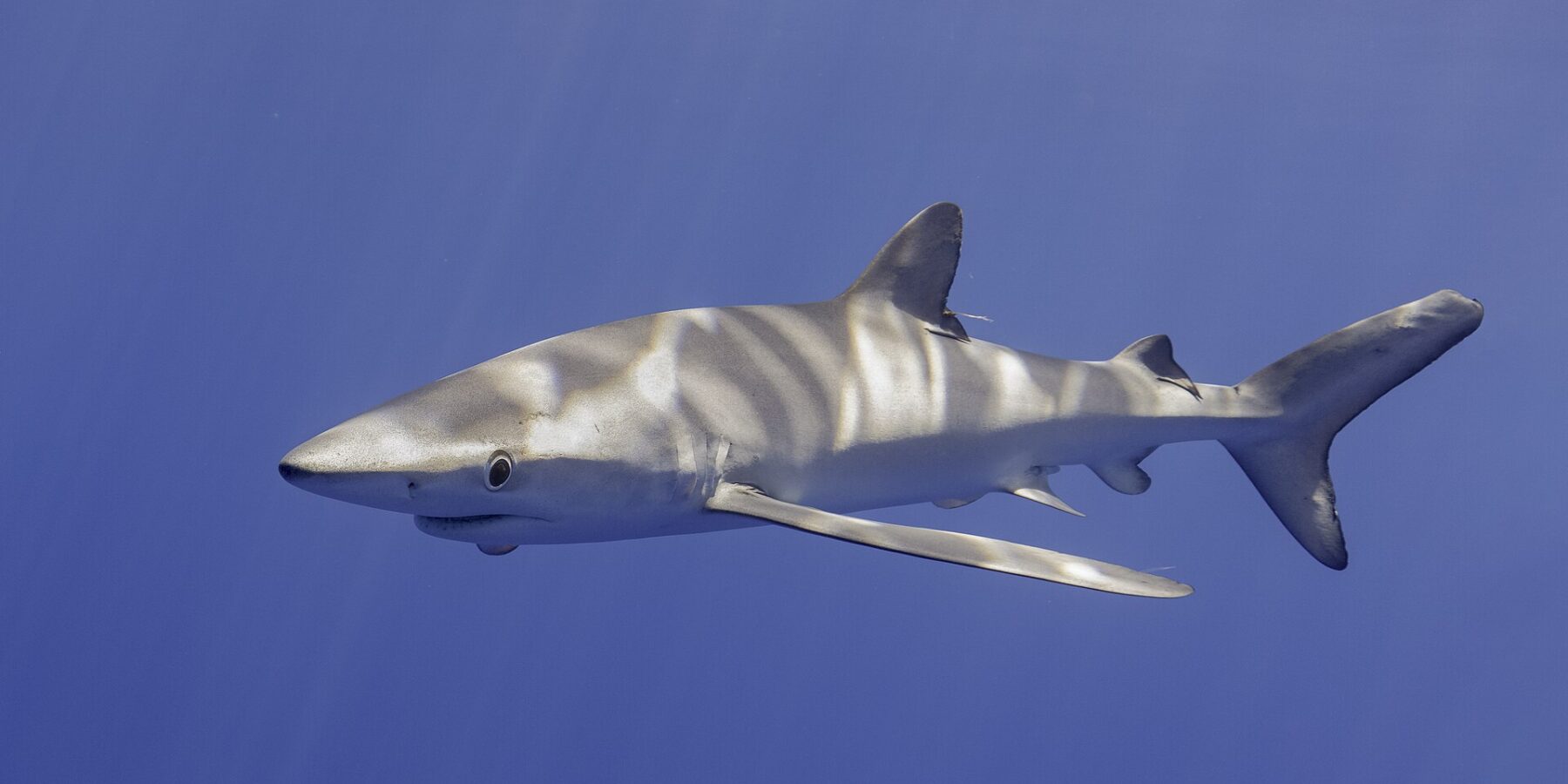
The blue shark lives offshore. Slim as a torpedo, it has a deep blue back and long pectoral fins. From July to October, it circles under the boats at Condor Bank, in the Azores, less than a meter from divers. It is the most heavily fished shark in the world, and the IUCN lists it as Near Threatened.
Where to dive to see the blue shark?
 Azores
How do you identify a blue shark?
The blue shark is slender, almost torpedo-shaped, with an outline like no other: a long, conical snout, large round eyes, and above all very long, narrow, scythe-shaped pectoral fins. The back is a deep blue, almost indigo, the flanks paler, the belly white: seen from above, it vanishes into the blue; seen from below, into the light. Males measure 1.80 to 2.80 meters at maturity, females 2.20 to 3.30 meters, and the largest individuals reach 3.80 meters. It swims slowly, in long curves, and circles whatever intrigues it, a boat, a bait crate, a diver, coming a little closer on each pass.
Blue shark in pictures
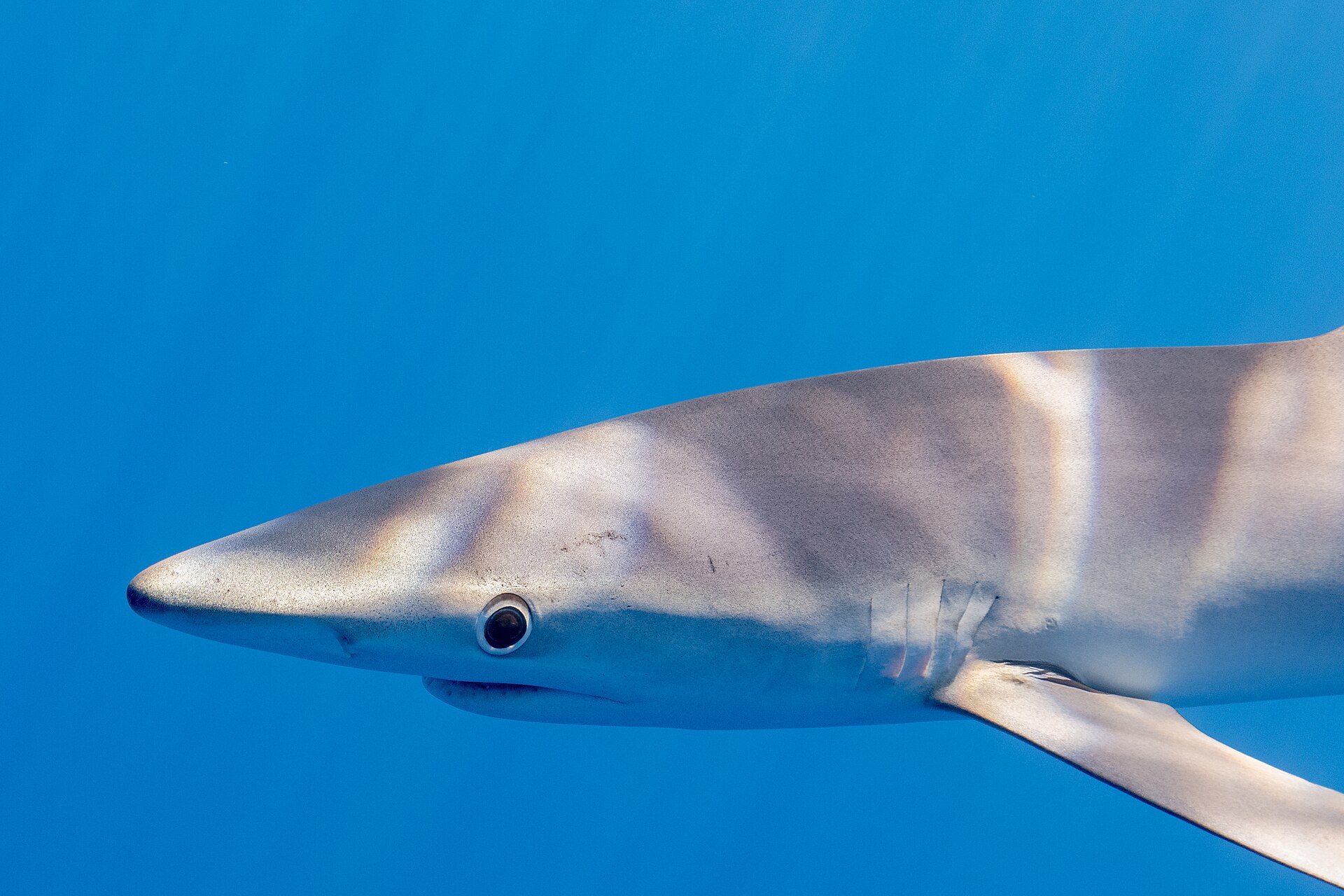
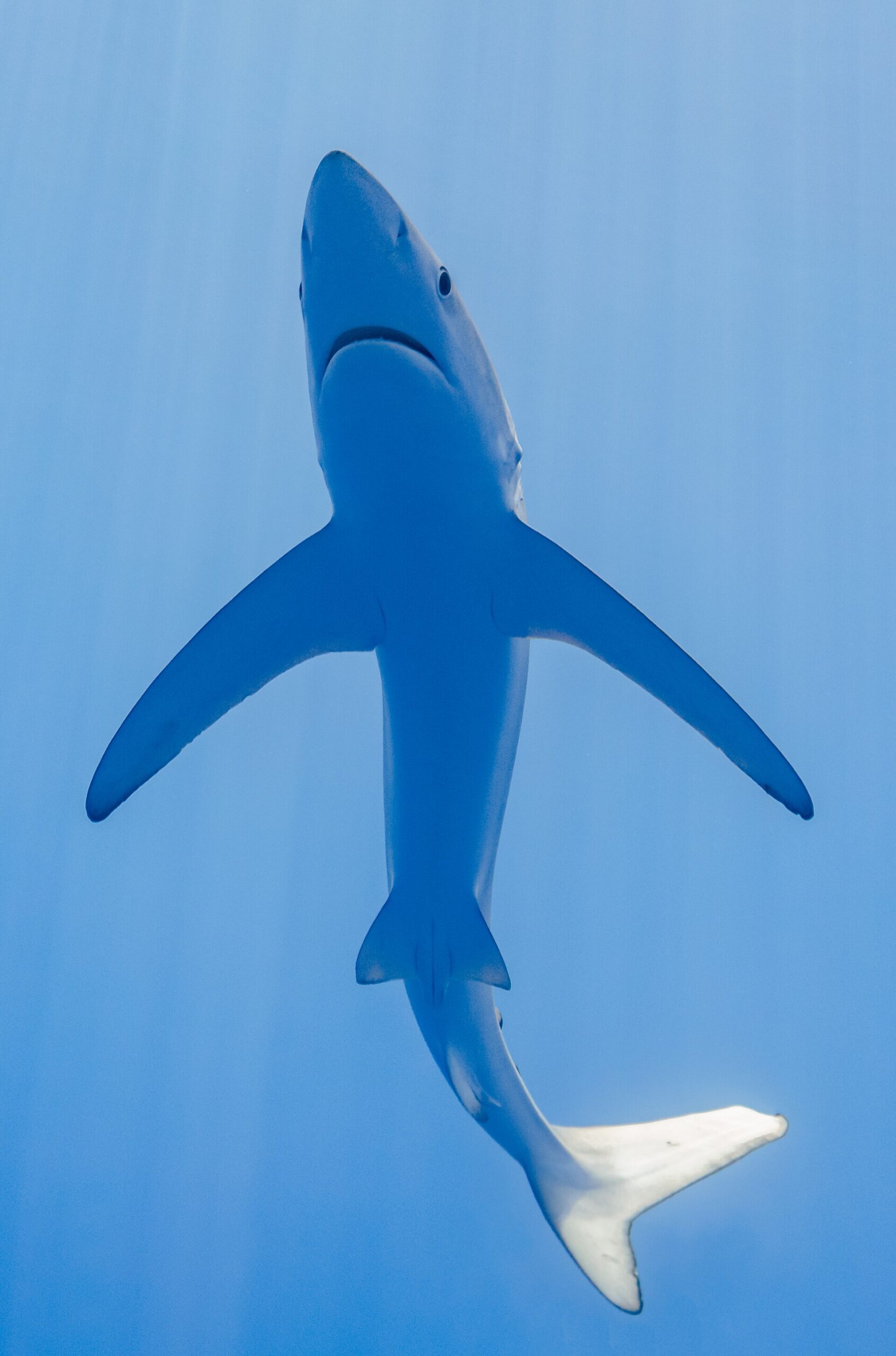
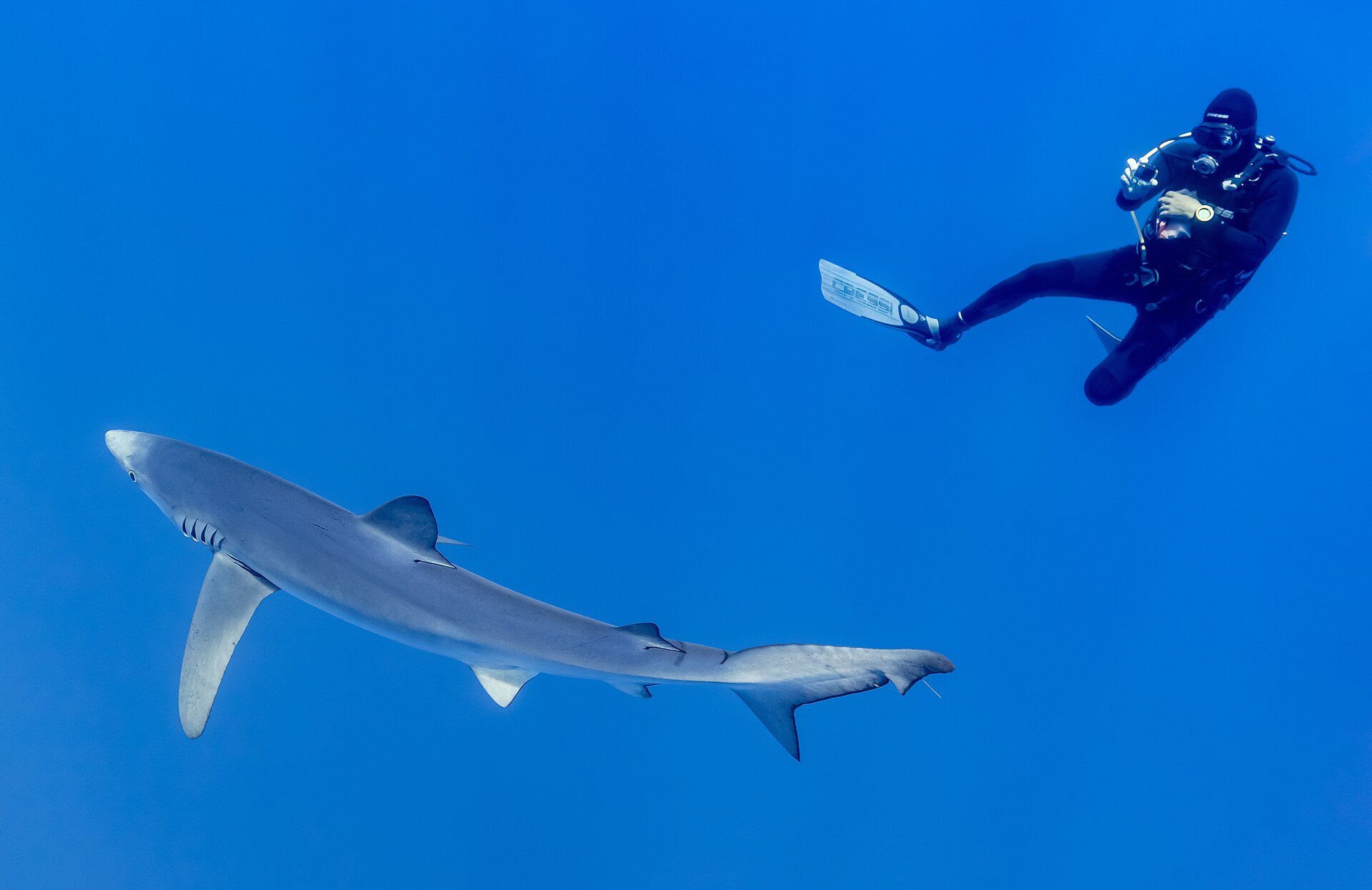
How does the blue shark live?
It is the most widespread shark in the world. It lives in all temperate and tropical seas, between 66° north and 55° south, in open water, most often from the surface down to 350 meters, and prefers water at 12 to 20 °C. It eats squid above all, then fish, from herring to tuna, small sharks, pelagic crabs, and now and then a dead cetacean. A great migrant, it crosses oceans: one shark tagged in California was recaught in Japan. Females give birth to 4 to 135 pups after nine to twelve months of gestation. It matures at four to six years and lives about twenty years.
Where and when can you see blue sharks in the Azores?
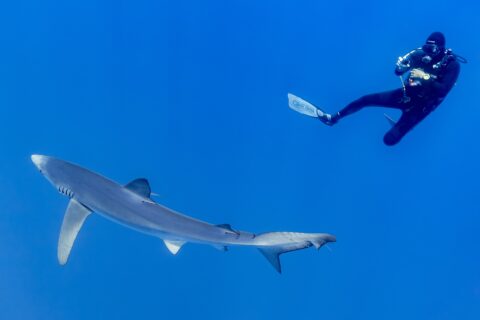
The Azores are the place in Europe to dive with blue sharks. At Condor Bank, a seamount 17 kilometers from Faial, the dive centers of Horta and Madalena attract them with a closed bait crate, without feeding them. Divers line up on the boat's line between 5 and 10 meters and see five to fifteen blue sharks per session, almost all males, from July to mid-October, with a peak in August and September. Blue sharks also show up in the blue at Princess Alice Bank, in the same season. The regional Azores code of conduct sets a limit of eight divers and one guide in the water and a maximum depth of ten meters, and bans feeding and contact.
Is the blue shark endangered?
The blue shark accounts for 85 to 90% of the sharks and rays caught as bycatch by high-seas longliners and nets, and it is also fished for its meat and fins: about 110,000 tons in 2019. The IUCN lists it as Near Threatened globally and Critically Endangered in the Mediterranean. It is listed on CITES Appendix II, which regulates its trade. On dives in the Azores, it has never injured anyone: watch it come, don't touch it, and get out of the water if one becomes persistent.
Our tip
Stay vertical on the line, with your buddy, between 5 and 10 meters, and never swim toward it: it comes to you, and it comes back. Look behind you as often as in front, since it likes to arrive from behind. No outstretched hand, no contact, and a wide-angle lens rather than a zoom: it passes within reach of your dome port.