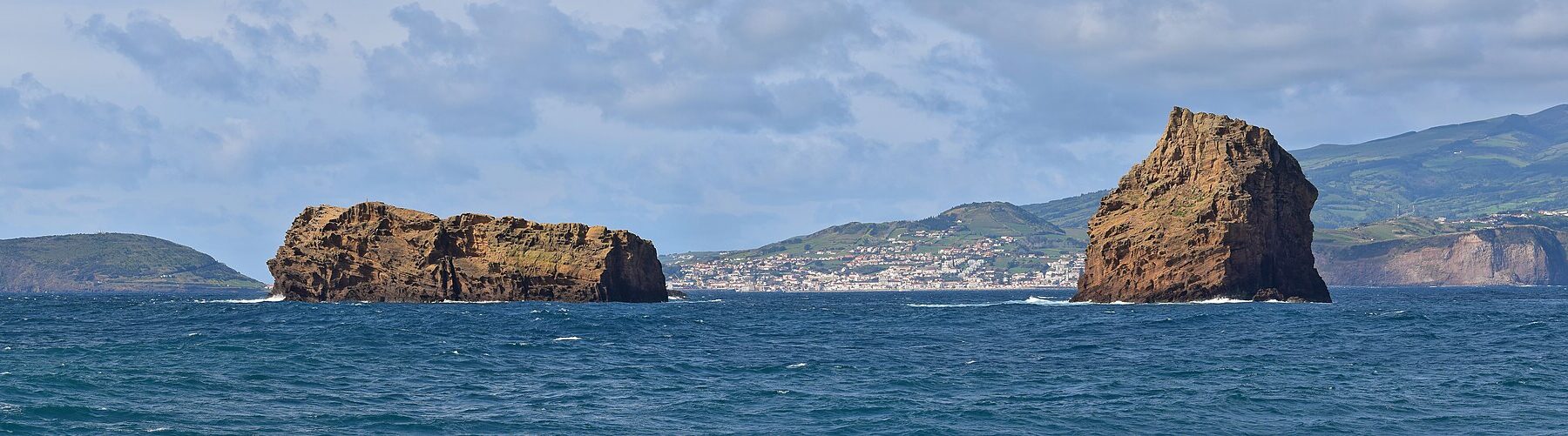
The Madalena islets are two tuff rocks 930 m from the harbor, the remains of an underwater volcano whose flooded crater forms a sheltered bay 20 m deep, home to groupers, morays and stingrays, with schools of bonito passing through. They are five minutes away by boat, open to Open Water divers with a guide.
Why dive the Madalena islets?
- Two islets 52 and 59 m high, the remains of a flooded volcanic crater, 930 m from Madalena harbor
- A sheltered bay between the islets, 20 m at most, open to Open Water divers with a guide
- Stingrays around the crater, morays in the cracks, schools of bonito and yellowmouth barracuda
- A Natura 2000 site since 1995, a refuge for terns and shearwaters
- Five minutes by boat from Madalena: the dive for windy days
The dive site on the map
Base: Madalena (Pico), 2 km as the crow flies.
See nearby dive sites on the mapThe Madalena islets in pictures
What will you see at the Madalena islets?
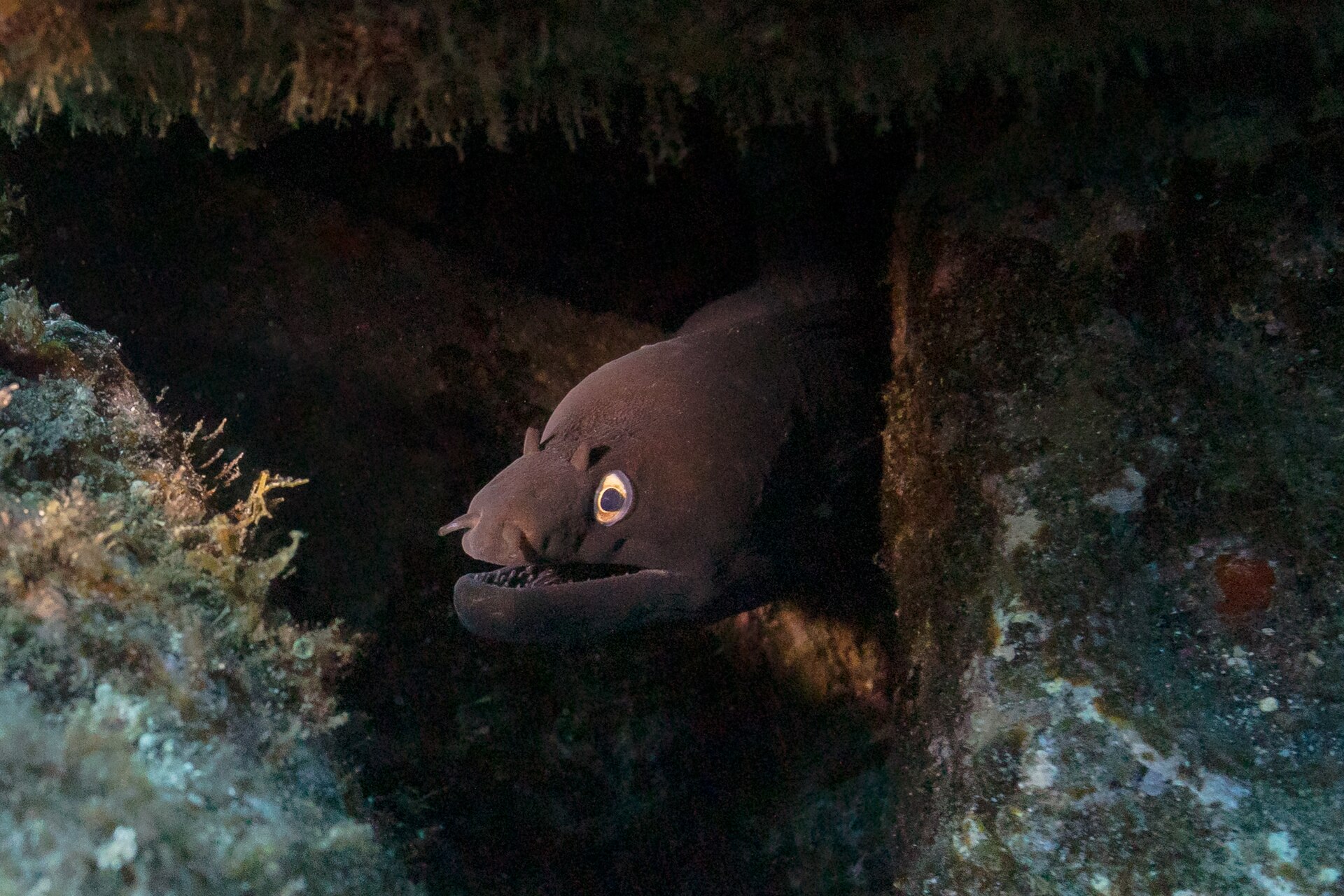
The bay between the two islets is the old crater, and its tuff walls shelter the marine life of Pico's coastal reefs. In the cracks, black and brown morays and conger eels poke their heads out; on the sand and rounded pebbles of the bottom, red mullet forage and stingrays gather in colonies around the crater. Groupers hold the boulders, salema graze in schools, and gray triggerfish, which spawn in the channel, guard their nests in the warm season. In open water, bonito, yellowmouth barracuda and garfish pass by, and bottlenose dolphins visit the waters around the islets. In spring and early summer, the Pico coast nudibranchs, Tambja ceutae and Hypselodoris picta, are worth a close search of the walls; on the island's drop-offs, the black coral Antipathella wollastoni appears from 18 m. Above water, the islets are a bird colony: common terns and roseate terns, Cory's shearwaters, gray herons, and passing shorebirds such as whimbrels, turnstones and sanderlings.
| Species | J | F | M | A | M | J | J | A | S | O | N | D | Note |
|---|---|---|---|---|---|---|---|---|---|---|---|---|---|
| Groupers | possible | possible | possible | possible | possible | possible | possible | possible | possible | possible | possible | possible | on the boulders and tuff walls of the crater, all year |
| Stingrays | possible | possible | possible | possible | possible | possible | possible | possible | possible | possible | possible | possible | in colonies on the sand and pebbles, around the crater |
| Black moray and brown moray | possible | possible | possible | possible | possible | possible | possible | possible | possible | possible | possible | possible | in the cracks in the tuff, with the conger eels |
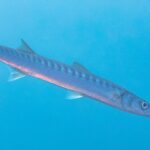 Yellowmouth barracuda | rare | rare | rare | possible | possible | peak season | peak season | peak season | peak season | possible | rare | rare | Sphyraena viridensis, schooling with bonito and garfish |
| Gray triggerfish | rare | rare | rare | possible | possible | peak season | peak season | peak season | peak season | possible | rare | rare | the channel is a spawning ground for Balistes capriscus; salema and red mullet on the sand |
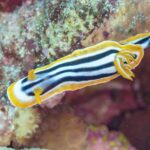 Nudibranchs | rare | rare | rare | possible | peak season | peak season | possible | rare | rare | rare | rare | rare | Tambja ceutae and Hypselodoris picta on the Pico coast, in late spring and early summer |
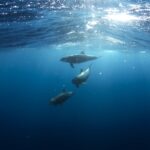 Bottlenose dolphin | possible | possible | possible | possible | possible | possible | possible | possible | possible | possible | possible | possible | around the islets and in the channel, seen from the boat |
peak seasonpossiblerare
What is diving like at the Madalena islets?
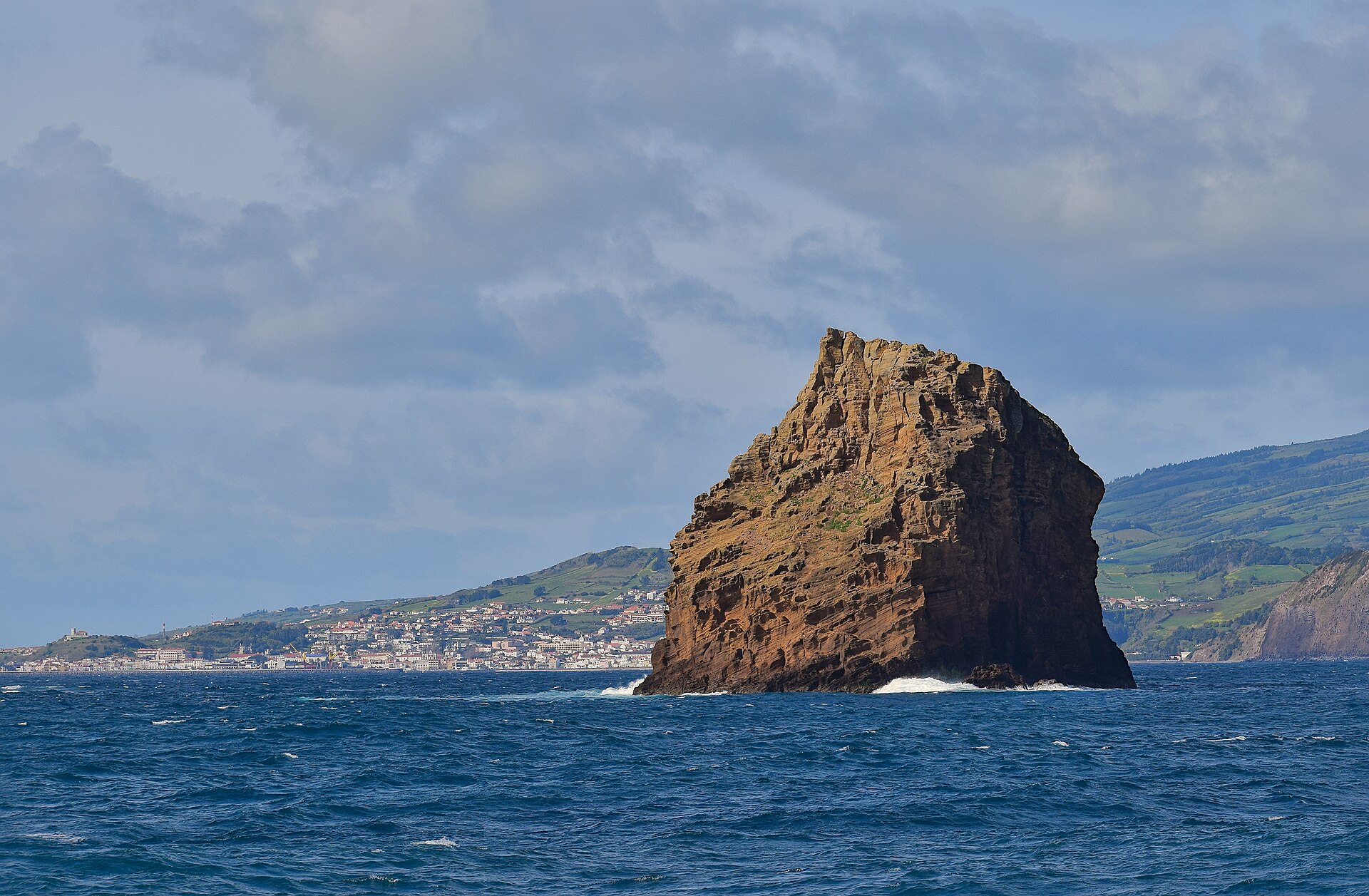
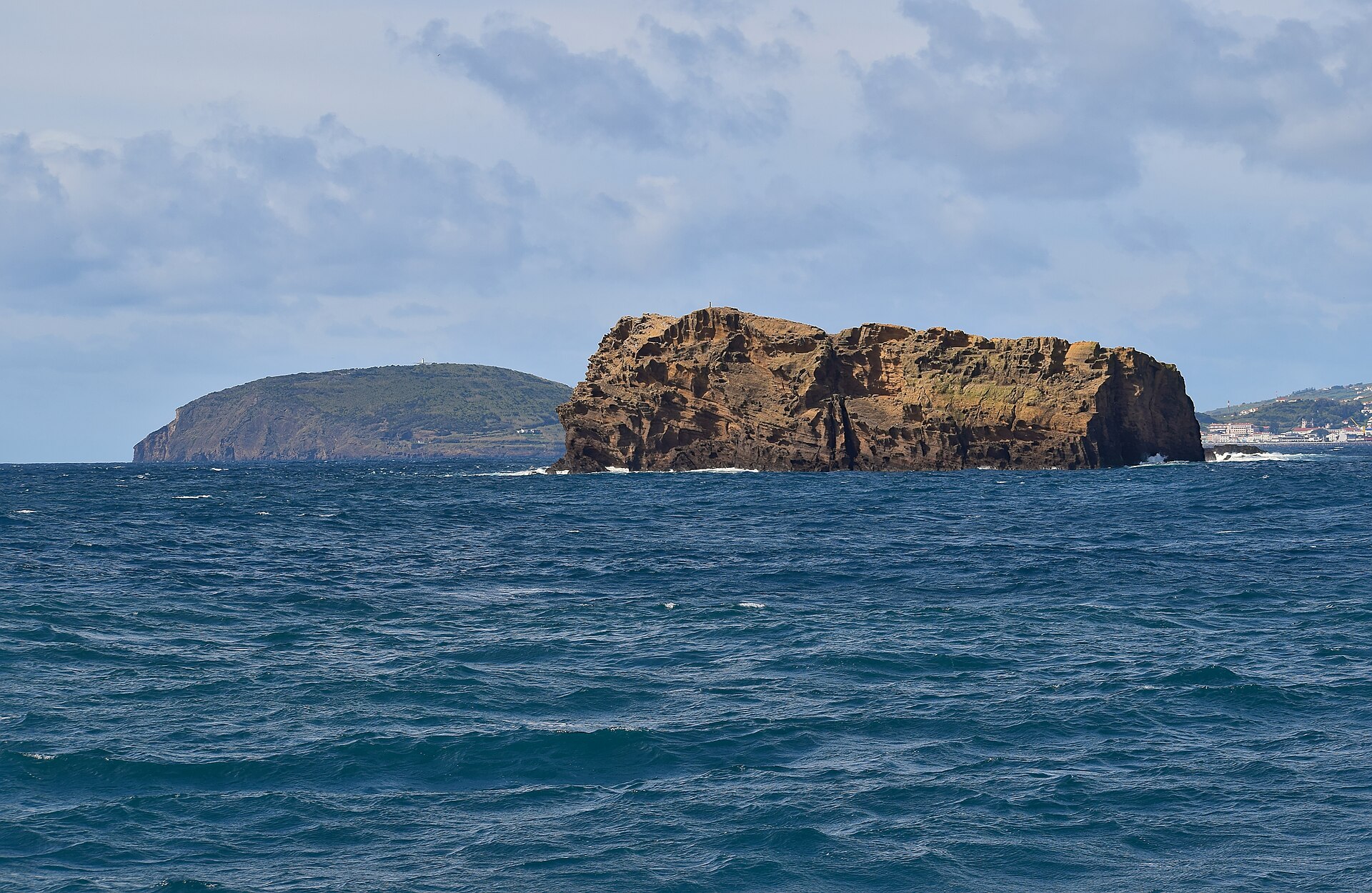
The two islets, Ilhéu Deitado, the lying one, 52 m high, and Ilhéu em Pé, the standing one, 59 m high, are the remains of an underwater tuff volcano, and the hollow between them is its old flooded crater, about twenty meters deep. You dive in this sheltered bay, along the crater walls, over a bottom of sand and rounded pebbles, 20 m at most: a site open to Open Water divers with a guide, with no difficulty as long as you stay inside. Everything changes when you leave the bay: the Faial-Pico channel is swept by strong currents, and leaving the shelter takes great care and a guide who knows the right moment. The channel is also the route of the ferries and the Madalena boats: a DSMB is mandatory for any ascent outside the bay. Visibility ranges from 15 to 30 m, and the water from 16 °C in winter to 23 °C in August.
When to dive the Madalena islets?
idealgoodnot recommended
The islets are dived from April to October, like the whole Pico coast, and fully from June to September, when the water goes from 19 to 23 °C and the sheltered site can be done almost every day. The water is 16 °C from January to April, 17 °C in May, 19 °C in June, 22 °C in July, 23 °C in August, 22 °C in September, 21 °C in October, 19 °C in November and 17 °C in December. Wear a 5 mm wetsuit in midsummer, 7 mm or a semidry at the two ends of the season. Norberto Diver, in Horta, opens from March to October; CW Azores, in Madalena, offers group prices from April to June. Late spring and early summer are the best time for nudibranchs; gray triggerfish are on their nests in summer; groupers, morays and stingrays are there all year. In winter, dive centers close or rarely go out, and the channel swell makes the site undiveable most days.
How to get to the Madalena islets?
The islets lie 930 m from Madalena harbor, in the channel, on the route of the Horta ferry: five minutes by RIB from the CW Azores base at Cais da Madalena. From Horta, Norberto Diver and Haliotis Faial cross the channel, eight kilometers wide. At CW Azores, a coastal dive costs €55, €200 for four and €440 for ten, tanks, weights, guide and boat included, and a night dive €65. At Haliotis Faial, it is €60 per dive, €99 for two and €89 for a try dive; at Norberto Diver, €65 for a coastal dive and €85 for a try dive. No price list names the islets: ask the dive center for them, as they are the closest coastal dive to Madalena. Pico airport is 8 km from Madalena, Horta's about ten kilometers from town; both get Azores Airlines flights from Lisbon and SATA Air Açores connections from Ponta Delgada, which Azores Airlines links to Paris nonstop in four hours.
Stay in Madalena (Pico)
Where to stay near the Madalena islets?
Hotels, apartments and rooms around Madalena (Pico), with current prices.
How did a tuff crater form the Madalena islets?
The Ilhéus da Madalena are what remains of an underwater volcano, a strongly welded cone of palagonitic tuff of hydromagmatic origin, broken apart by the sea and earthquakes. Two pinnacles still rise above the water, 930 m from the harbor: Ilhéu Deitado, the lying one, 52 m high, and Ilhéu em Pé, the standing one, 59 m high. Between them, the hollow is the old crater, flooded to about twenty meters; around it, the channel floor alternates sandy clearings and rounded pebbles, 20 m deep at most. The islets have been a Natura 2000 site since June 1995, a 1.43 km² Special Area of Conservation within Pico Natural Park, created in 2008, for the seabirds that nest there: common terns, roseate terns and Cory's shearwaters. The surrounding channel is itself protected for the tern, the loggerhead turtle and the bottlenose dolphin, and it is a spawning ground for the gray triggerfish.
What can you see underwater at the Madalena islets?
The boat anchors in the bay between the two islets, and you descend along the crater walls, dark streaked tuff riddled with cracks and overhangs. This is where to look closely: black and brown morays, conger eels and, in the warm season, the colorful nudibranchs of the Pico coast. The bottom, at 20 m, is a mix of sand and pebbles where red mullet forage and stingrays settle in numbers. Above, bonito, yellowmouth barracuda and garfish pass in the blue, and gray triggerfish guard their nests. A tour of the bay takes a whole dive; heading out toward the channel only makes sense with a guide, at slack current, and it is not always worth it. The site suits photography, with wide-angle for the tuff walls and macro for the cracks.
When should you dive the Madalena islets on a Pico trip?
On a stay on Pico or Faial, the Madalena islets are the dive you do when the open sea is off: five minutes from the harbor, sheltered by two rocks, diveable when swell closes the channel and the open sea. Madalena dive centers pair it with the channel shoals, Baixa do Sul first, for more seasoned divers, and with the two expeditions that make the trip: Condor Bank, an hour away by boat, for blue sharks, and Princess Alice Bank, three hours away, for mobulas. You can also see the islets from the Horta ferry, which passes right by, and from the café terraces of Madalena harbor, at the foot of the Pico volcano.
Our tip
Stay in the bay and follow the guide to leave it: the channel current picks up without warning. Look for morays in the cracks and stingrays on the sand, light in hand.
Other dive sites nearby
 AzoresReef
Baixa do Sul
Pico and Faial AzoresPelagic
Condor Bank
Pico and Faial AzoresPelagic