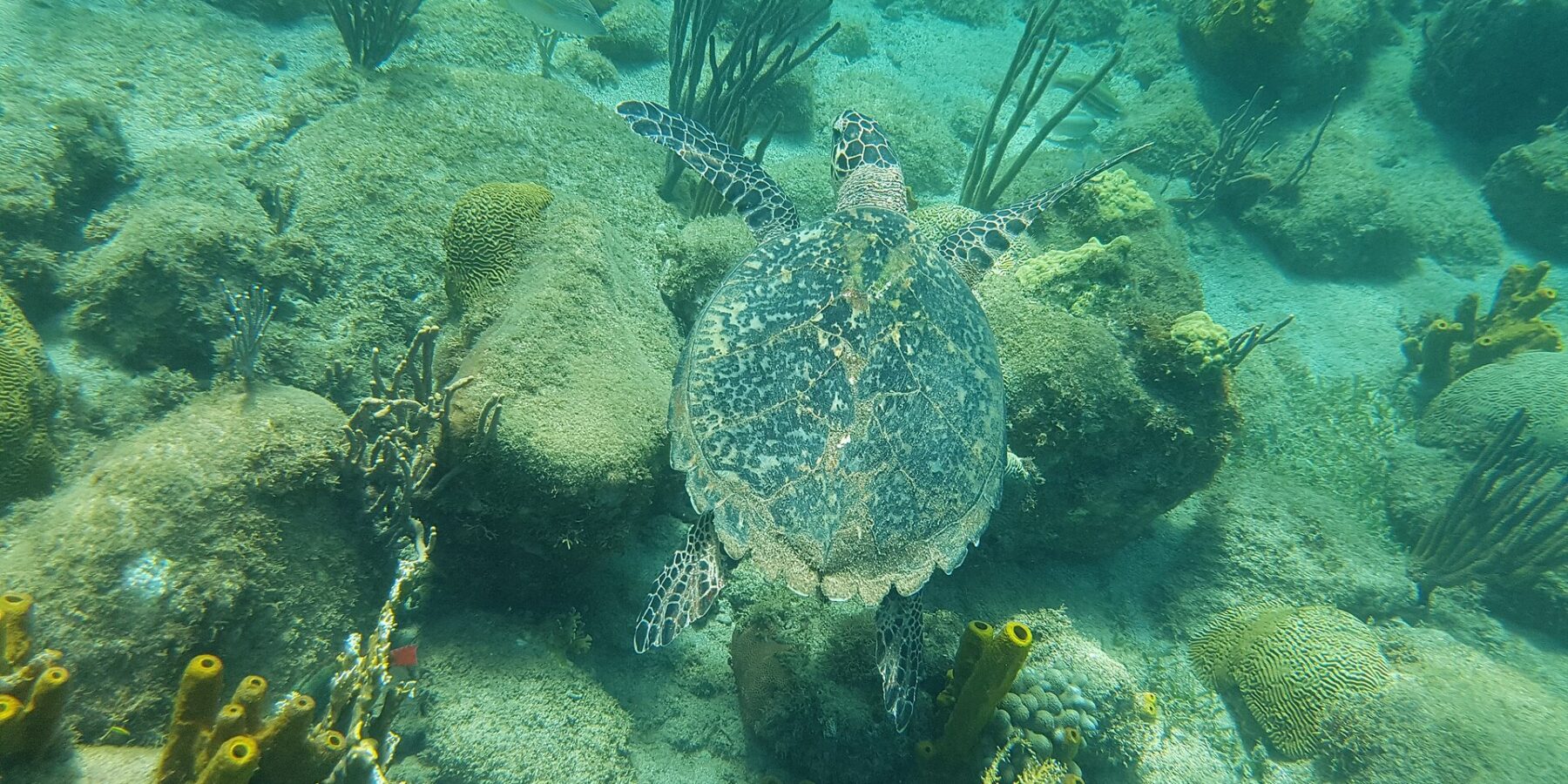
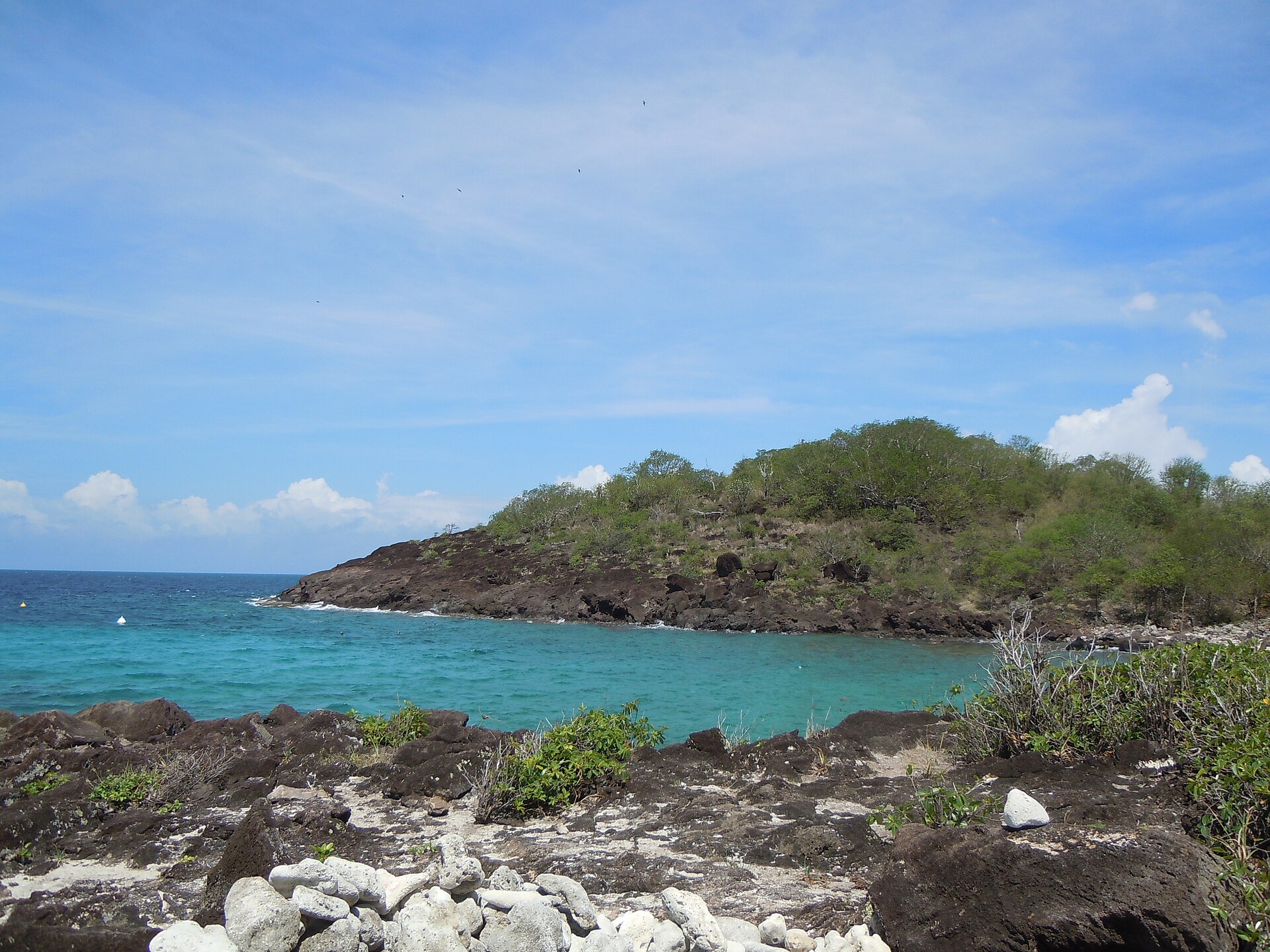
The Cousteau Reserve surrounds two volcanic islets 1.5 km off Malendure beach in Guadeloupe and has been the marine core of the National Park since 2009. You see green turtles right from the beach, Cousteau's bust at 12 m, hot springs and walls down to 40 m, in water that never drops below 26 °C.
Why dive the Cousteau Reserve?
- Green and hawksbill turtles a few meters down, visible right from Malendure beach
- Marine core of Guadeloupe National Park since 2009: no anchoring, no recreational fishing, no contact with the bottom
- Cousteau's bust at 12 m on the Coral Garden and the underwater hot springs of Grand Îlet
- All levels: try dives at 6 m in the Pool, walls down to 40 m for experienced divers
- Water at 26.5 to 29 °C all year, 1.5 km from the beach
The dive site on the map
Base: Malendure beach, Bouillante, 1 km as the crow flies.
See nearby dive sites on the mapThe Cousteau Reserve in pictures
What will you see at the Cousteau Reserve?
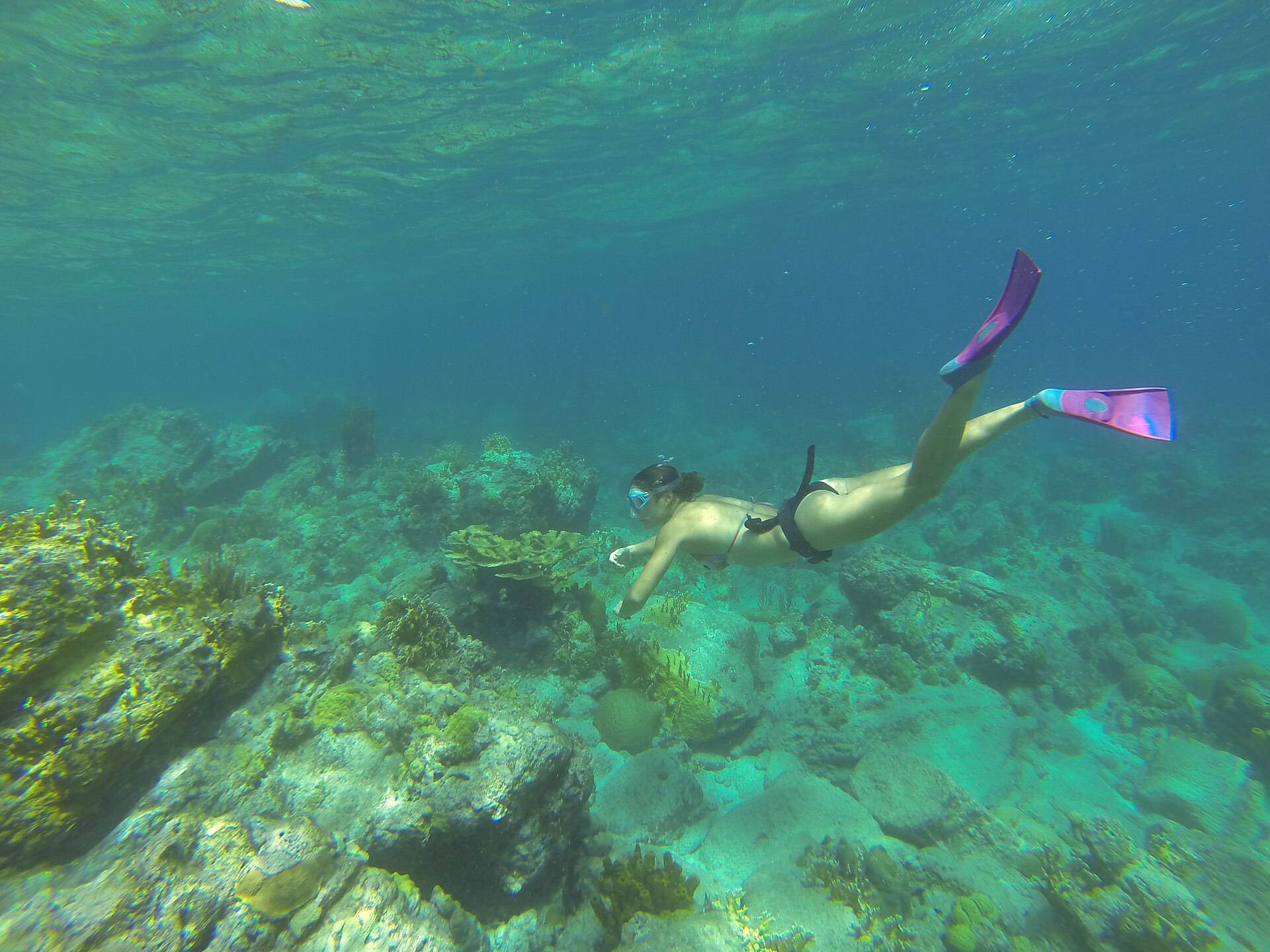
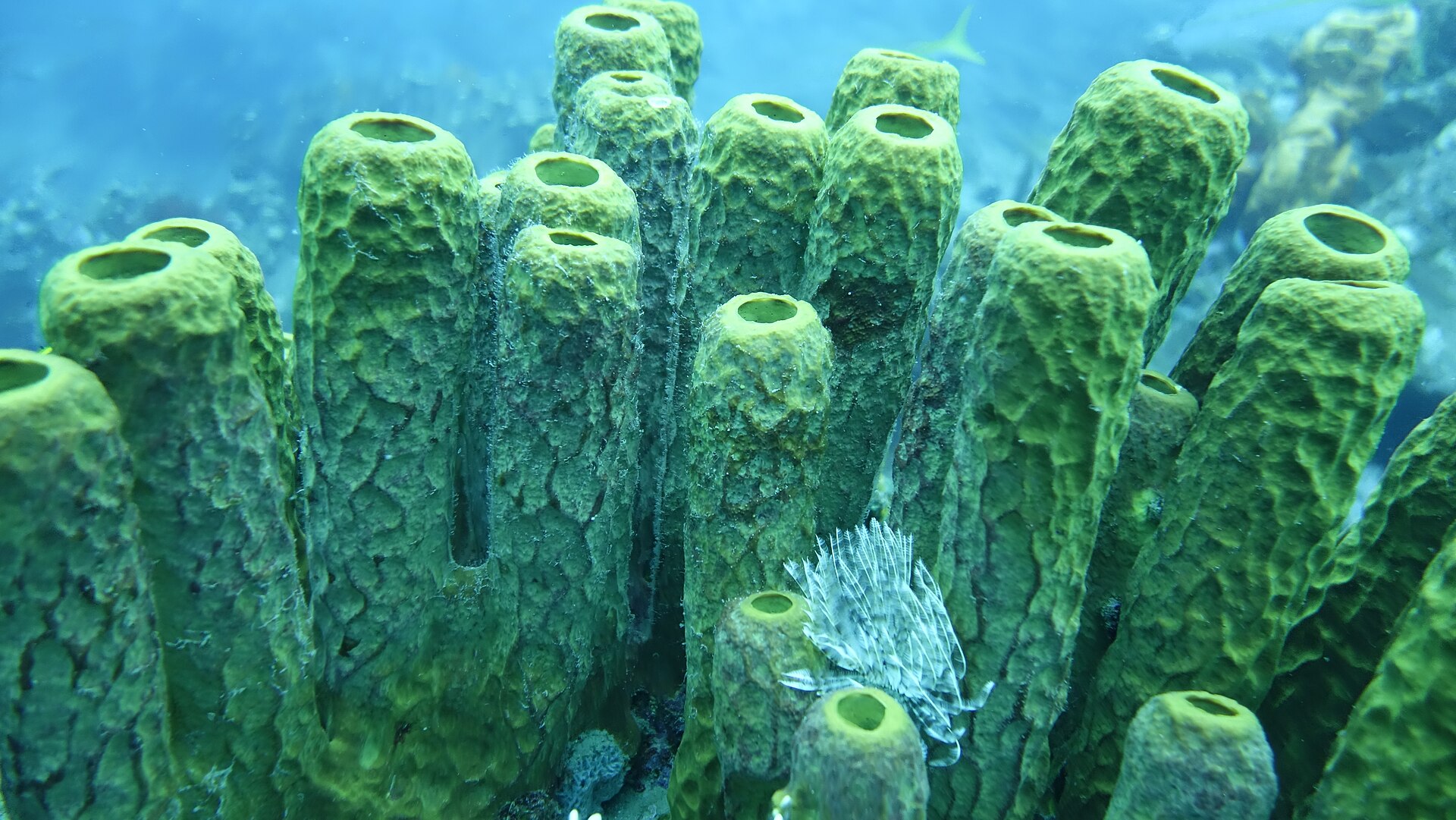
The turtles made the site's name. Green turtles graze the seagrass beds off Malendure, a few meters down, and you can already see them snorkeling from the beach; hawksbill turtles prefer the islet plateaus, among the sponges. Great barracuda, jacks and cero circle on the Coral Garden wall and at Pointe Barracuda, and spiny lobsters keep under the overhangs. The scenery is made of barrel and tube sponges, gorgonians and hard corals, with featherduster worms and nudibranchs for macro. The lionfish, a newcomer to the Caribbean, has settled among the rocks. In January and February, you can hear humpback whale song underwater. The reef has suffered: coral cover fell by 54% between 2012 and 2021, after the 2019 bleaching and the 2020 coral disease.
| Species | J | F | M | A | M | J | J | A | S | O | N | D | Note |
|---|---|---|---|---|---|---|---|---|---|---|---|---|---|
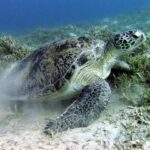 Green turtle | peak season | peak season | peak season | peak season | peak season | peak season | peak season | peak season | peak season | peak season | peak season | peak season | all year on the seagrass beds off Malendure and the islet plateaus, visible right from the beach with fins, mask and snorkel |
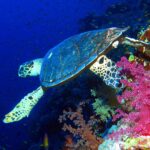 Hawksbill turtle | peak season | peak season | peak season | peak season | peak season | peak season | peak season | peak season | peak season | peak season | peak season | peak season | among the sponges on the plateaus, at the Aquarium and the Coral Garden |
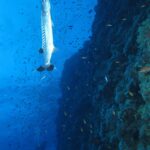 Great barracuda | possible | possible | possible | possible | possible | possible | possible | possible | possible | possible | possible | possible | on the Coral Garden wall and at Pointe Barracuda |
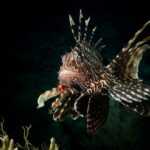 Lionfish | possible | possible | possible | possible | possible | possible | possible | possible | possible | possible | possible | possible | an invasive species in the Caribbean, sheltering under the rocks |
| Jacks | peak season | peak season | peak season | peak season | peak season | peak season | peak season | peak season | peak season | peak season | peak season | peak season | schooling at Pointe Carangue, in the current |
| Spiny lobsters | possible | possible | possible | possible | possible | possible | possible | possible | possible | possible | possible | possible | under the overhangs of the walls |
| Humpback whale song | peak season | peak season | rare | rare | rare | rare | rare | rare | rare | rare | rare | possible | audible underwater in January and February, while the whales stay offshore |
peak seasonpossiblerare
What is diving like at the Cousteau Reserve?
The site welcomes everyone. Try dives take place between the surface and 6 m on the plateaus of the Pool, between the two islets; the Coral Garden and its Cousteau bust at 12 m are open from PE12, Level 1 or Open Water; the walls at Pointe Barracuda and the Hot Springs, beyond 20 m and down to 40, require Level 2 or Advanced. On the leeward coast, the current is weak on the plateaus; it picks up at times at Pointe Carangue, where the slope drops from 12 to 22 m. Visibility ranges from 10 to 30 m, less in September. Groups have four divers at most per guide at Atlantis, for a dive of about 50 minutes. The real danger is at the surface: boats and kayaks circle the islets all day.
When to dive the Cousteau Reserve?
idealgoodnot recommended
Dive centers go out all year, up to seven times a day at Les Heures Saines, and the water never drops below 26 °C: 26.5 °C in February, 29 °C in September and October. The best period runs from December to May, in the dry season: flat seas on the leeward coast, clear water and whale-watching trips offshore, with humpback whale song audible underwater in January and February. The hurricane season runs from June 1 to November 30; dives go on, but September brings most of the strong winds, visibility drops and currents pick up on the points. A 3 mm wetsuit is enough all year, and a Lycra top protects you from the sun at the surface without sunscreen.
How to get to the Cousteau Reserve?
Everything leaves from Malendure beach in Bouillante, on the leeward coast of Basse-Terre: the islets lie 1.5 km offshore, a few minutes by boat. Allow about 8 hours 45 minutes of nonstop flight between Paris-Orly and Pointe-à-Pitre with Air France, Air Caraïbes or Corsair, then a rental car to cross the island. Les Heures Saines, based at the Malendure rock for nearly forty years, charges €53 for a guided dive with full gear, €45 for an independent dive, €300 for six dives and €470 for ten, with computer rental at €5; Atlantis Plongée, at Galet Pigeon, asks €50 per dive and €264 for six, and takes non-diving companions for €25. The trip lasts two hours in all. Divers pay no entry fee in the park core zone. Plan 18 to 24 hours without diving before your flight home.
Stay in Malendure beach, Bouillante
Where to stay near the Cousteau Reserve?
Hotels, apartments and rooms around Malendure beach, Bouillante, with current prices.
Why is it called the Cousteau Reserve?
The Pigeon Islands take their name from a 17th-century owner, Anthoine Pigeon; they were also called the Îlets à Goyave. They are two andesite rocks, 8 hectares in all, 35 m high at the top of Grand Îlet, owned by the State and managed by the Office national des forêts. In 1959, Jacques-Yves Cousteau tested his diving saucer here and wanted to see the site protected. The name Cousteau Reserve comes from the Malendure shopkeepers, not from any legal text: until 2009, only a prefectural order banned fishing and anchoring around the islets.
The decree of June 3, 2009 made the islets and the surrounding waters, about 400 hectares, the marine core of Guadeloupe National Park. The islets have also been listed as a ZNIEFF, a French natural area of ecological interest, since 1996, and they are part of the archipelago's biosphere reserve. A bronze bust of Commandant Cousteau watches over the Coral Garden at 12 m, and a scorpion endemic to the islets bears his name, Oiclus cousteaui.
Which dives can you do around the Pigeon Islands?
The Pool fills the channel between the two islets: sheltered plateaus less than 6 m deep, used for try dives and children's dives. The Coral Garden starts on a plateau a few meters down, passes Cousteau's bust at 12 m and tips over onto a wall where barracuda circle. The Aquarium, between 5 and 20 m, packs in sponges, gorgonians and hawksbill turtles. Pointe Carangue slopes from 12 to 22 m, in the current that holds the schools of jacks; Pointe Barracuda opens onto the wall, down to 40 m.
The Hot Springs, north of Grand Îlet, are a reminder that the islets are volcanic: a hot spring flows out of the bottom at 26 m, and threads of warm water rise between the rocks. Along with the walls, this is the dive for experienced divers.
How healthy is the reef at the Cousteau Reserve?
The most dived site in France pays for its popularity. The Park and the dive centers agreed to hold the number of dives at the islets between 80,000 and 100,000 a year, and wrecks were sunk along the coast in the late 1990s and early 2000s to offer other sites. The Park's scientific monitoring of twelve stations shows a 54% drop in coral cover between 2012 and 2021 and a 16% rise in macroalgae, after the 2019 bleaching and the 2020 hard coral disease. A public consultation on a management plan for the islets ran from October 2024 to July 2025.
What are the diving rules in the Guadeloupe National Park core zone?
Any contact with fixed wildlife and plants is an offense in the park core zone: put down neither hand nor knee, set your buoyancy before approaching a turtle and do not follow it. Boats do not drop anchor; they use the buoys provided, with the professional buoys reserved for authorized dive centers. Recreational fishing is banned, and so are drones without a permit. Malendure dive centers do not allow sunscreen on board: a Lycra top does the job. At the surface, stay together near the boat, as kayak and shuttle traffic is heavy around the islets.
Our tip
Take the first morning trip, before the boats and kayaks arrive. A six-dive package lets you string together the Pool, the Coral Garden, Pointe Carangue and the Hot Springs. Leave the sunscreen at the hotel and wear a Lycra top.
Other dive sites nearby
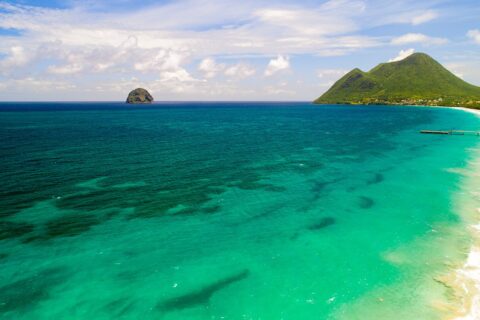
 FrancePelagic
Diamond Rock
French West Indies: Guadeloupe and Martinique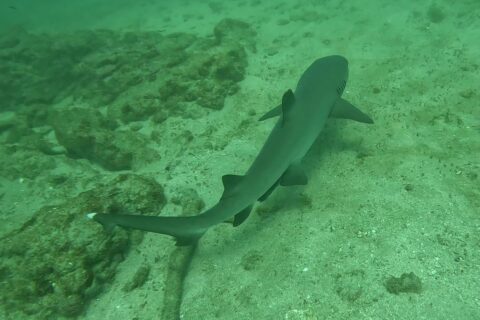
 Costa RicaCave or cenote
Caño Island
South Pacific: Osa and Caño Island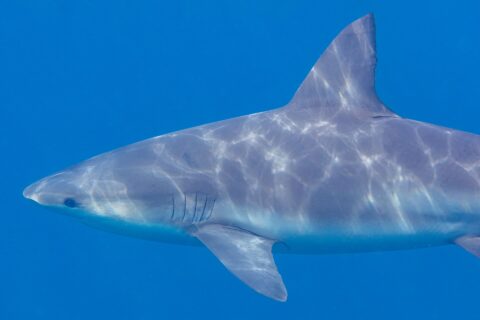 Costa RicaPelagic