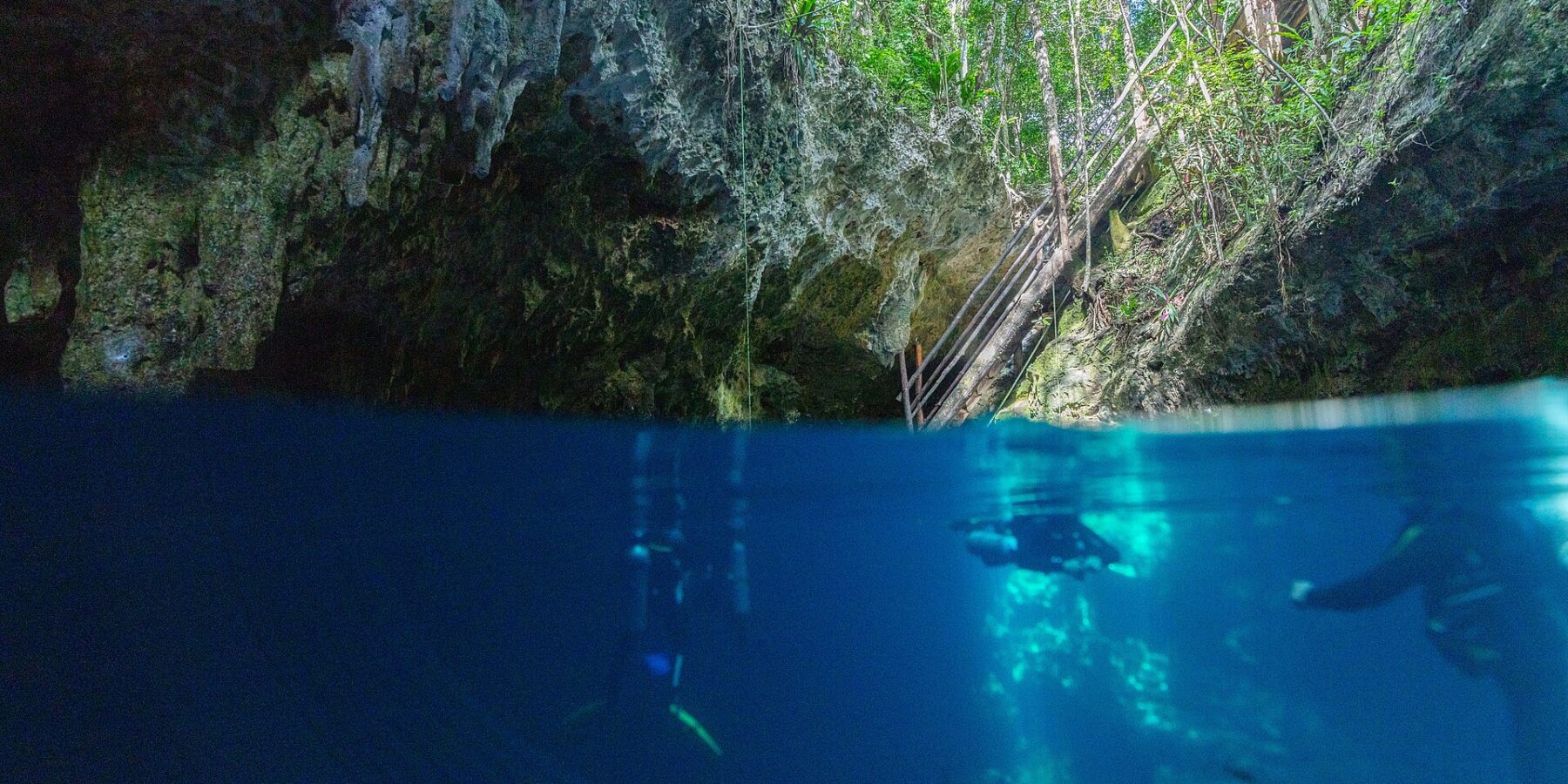
The Pit is a 119-meter shaft in the jungle of Dos Ojos Park, near Tulum. You descend in full light to 30 or 40 meters, through the blurry boundary between fresh and salt water, then a cloud of hydrogen sulfide that hangs like fog. The dive requires Advanced.
Why dive The Pit?
- A 119-meter shaft, the deepest known passage in Quintana Roo, dived to 30 or 40 meters
- Sunbeams that fall all the way to 30 meters and break on the hydrogen sulfide cloud
- A halocline that blurs the water like a mirage, then a forest of dead trunks under the cloud
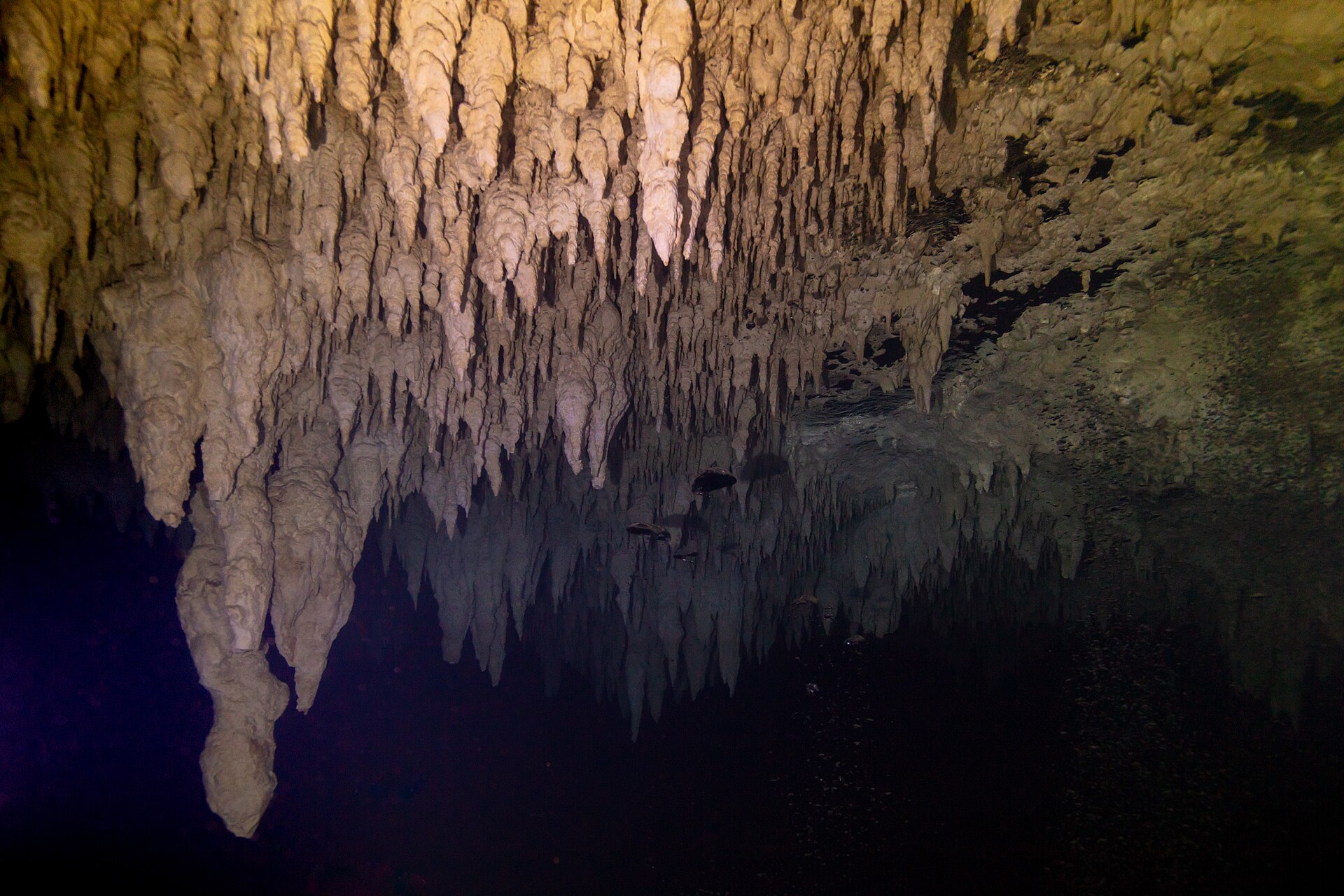
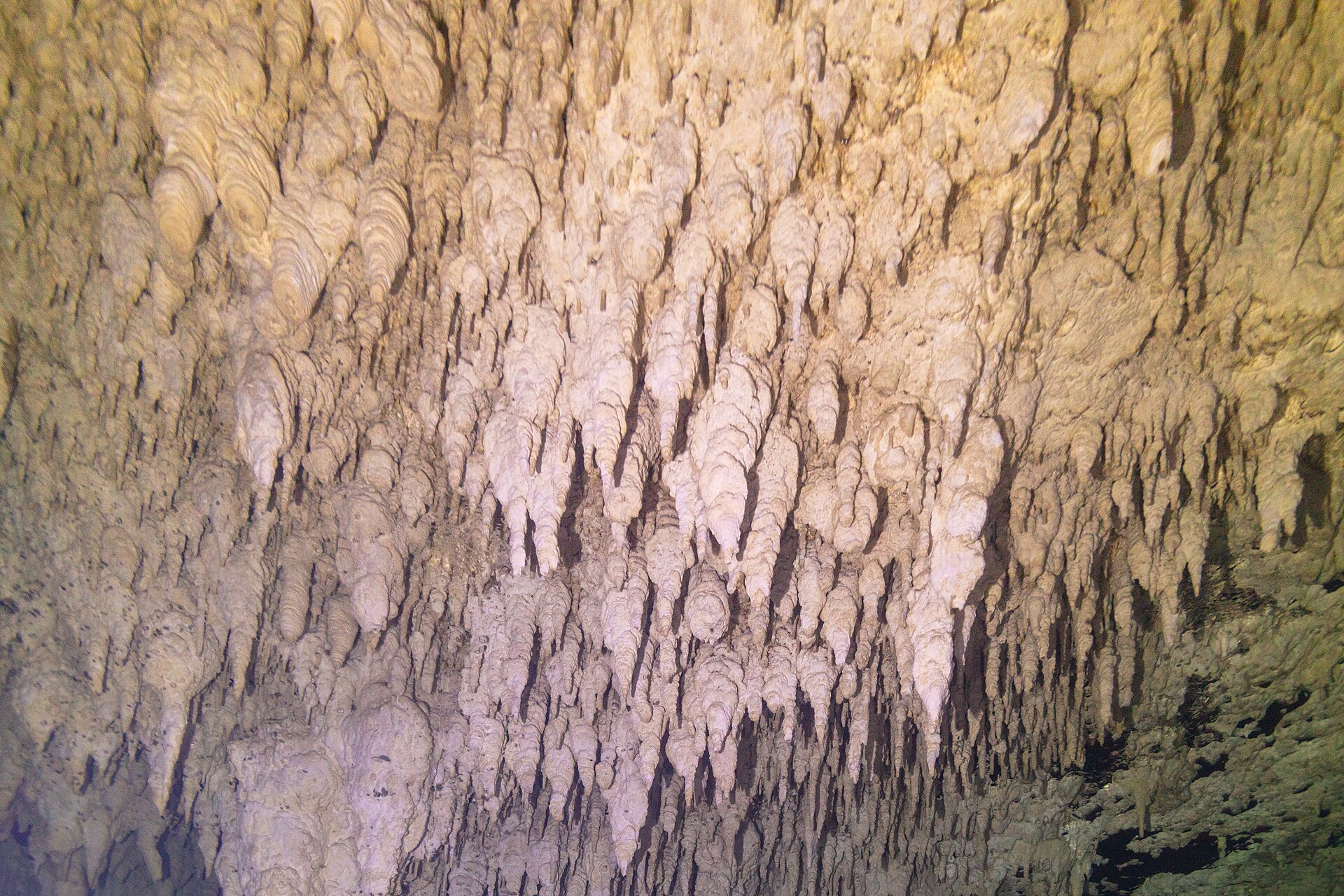
- Stalactites and white draperies on the ceiling, and black lines on the wall that mark old water levels
- 25 to 27 °C water year-round, no current, three kilometers from Dos Ojos
The Pit in pictures
What will you see at The Pit?
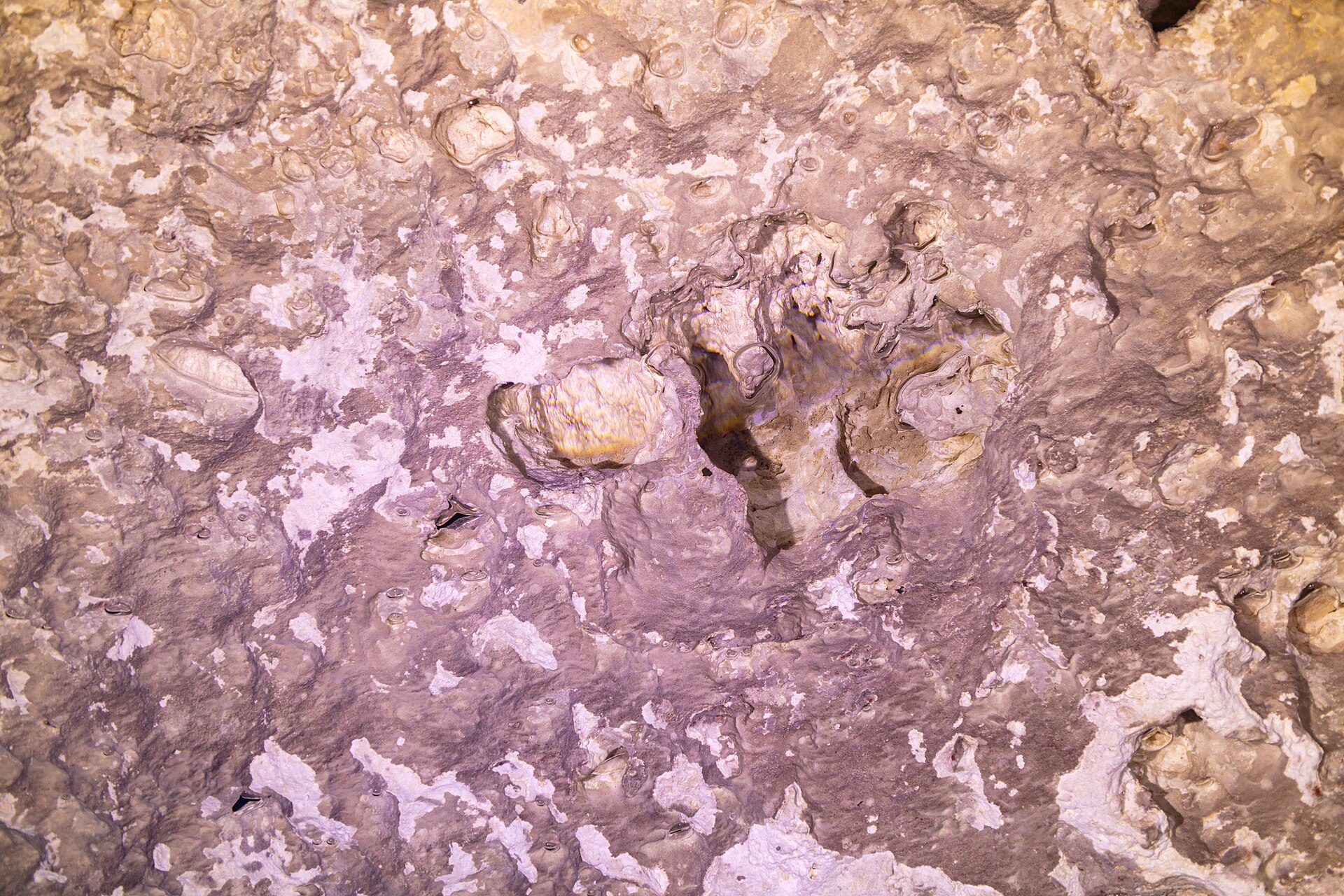
Wildlife is not the point of The Pit: a few schools of small freshwater fish in the first meters, and that is all. What you come to see is the water itself and what it hides. On the way down, you first cross the halocline, the boundary where fresh surface water floats on salt water that comes in from the sea through the passages: the view blurs, as if through oil, then sharpens again. Around 30 meters lies a milky white cloud of hydrogen sulfide, produced by the decay of leaves and branches fallen from the jungle. It hangs like fog, and the sunbeams break on it. Below, in the half-light, a mound of silt holds a forest of dead trunks and branches, animal bones and pottery shards, and the walls show stalactites and stalagmites formed when the cave was dry. Higher up, horizontal black lines mark the water levels through the ice ages, and the ceiling carries fine white formations.
| Species | J | F | M | A | M | J | J | A | S | O | N | D | Note |
|---|---|---|---|---|---|---|---|---|---|---|---|---|---|
| Small freshwater fish | peak season | peak season | peak season | peak season | peak season | peak season | peak season | peak season | peak season | peak season | peak season | peak season | a few schools in the freshwater layer, near the surface |
| Fossil trunks and branches | peak season | peak season | peak season | peak season | peak season | peak season | peak season | peak season | peak season | peak season | peak season | peak season | under the hydrogen sulfide cloud, a dead forest on a mound of silt, with bones and pottery |
peak seasonpossiblerare
What is diving like at The Pit?
The shaft drops to 119 meters, but recreational dives stop between 30 and 40 meters, under the hydrogen sulfide cloud that hangs around 30 meters. You descend straight along the wall, take a look under the layer for the trunks and fossils, then spiral back up the cylinder, in stages, to the formations on the ceiling. There is no current, and visibility is over 30 meters above the cloud and zero inside it; the halocline, which you cross on the way down and back up, blurs your view for a few meters. The required level is Advanced or the Deep specialty, with a recent dive and solid buoyancy: you move in an open shaft, but under overhangs that you do not enter without a cave certification, and the silt on the bottom lifts at the slightest fin kick. Four divers per guide, two lights, reduced weighting. Dos Ojos, three kilometers away, is the right place to test your comfort in a cavern the day before.
When to dive The Pit?
idealgoodnot recommended
You can dive The Pit year-round: the water stays between 25 and 27 °C from the surface to the bottom, with no marked thermocline and no current, and the shaft is sheltered from the wind. What changes with the season and the time of day is the light. The beams that reach down to the cloud only form when the sun is high above the opening, around midday, and they are at their best in the summer months, when it is almost straight overhead; in winter the light comes in at an angle and the show is softer. Dive centers schedule The Pit as the first dive, because it is the deepest, and follow with Dos Ojos. In hurricane season, from June to November, only storm days close the park. Bring a 5 millimeter wetsuit: after 45 minutes in 25 °C water without sun, you end up cold.
How to get to The Pit?
The Pit is in Dos Ojos Park, 20 minutes north of Tulum, three kilometers from Dos Ojos Cenote along a jungle track; a staircase and a platform lead down to the water. Dive centers almost always sell it paired with Dos Ojos, with The Pit as the first dive. Scuba Tulum charges US$140 for the day, US$130 from three divers, two or three dives, equipment and light included, four divers per guide at most, plus the MXN 900 park entry fee for both sites charged since January 17, 2025. Mexico Kan Tours, in Tulum, sells the same day for US$215, including entry, equipment and transport, with a minimum of two divers. Wild Playa, in Playa del Carmen, offers the day with a private guide for MXN 3,900, all inclusive, from Playa or Tulum. Scuba Libre, in Playa del Carmen, takes Advanced divers there from age 15, with equipment rental at €28. Tulum is two hours from Cancún airport, Playa del Carmen one hour; both towns have hyperbaric chambers within reach.
Stay in Tulum
Where to find a dive guide in The Pit?
Guided tours you can book online, ranked by number of reviews. These are affiliate links: if you book, you support us at no extra cost.

 Viator
Dos Ojos Cenote Dive: Barbie Line & Bat Cave - 2 Dives
5.0 (500 reviews)View and book Viator
2 cenote divings (including one deep diving) for advanced divers in Tulum
5.0 (187 reviews)View and book Viator
Private Full-Day Cenote Diving Experience 2 Dives with Lunch
5.0 (173 reviews)View and book Viator
Amazing beginner dive in Tulum cenote (or refresher dive)
5.0 (117 reviews)View and book Viator
Go for 2 dives in cenote Dos ojos for certified divers
5.0 (90 reviews)View and book Viator
2 tanks Cenote Diving Adventure in Tulum for Certified Divers
4.9 (78 reviews)View and bookWhere to stay near The Pit?
Hotels, apartments and rooms around Tulum, with current prices.
How deep is The Pit, the deepest cenote in Quintana Roo?
The Pit, or El Pit, is the deepest known point of the Dos Ojos system: 119 meters, reached by explorers who set out from the main entrance, 1,500 meters away, and discovered it in 1996. The shaft opens in the jungle a few kilometers from the coast, in the same park as Dos Ojos, and since 2018 it has been part of Sistema Sac Actun, the longest underwater cave network in the world, which already exceeded 319 kilometers in 2014. Like all cenotes, it is a collapse in the limestone plateau, which was carved out during the ice ages, when the sea was lower and the cave dry: the stalactites on the ceiling and the black lines on the wall, which mark old water levels, are the proof.
What is a dive in The Pit like, from the surface to the cloud?
You enter by the staircase and the platform, check your buoyancy at the surface, then descend straight along the wall. The first meters are fresh water; at the halocline, the view blurs for a few meters, then sharpens again, in salt water that comes in from the sea. Around 30 meters, the hydrogen sulfide cloud appears, a still white layer that swallows the light; around midday, the sunbeams crash into it. You put your head under it for a few minutes to see the silt mound, its dead tree trunks, its bones and its pottery, then you spiral back up the cylinder, in stages, to the formations on the ceiling. The dive lasts 40 to 50 minutes, with little of it at depth: it is a deep dive on air, and you keep an eye on your computer.
How do you photograph The Pit?
The subject is the beams: you need to be there when the sun falls into the opening, around midday, ideally in summer. Position yourself under the beams, a little above the cloud, and frame a diver in the light from below, flash off; the cloud makes a white floor. The halocline does not photograph well: you just cross it. Under the layer, a light is essential and the silt lifts at the slightest movement, so stay still and let the guide light up the trunks. A large housing sometimes costs extra, MXN 300 at Wild Playa.
Our tip
Dive it when the sun is high: that is the only time light falls straight into the shaft. Cross the halocline, the blurry boundary between fresh and salt water, slowly and in single file. At 40 meters, watch your computer: no-decompression time runs out fast.
Other dive sites nearby
 MexicoCave or cenote
Dos Ojos Cenote
Yucatán and the Caribbean: Cozumel, cenotes, Playa del Carmen MexicoReef
Palancar Reef
Yucatán and the Caribbean: Cozumel, cenotes, Playa del Carmen MexicoWall