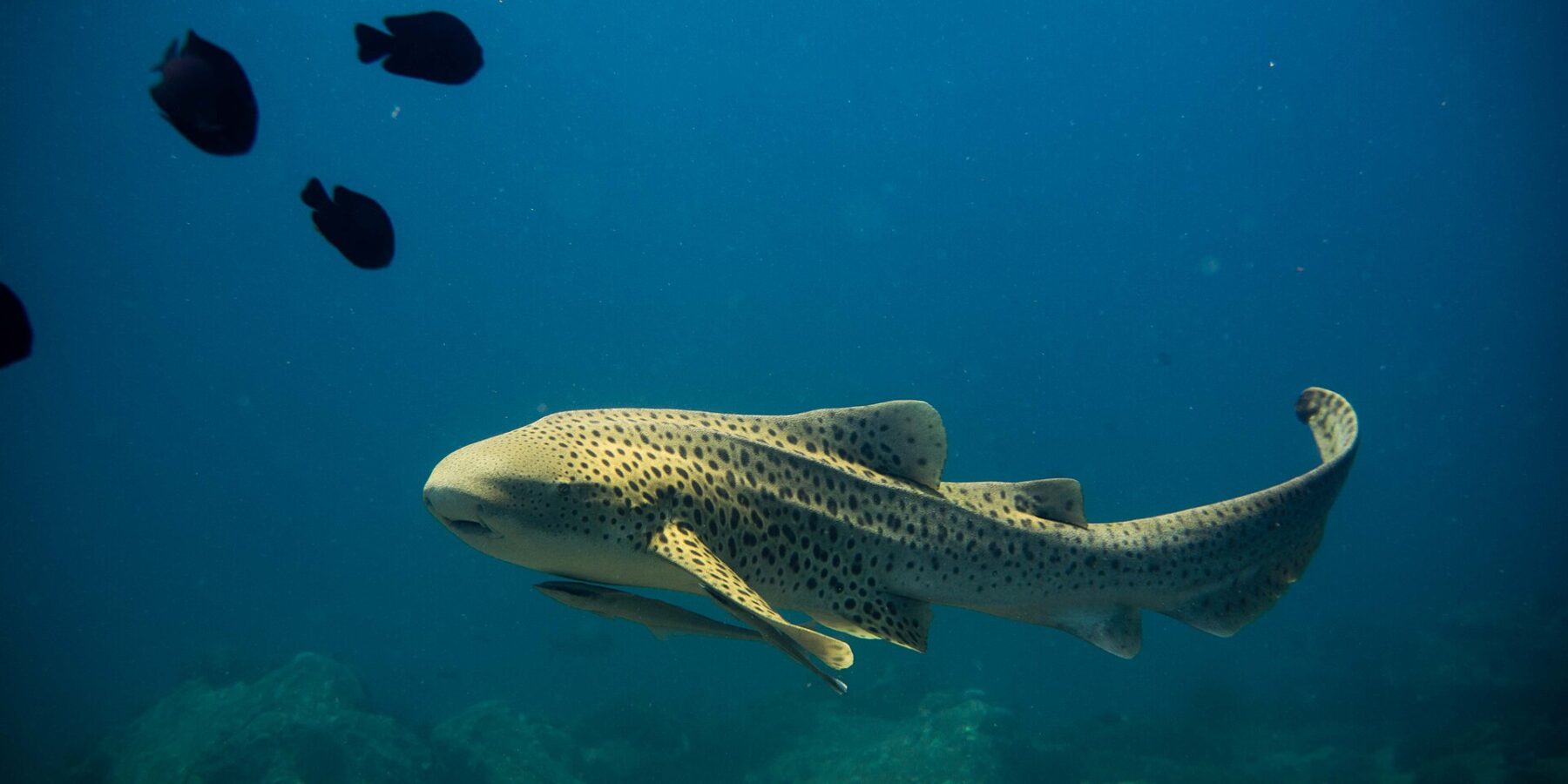
The zebra shark grows to 2.50 meters at most. Spotted like a leopard as an adult, it is striped like a zebra in its first months. It sleeps on the sand by day, at the foot of Richelieu Rock or Chumphon Pinnacle, and lets you approach. The species is Endangered: watch it without touching it.
Where to dive to see the zebra shark?
 ThailandPelagic
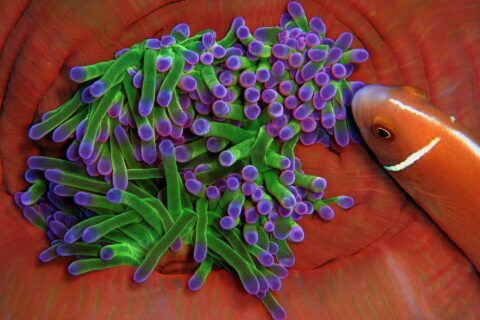
Chumphon Pinnacle
Gulf of Thailand: Koh TaoCan be seen all year round: now and then on the sand at the foot of the pinnacle
 ThailandReef
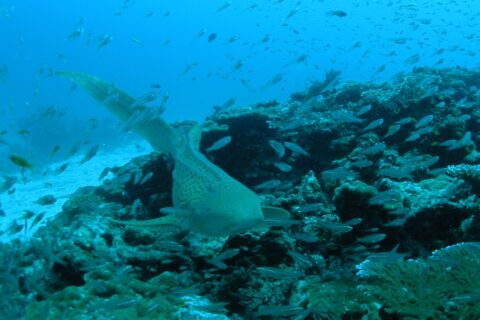
Elephant Head Rock
Andaman Sea: Similan, Surin and LantaCan be seen all year round: resting on the sand between the boulders, at the foot of the swim-throughs
 ThailandPelagic
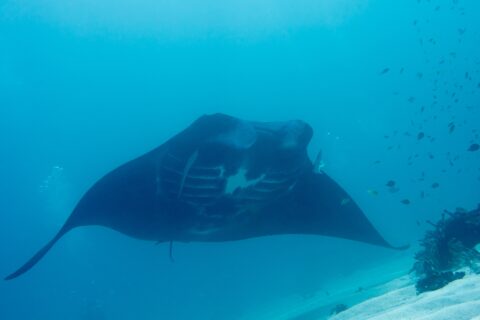
Koh Tachai Pinnacle
Andaman Sea: Similan, Surin and LantaCan be seen all year round: resting on the sand between the boulders
 ThailandPelagic
Richelieu Rock
Andaman Sea: Similan, Surin and LantaCan be seen all year round: resting on the sand at the foot of the rocks
How do you identify a zebra shark?
The zebra shark, Stegostoma tigrinum, long known as Stegostoma fasciatum, is a carpet shark and the only member of the family Stegostomatidae. The adult reaches 2.50 meters. The body is cylindrical, the head broad and slightly flattened, the snout short and rounded; the eyes are small, with large spiracles behind them. Five ridges run along the body, one on the back and two on each side, and the low tail fin makes up nearly half of the total length. The adult's coat is pale and covered in dark spots, hence its other name, leopard shark. Each pattern is unique to an individual and is used to identify it from photos. The juvenile, on the other hand, is brown with pale stripes and has no ridges: hence the name zebra shark. The switch from one pattern to the other happens between 50 and 90 centimeters, and the first naturalists thought they were two species.
How does the zebra shark live?
The zebra shark lives on reefs, rubble areas and sandy bottoms of the tropical Indo-Pacific, from the tidal zone down to 62 meters. It is nocturnal. By day, it rests on the bottom, often propped on its pectoral fins, head raised into the current and mouth open to breathe, preferably in a channel where the water flows. At night, it hunts mollusks, crustaceans and small fish in holes in the reef, where its flexible body lets it squeeze in. It is oviparous: the female attaches large egg cases to structures on the bottom with sticky filaments, and the young hatch after four to six months in aquariums, 20 to 36 centimeters long. Solitary for most of the year, it forms seasonal gatherings, of several hundred adults in southeast Queensland, and movements of 140 kilometers have been recorded.
Where and when can you see zebra sharks in Thailand?
The zebra shark is the most common shark at Thai dive sites, on both sides of the peninsula. In the Andaman Sea, you find it resting on the sand at the foot of Richelieu Rock and Koh Tachai from November to April, when the parks are open. It also rests at Shark Point and Phi Phi, off Phuket, and at Hin Klai, off Krabi. In the Gulf of Thailand, it rests from time to time on the sandy bottom of Chumphon Pinnacle, at 30 meters, all year round. You also see it in the Maldives, the Red Sea and on the Great Barrier Reef. It doesn't flee if you arrive calmly from the side, and it tolerates several minutes of observation before getting up and swimming away with a wavy motion.
Is the zebra shark endangered?
The zebra shark is listed as Endangered on the IUCN Red List. It is fished across almost its entire range with bottom trawls, gillnets and longlines; the meat is sold fresh or salted, the fins go into soup and the liver into oil. Its shallow habitat and the little mixing between populations make it vulnerable to local extinctions, and it has become scarce in Southeast Asian markets. Harmless and slow, it has bitten divers who pulled its tail or tried to ride it: don't touch it, don't wake it, and keep out of its way when it leaves.
Our tip
Approach from the side, slowly, at sand level, without passing over it or in front of its mouth. Stay two meters away and touch neither the tail nor the fins: the only known bites were responses to divers pulling on it. Photograph it with a wide-angle lens, in profile, without a direct flash in its eyes, and give it room when it lifts off the sand.