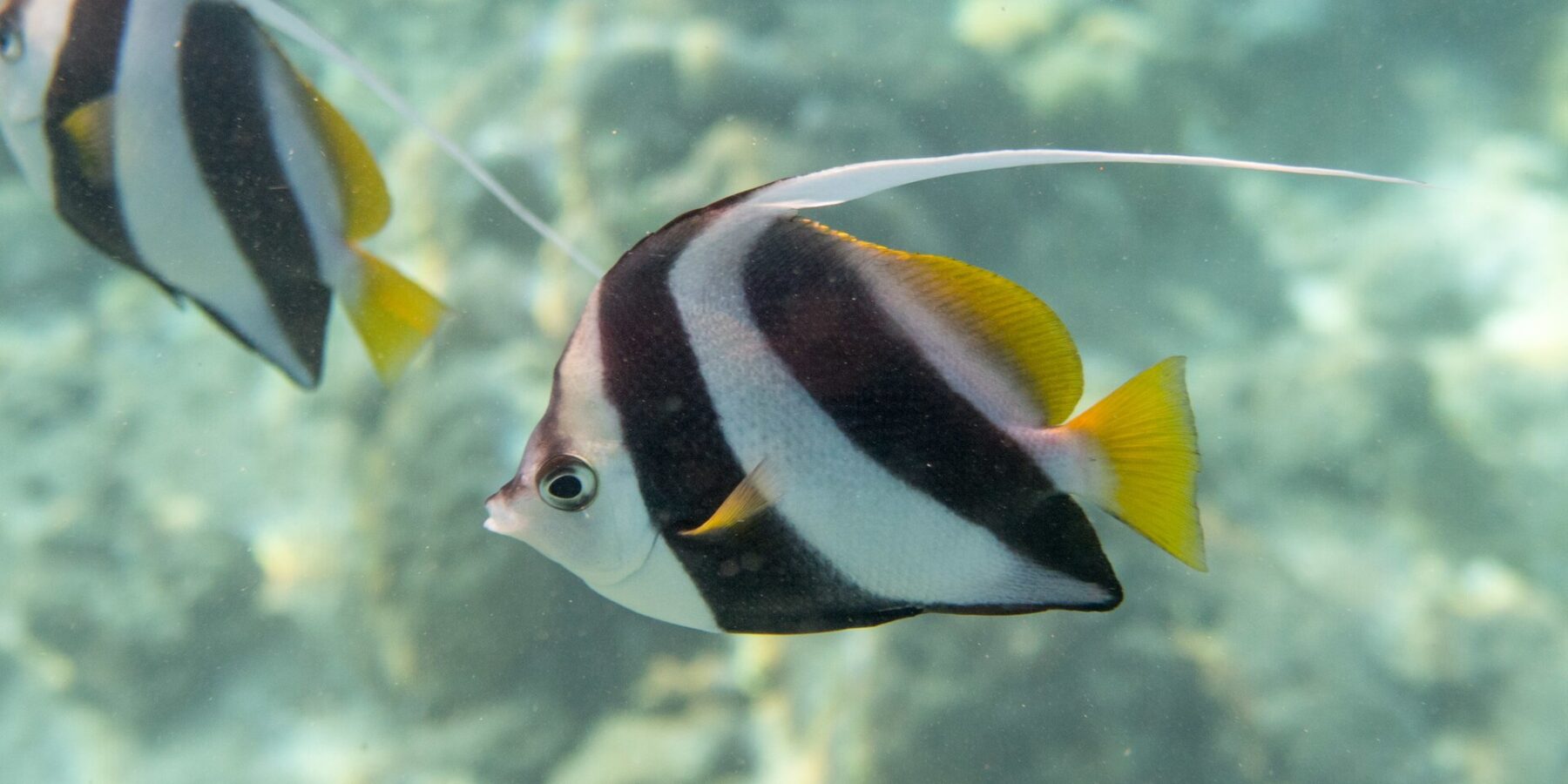
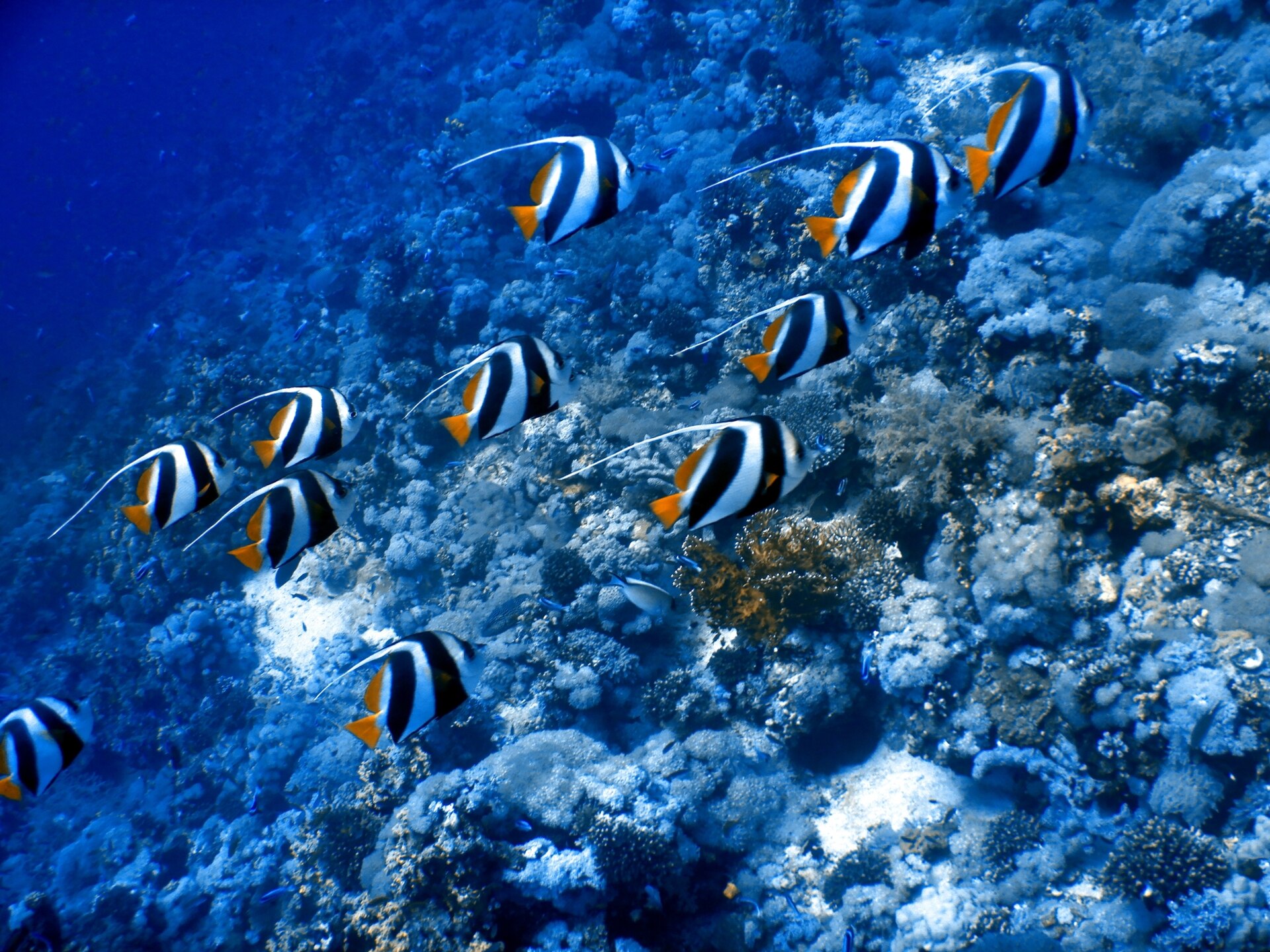
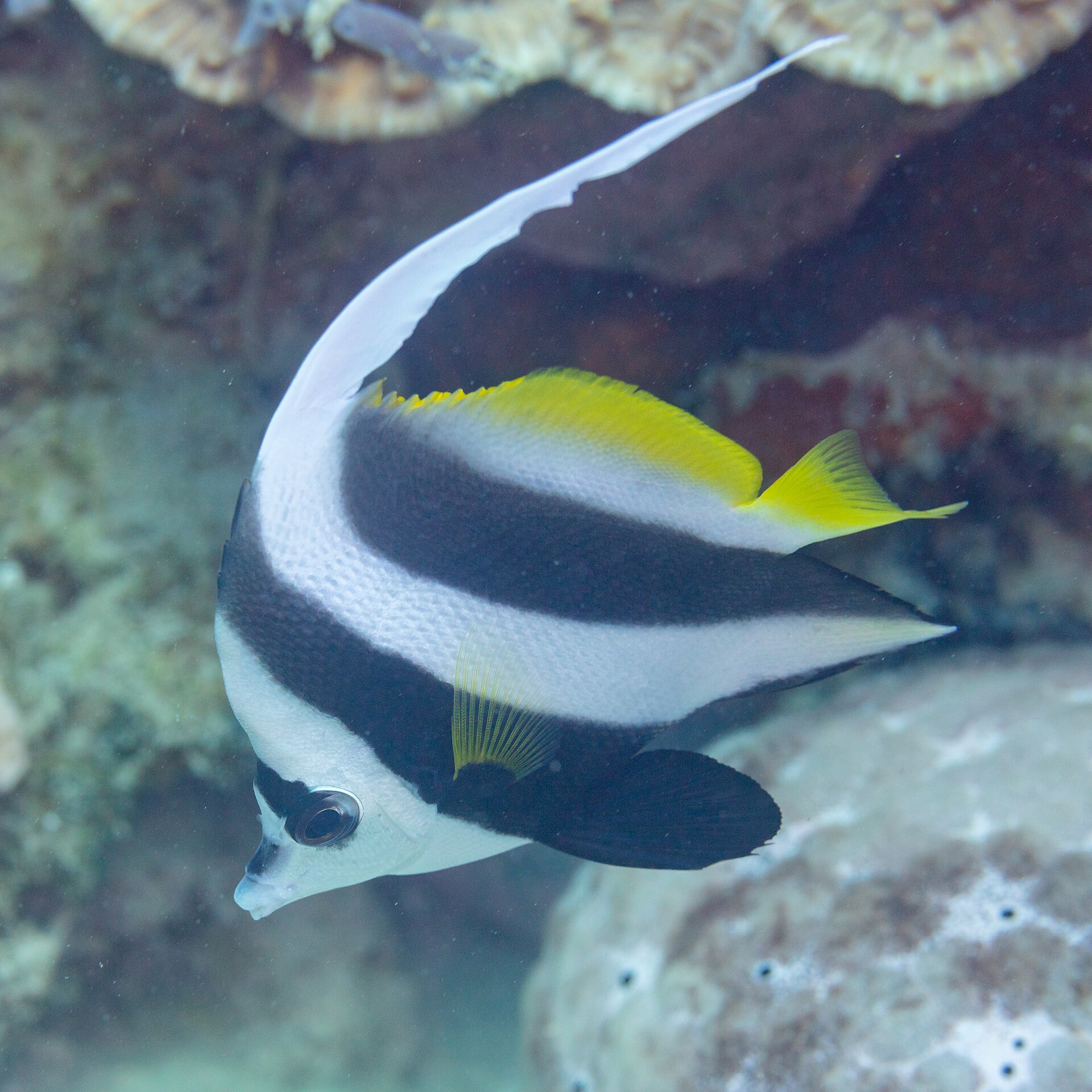
The bannerfish is a white fish with two black bands, yellow fins and a long dorsal filament, often mistaken for a Moorish idol. The schooling bannerfish gathers by the hundreds in the current and the longfin bannerfish lives in pairs near the bottom: Banana Reef, Castle Rock and Crystal Bay show them all year.
Where to dive to see the Bannerfish?
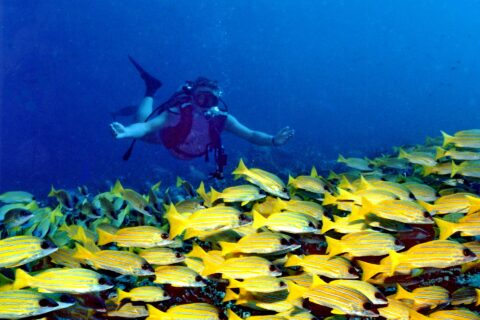
 MaldivesReef
Banana Reef
Malé atollsPeak season all year round: a huge resident school east of the reef, in the current
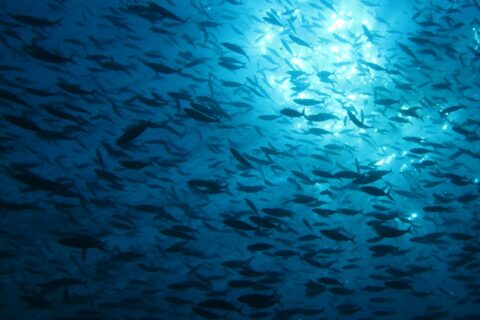
 IndonesiaPelagic
Castle Rock
KomodoPeak season all year round: walls of fish by the thousands, bannerfish around the safety stop
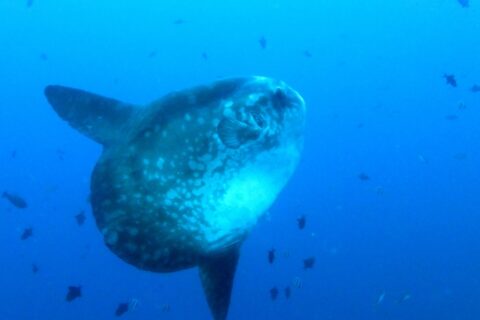 IndonesiaPelagic
Crystal Bay
Bali and Nusa PenidaPeak season all year round: bannerfish clean the molas; tuna, parrotfish, clownfish and scorpionfish on the wall
How do you identify a bannerfish?
The bannerfish is a butterflyfish with a tall, compressed white body crossed by two broad slanting black bands. Behind the second band, the dorsal, tail and pectoral fins are yellow; the head is white with black eyes, and the first rays of the dorsal fin extend into a long white filament, like a coachman's whip. It looks enough like the Moorish idol that the schooling species is also called the false Moorish idol. Two species share the name and look very much alike. The schooling bannerfish, Heniochus diphreutes, measures 18 to 21 centimeters. The longfin bannerfish, or pennant coralfish, Heniochus acuminatus, usually measures 15 centimeters and 25 at most, with a longer snout with dark markings and longer, rounded pelvic fins, where those of the schooling bannerfish are short and angular.
Bannerfish in pictures
How does the bannerfish live?
Both species live throughout the Indo-Pacific, from the Red Sea and East Africa to Polynesia, and from southern Japan to the Great Barrier Reef; the schooling bannerfish ranges as far as Hawaii and the Kermadecs, the longfin bannerfish as far as the Persian Gulf. The schooling bannerfish stays in open water above outer slopes and in passes with current, usually between 5 and 30 meters, sometimes down to 210 meters. It forms schools of a few dozen to several hundred, even several thousand fish, which feed on zooplankton, and both young and adults clean parasites off other fish. The longfin bannerfish prefers the deeper water of sheltered lagoons, passes and outer slopes, from 15 to 75 meters. Adults live in pairs and juveniles alone, and they eat zooplankton, some coral polyps and bottom invertebrates; the young sometimes clean other fish. Both spawn in pairs, in open water.
Where and when can you see bannerfish in the Maldives and Indonesia?
In the Maldives, Banana Reef, in the Malé atolls, is home to a huge resident school on the east side of the reef, in the current, all year. In Indonesia, Castle Rock, in Komodo, shows them all year among walls of fish by the thousands, with bannerfish around the safety stop. At Crystal Bay, in Bali, they clean the sunfish all year, alongside the reef schools of the wall.
How do you tell the two bannerfish species apart?
Both bannerfish are listed as Least Concern on the IUCN Red List; the longfin bannerfish is considered Vulnerable only in the Persian Gulf. They are rarely fished but end up in aquariums, the schooling bannerfish as a cheap Moorish idol, and the longfin bannerfish is also farmed. Underwater, the rule is simple: a school in open water in the current is the schooling bannerfish; a pair near the bottom, a little deeper, is the longfin bannerfish.
Our tip
On your safety stop, stay still in the current: the bannerfish school comes to circle around you and moves off as soon as you fin toward it. To tell the two species apart, look at the snout and the pelvic fins: they are longer and more rounded in the longfin bannerfish, which swims in pairs near the bottom. At Crystal Bay, look for them around the sunfish, which they clean at the cleaning station.