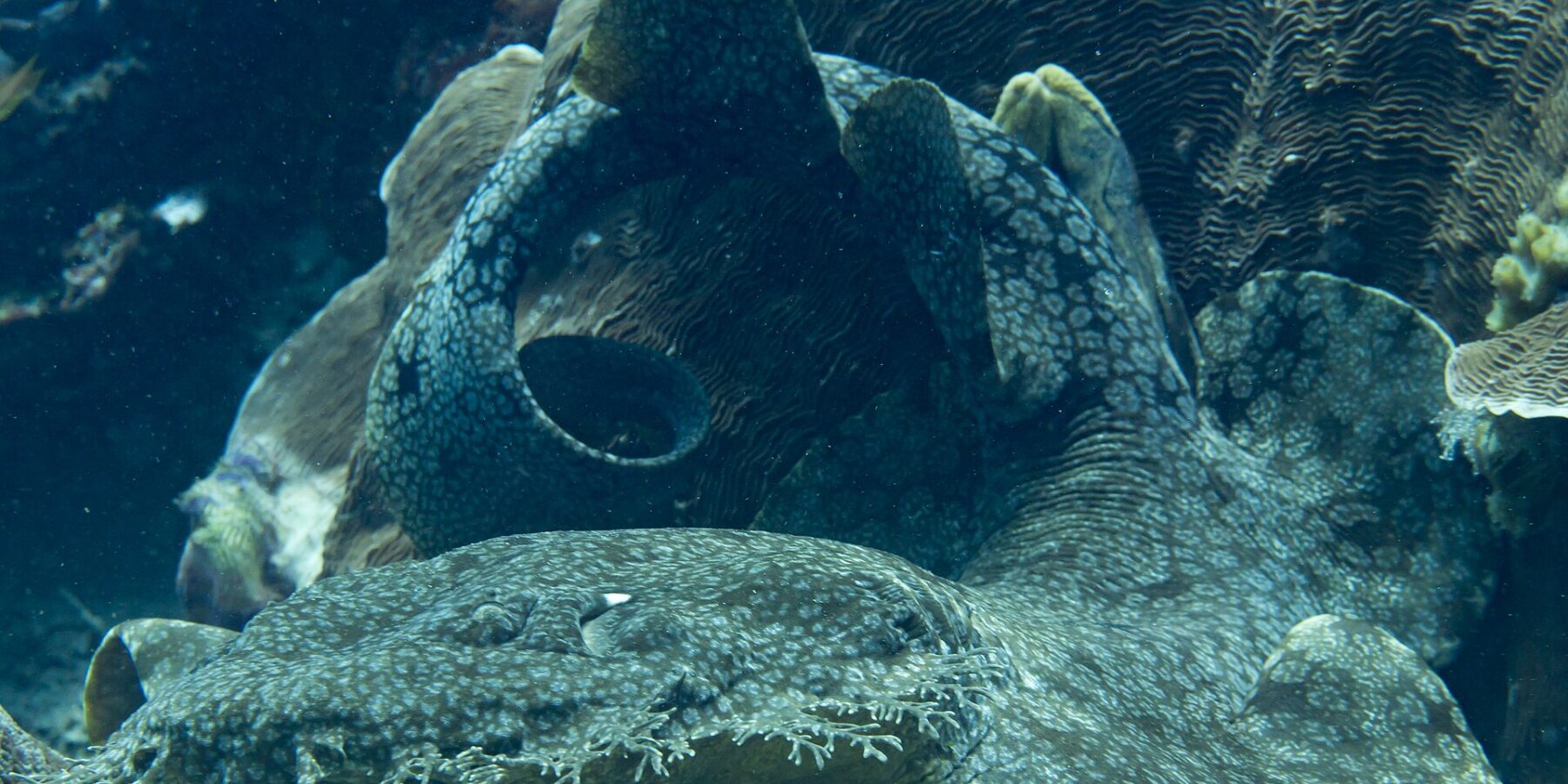
The tasseled wobbegong is flat, 1.80 meters long, and lies under coral tables by day; the fringe of lobes around its head erases its outline. It is one of the most photographed residents of Raja Ampat, from Cape Kri to Misool, and it stays put as long as you do not touch it.
Where to dive to see the tasseled wobbegong?
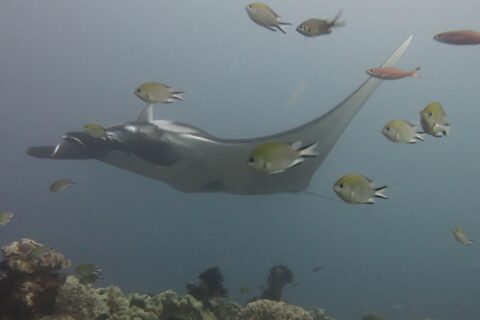
 IndonesiaPelagic
Blue Magic
Raja AmpatPeak season all year round: resident, lying under the table corals and in the hollows of the pinnacle
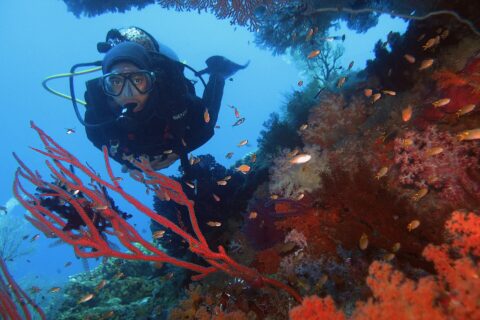 IndonesiaReef
Cape Kri
Raja AmpatPeak season all year round: lying under the table corals on the slope; look for them with your guide
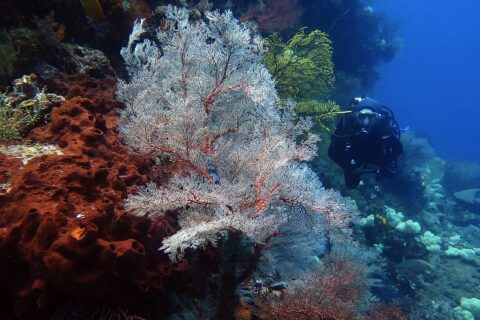 IndonesiaPelagic
Magic Mountain (Misool)
Raja AmpatCan be seen all year round: now and then, lying on the seamount's terraces
How do you identify a tasseled wobbegong?
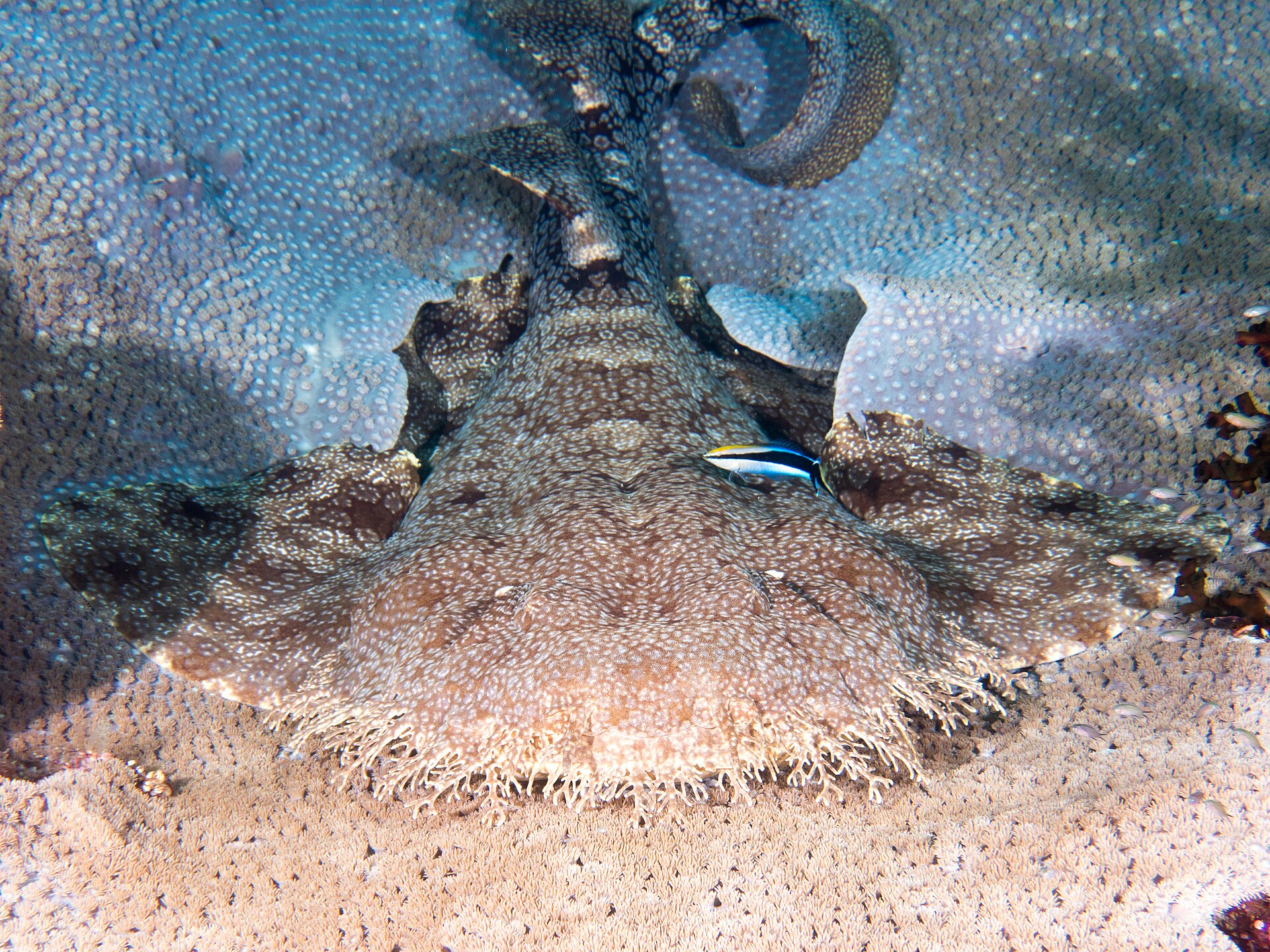
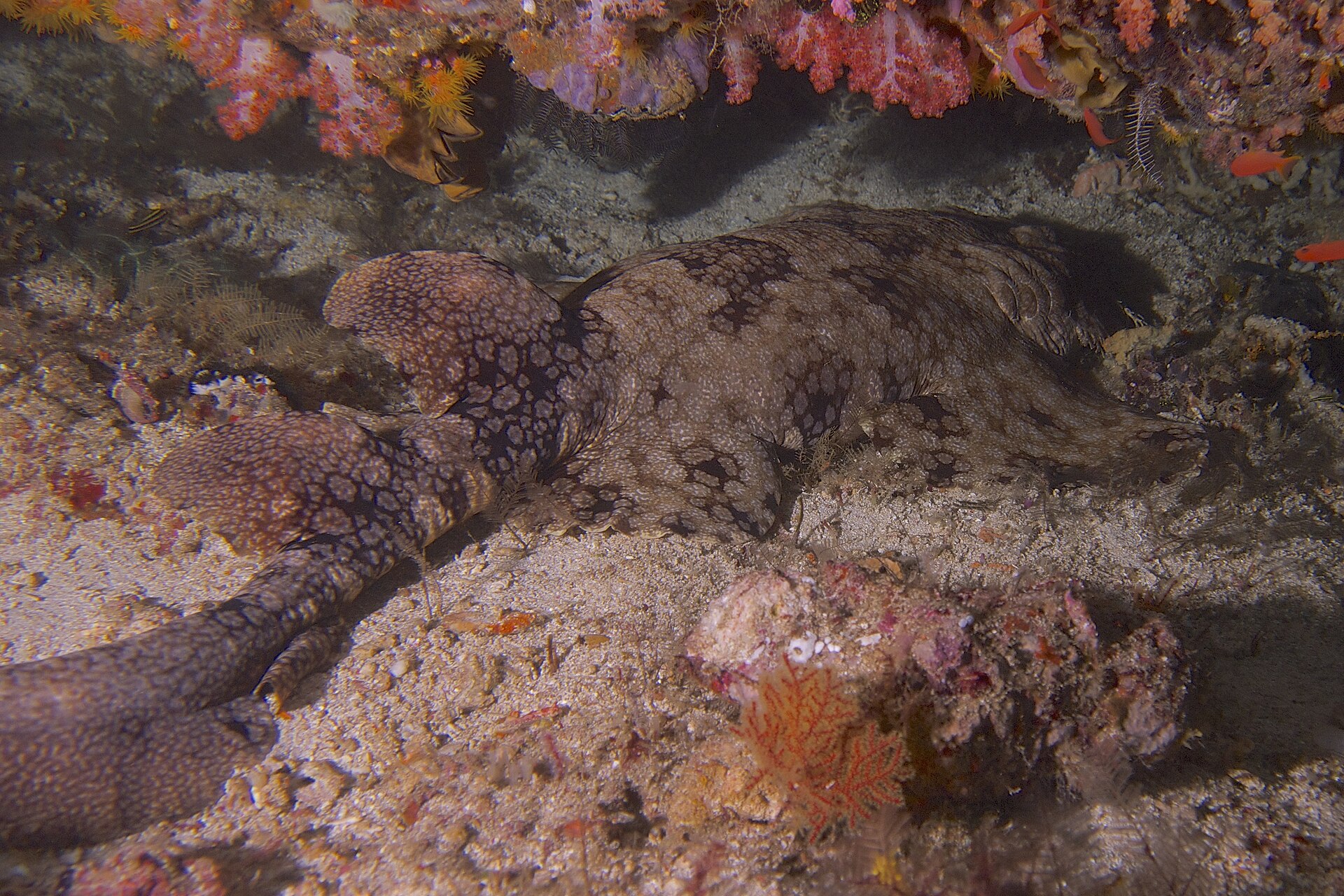
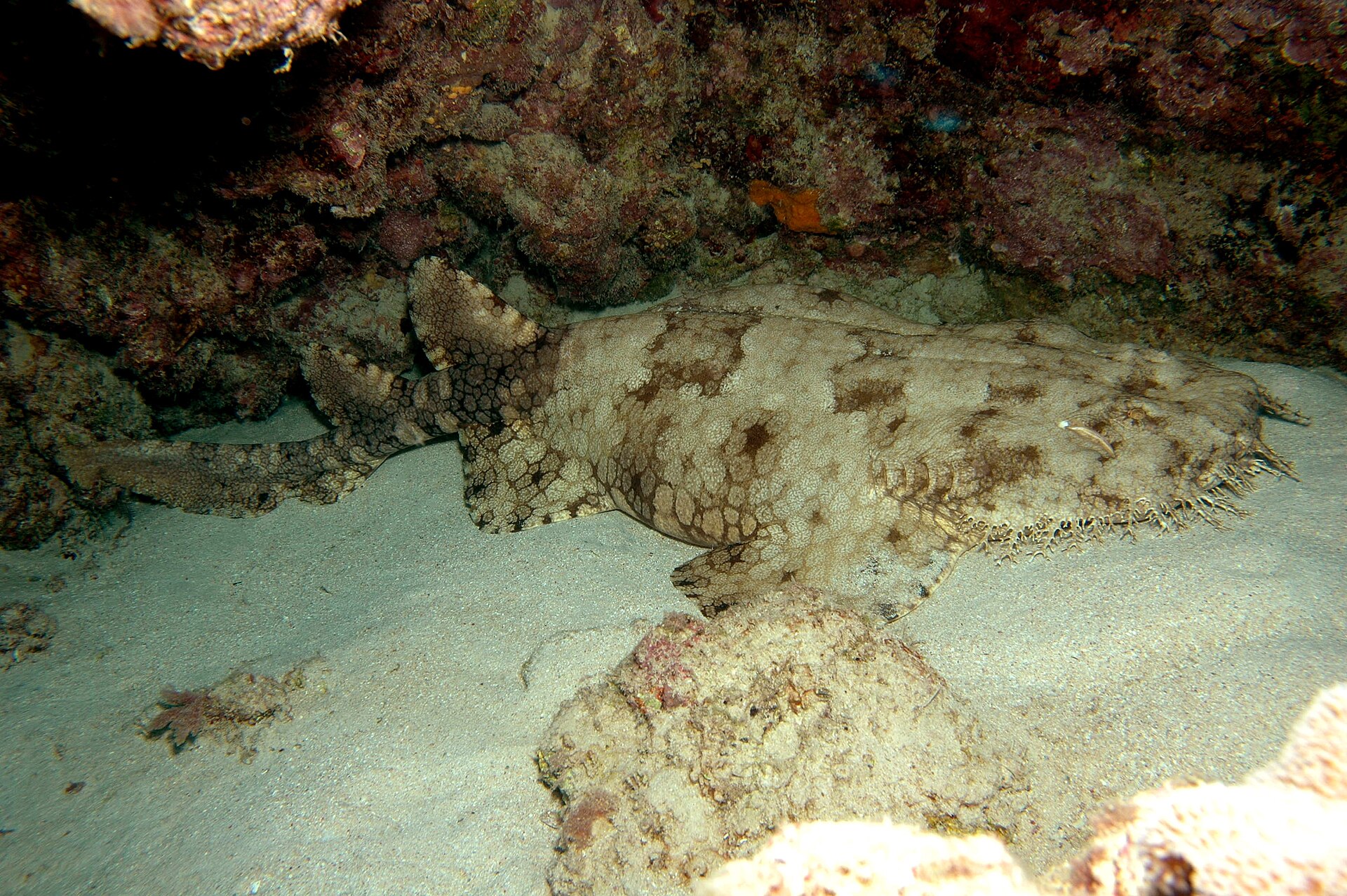
The tasseled wobbegong, also called the bearded wobbegong or bearded carpet shark, is a very broad, flattened shark with a head wider than it is long. Its surest feature is the fringe of branched skin lobes that runs almost without a break from the tip of the snout to the base of the pectorals, with a true beard under the chin; the nostrils carry long barbels. The large mouth opens almost at the front of the head, ahead of the eyes, with slender single-cusped teeth and, in the center, rows of long, fang-like teeth. The pectoral and pelvic fins are broad and rounded, the body narrows quickly behind the pelvics, and the tail is short, with no lower lobe. The back carries a mosaic of small dark spots and lines on a gray or yellowish-brown background, sometimes crossed by darker bands, which continues under the tail; the belly is white. It reaches 1.80 meters; the old record of 3.70 meters is considered an error. People confuse it with the other wobbegongs, but none has such a continuous fringe or such a broad head.
Tasseled wobbegong in pictures
How does the tasseled wobbegong live?
The tasseled wobbegong lives on the shallow coral reefs of northern Australia, from Ningaloo to Bundaberg, New Guinea, Waigeo and the Aru Islands. It is the wobbegong of Indonesian waters: Pieter Bleeker described it in 1867 from two specimens caught at Waigeo and Aru, under a Greek name meaning shaggy beard. Solitary, it spends the day lying in a cave, under an overhang or a coral table, tail folded, and returns to the same resting spots; each individual holds a small territory. It is an ambush hunter: motionless, it snaps up fish and invertebrates that come within reach, and it waves the tip of its tail to mimic a small fish and lure the curious. At night, it comes out and hunts actively. It is viviparous without a placenta, and the rest of its biology is poorly known. Only one fatal unprovoked bite is on record, in 1940; accidents come from hands or feet placed too close to its mouth.
Where and when can you see tasseled wobbegongs in Indonesia?
Raja Ampat is the best place in the world to see it, all year round. In the Dampier Strait, it sleeps under the coral tables on the slope of Cape Kri and in the hollows of the Blue Magic pinnacle, where you often find two or three per dive. Among the Misool sites, Magic Mountain sometimes shelters one on its steps, and the soft coral walls of Fiabacet or Boo hide others. The guides at the Kri resorts know its resting spots and show them from the first dive. Photograph it head-on, its fringe spread over the coral, or from above for the mosaic of its back; it stays put as long as you do not touch it. The same reef is home to its endemic cousin, the Raja Ampat walking shark, which you mostly see at night.
Is the tasseled wobbegong threatened?
Listed as Near Threatened in 2003, the tasseled wobbegong moved to Least Concern in the 2015 assessment, and the 2024 assessment confirmed that status. In Australia, it is common and little fished. Outside Australia, in Indonesia and New Guinea, it suffers from reef fishing and coral degradation, and the protection of marine parks, led by Raja Ampat's, is what secures its resting spots. For divers, the rule is short: look, do not touch, and never slide a hand under a coral table without looking first.
Our tip
Look under coral tables and in hollows on the slope: that is where it spends the day, tail folded. Approach it from the side or from the front, to within a meter, without blocking its exit or touching it: it does not move, but its mouth is wide and its teeth long. For photos, a wide-angle lens and a soft light are enough; it does not flee a calm diver.