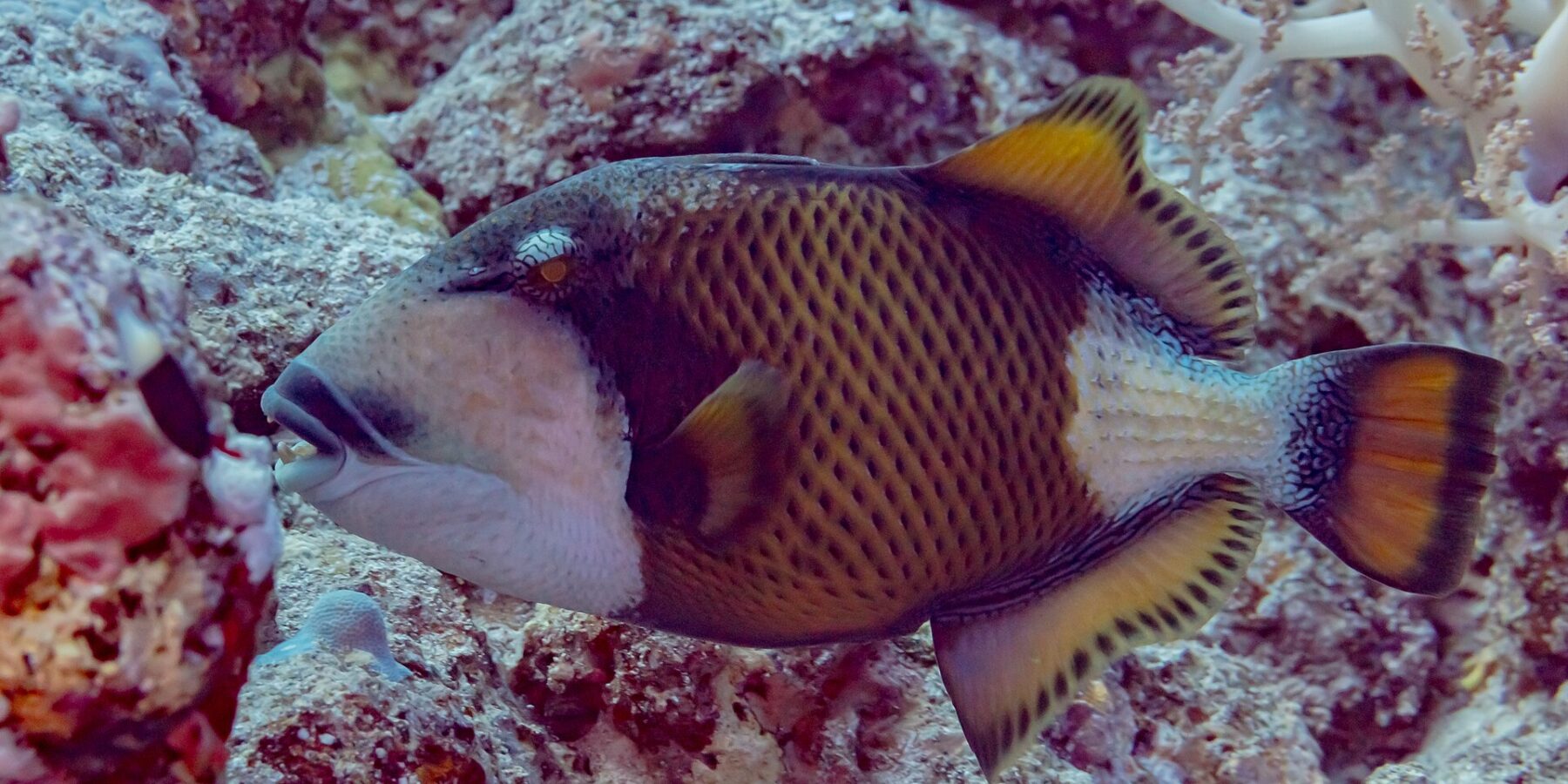
The titan triggerfish is the largest triggerfish on Indo-Pacific reefs, up to 75 centimeters, with its black mustache and dark mask. During nesting, the female defends her nest with her teeth against any diver: at Balicasag from May to July, as at Chumphon Pinnacle, give it a wide berth.
Where to dive to see the Titan triggerfish?
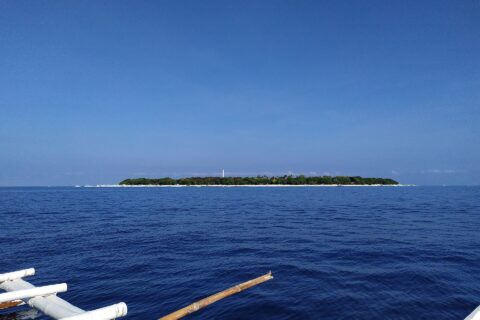
 PhilippinesReef
Balicasag Island
Visayas: Cebu, Bohol and NegrosPeak season from May to July: on their nests at Black Forest from May to July: give them a wide berth
 ThailandPelagic
Chumphon Pinnacle
Gulf of Thailand: Koh TaoPeak season all year round: territorial on the plateaus, swim around them
How do you identify a titan triggerfish?
The titan triggerfish, also called the moustache triggerfish or giant triggerfish, is the largest triggerfish on Indo-Pacific reefs: up to 75 centimeters. Its oval, sturdy body carries a large head, about a third of its length, and a small mouth armed with powerful teeth. Three marks give it away: a black mustache above the upper lip, a wide dark mask that covers the eye area and runs down toward the pectoral fins, and an olive-yellow body whose dark-edged scales draw a net pattern. The throat and the base of the tail are pale, and the orange fins are edged in dark. Like all triggerfish, it can raise and lock its first dorsal spine, the trigger that gave the family its name. Juveniles are whitish to beige, dotted with black spots.
Titan triggerfish in pictures


How do titan triggerfish live?
The titan triggerfish lives in lagoons, on outer slopes and inside passes, from the surface to 50 or 60 meters. Adults move alone or in pairs; juveniles shelter in coral rubble and clumps of branching coral in shallow, sheltered lagoons. It feeds on the bottom, on sea urchins, crabs and other crustaceans, mollusks, tube worms and coral: it flips over blocks, digs through the sand and breaks off coral branches to reach its prey, and it also attacks the crown-of-thorns starfish, the coral-eating sea star. It ranges from the Red Sea and East Africa to the Line Islands and the Tuamotus, and from southern Japan to northern Australia; it is absent from Hawaii. The IUCN lists it as Least Concern.
Where and when can you see titan triggerfish?
In the Philippines, you come across the titan triggerfish year-round around Balicasag Island, in the Visayas, but the season that matters is nesting season: from May to July, titan triggerfish nest at Black Forest, the black coral wall, and defend their nests with their teeth; a wide half-circle keeps you clear of them. In Thailand, at Chumphon Pinnacle, off Koh Tao, they guard their nests on the plateaus year-round: swing wide around them without facing them, and only photograph them from afar, because they charge when you get close to the nest.
Is the titan triggerfish dangerous?
The titan triggerfish can attack a diver unprovoked. During the breeding season, about one week a month, the female guards her eggs in a crater-shaped nest dug into flat sand, and she defends the whole water column above it: her territory is a cone that widens toward the surface. She charges any swimmer or diver who enters it and chases them a long way, biting if she has to. The bite is not venomous, but her teeth, built to crush sea urchins, open deep, painful wounds that sometimes need stitches. If she charges, swim away horizontally while keeping an eye on her, and never toward the surface, which is still inside the cone.
Our tip
Look for the sand crater at the foot of the reef and the triggerfish circling above it: that is a nest, and you go around it from a distance. If it charges you, swim away horizontally and never up, because its territory is a cone that widens above the nest. Photograph it from afar, and never by moving toward the nest.