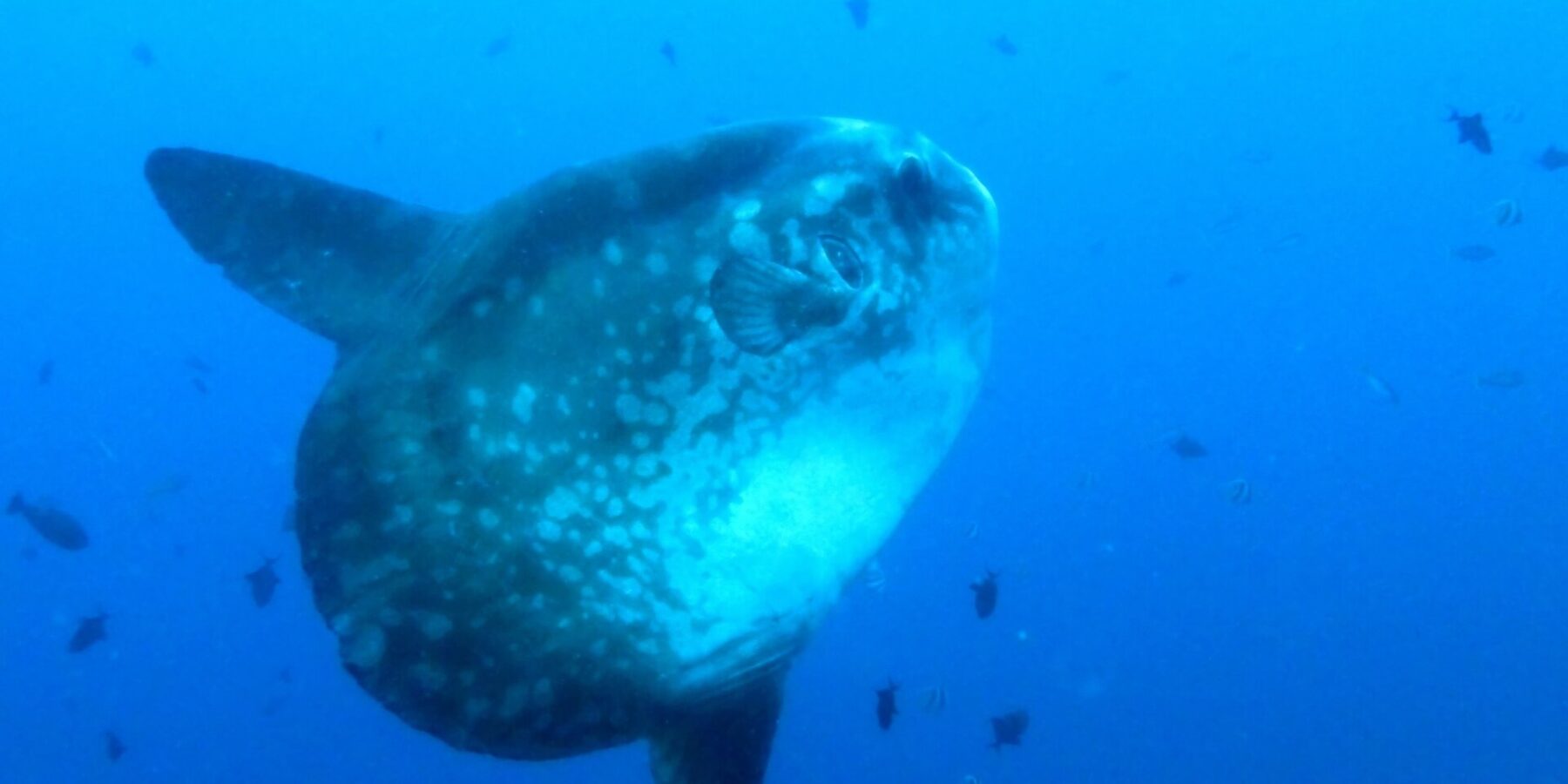
The giant sunfish is the heaviest bony fish in the world: its disk-shaped body can top three meters and two tons. In Bali, from July to October, cold upwellings bring it to the cleaning stations of Nusa Penida, and Crystal Bay is the most reliable site to see it.
Where to dive to see the giant sunfish?
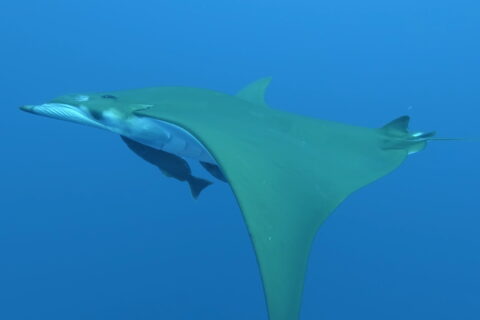
 AzoresPelagic
Ambrósio
Santa MariaCan be seen all year round: in open water or near the bottom, passing through
 AzoresReef
Baixa do Sul
Pico and FaialCan be seen all year round: passing over the platforms
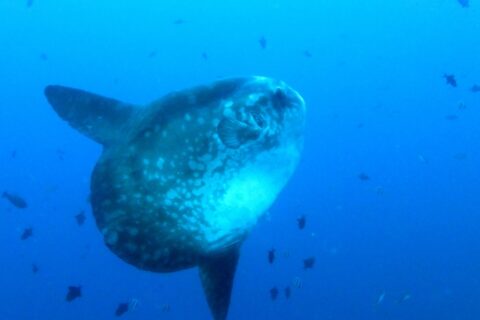
 IndonesiaPelagic
Crystal Bay
Bali and Nusa PenidaPeak season from July to October: at the cleaning stations on the wall, between 18 and 30 m, when the cold water wells up; best in August and September
How do you identify a giant sunfish?
You recognize the sunfish at first glance: a flat, almost round body, compressed on the sides, with no tail fin. At the back, a clavus, a rounded band of fin, serves as a rudder; above and below, a tall triangular dorsal fin and anal fin beat together to drive it forward. The mouth is small, the teeth fused into a parrot-like beak, the pectoral fins tiny and round. The thick, rough skin is brown or gray with pale spots, over a layer of white gelatin several centimeters thick. The Bali mola is Mola alexandrini, the bump-head sunfish, long called Mola ramsayi: a bump on the forehead, another under the chin, rectangular scales and a clavus with a rounded edge set it apart from Mola mola, the ocean sunfish of temperate seas. It is the heaviest bony fish: up to 3.3 meters and 2,700 kilos, with a record of 2,744 kilos for 3.25 meters, weighed on an animal stranded on Faial, in the Azores, in 2021.
How does the giant sunfish live?
Mola alexandrini lives in all tropical and temperate seas outside the polar regions, mostly in the Southern Hemisphere, offshore, from the surface to great depths. It prefers cool water, between 17 and 25 °C, and dives deep to hunt before coming back up to warm itself; you then see it lying on its side at the surface, where birds pick off its parasites. Underwater, it does the same at reef cleaning stations, where bannerfish and wrasses remove the crustaceans that cover its skin. It follows the seasons and the cold-water fronts, moving north in summer off Japan, and the same movement brings it close to Bali during the southern winter. It swims slowly but effortlessly, and vanishes toward the depths in a few fin strokes as soon as it feels pressured.
Where and when can you see giant sunfish in Bali?
From July to October, the cold upwellings that wash over Nusa Penida drop the water temperature from 28 to 18 or 20 °C, and the molas rise to be cleaned at the island's reef stations, between 18 and 30 meters. Crystal Bay, on the west coast, is the most reliable site, with a peak in August and September; Blue Corner, the north coast of Penida, Toyapakeh and Pura Ped also produce sightings, and Manta Point sees them pass from time to time. The dive centers of Nusa Penida and Lembongan, which dive there every day, know where they are. The encounter lasts a few minutes, sometimes a quarter of an hour if the group stays low and still. Nothing is guaranteed, and two or three mornings on site are better than a single day trip from Bali. The cold water, thermoclines and down currents of the site make this an Advanced dive.
What are the rules for diving with giant sunfish?
Mola alexandrini does not yet have its own IUCN status; its cousin Mola mola is listed as Vulnerable because of longline bycatch, and both species are among the high-risk catches of eastern Australian fisheries. Indonesia's marine affairs ministry has placed the sunfish under a protection plan, and since 2016 the Nusa Penida marine protected area has enforced a stricter code of conduct that dive centers have divers sign: slow approach, a one-minute wait when it arrives at the station, 3 meters' distance while it is being cleaned, 10 meters if it is swimming, never above it, no flash, no contact, and boats staying 10 meters from the divers' safety-stop buoys. A disturbed mola heads back to the depths, and the next divers will not see it.
Our tip
Wait until it has been at the cleaning station for a minute before approaching, slowly, within its field of view, and stay 3 meters away, 10 if it is swimming. Never pass above it or between it and the bottom: that is its escape route, and it will not come back. Flash off, hands to yourself, and wear a 5-millimeter wetsuit, because you wait in water at 18 °C.