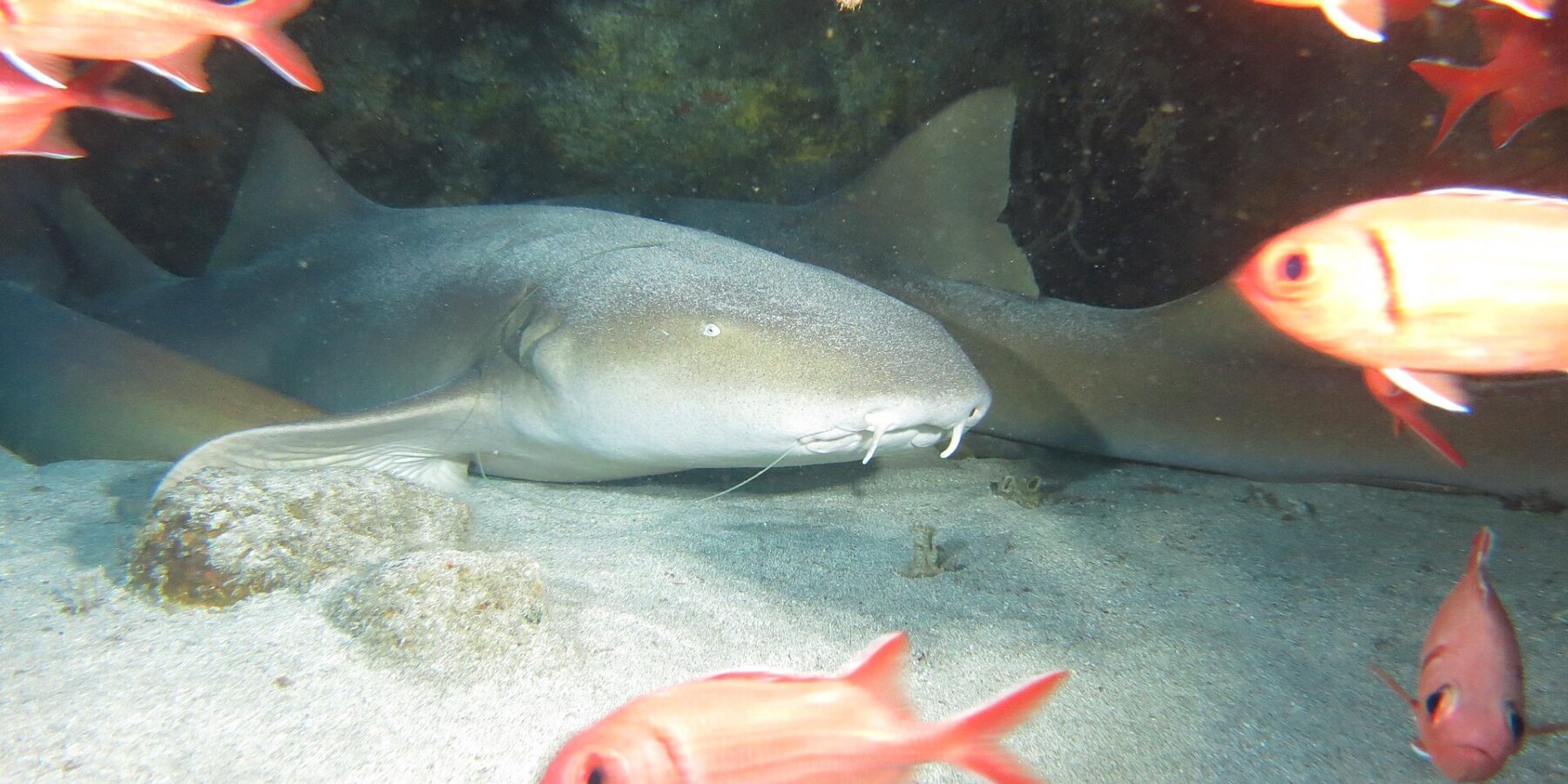
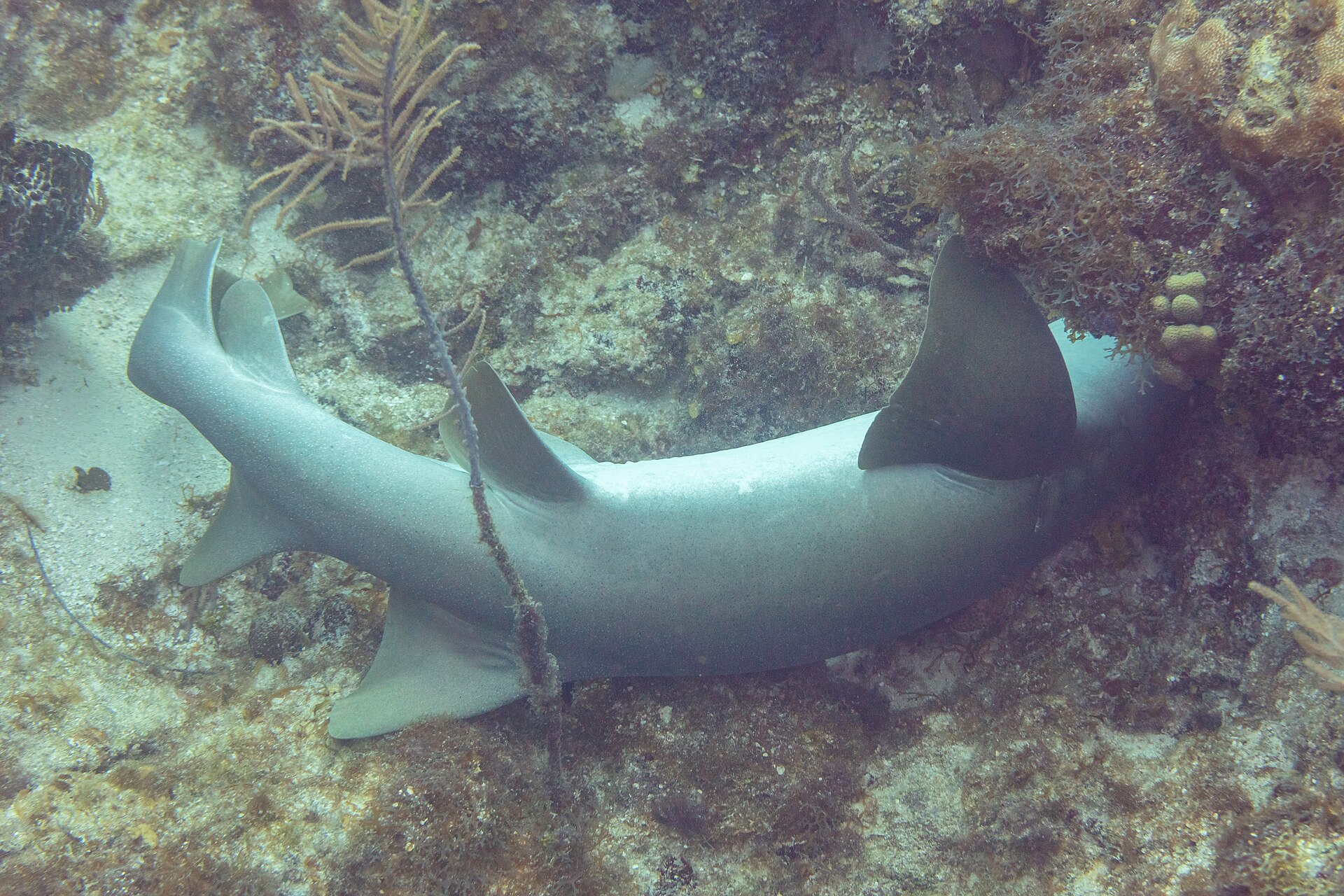
The nurse shark, plain brown with barbels, lives on the bottom in the Caribbean: it sleeps under overhangs by day and hunts in the holes of the reef at night. In Cozumel, you find it asleep in the Palancar caves or on Santa Rosa Wall; placid as long as you leave it alone, it is listed as Vulnerable.
Where to dive to see the nurse shark?
 MexicoReef
Palancar Reef
Yucatán and the Caribbean: Cozumel, cenotes, Playa del CarmenCan be seen all year round: asleep under the overhangs of Caves and Bricks
 MexicoWall
Santa Rosa Wall
Yucatán and the Caribbean: Cozumel, cenotes, Playa del CarmenCan be seen all year round: asleep on a ledge, now and then
How do you identify a nurse shark?
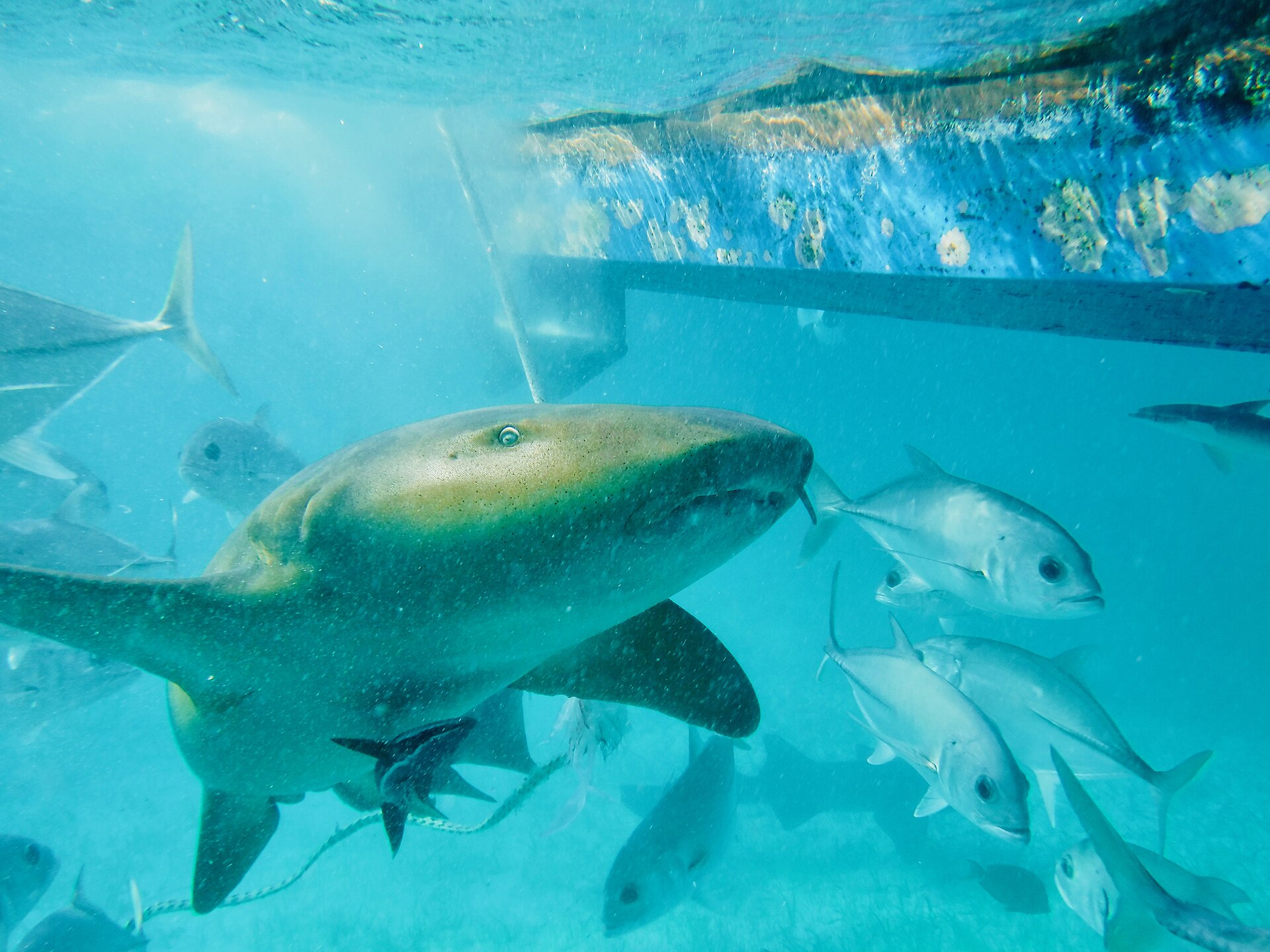
The nurse shark is a massive, heavy shark with a slightly flattened body, commonly 2.30 to 2.40 meters long and over 90 kg. The largest individual measured was 3.08 meters and the heaviest weighed nearly 110 kg, though lengths of 4.30 meters have been claimed. The color is plain, from beige to dark brown, sometimes with small dark spots; newborns are spotted with black, and the spots fade with age. The head is broad and flat, and the small mouth sits well ahead of the eyes, framed by two fairly long barbels that reach it. The eyes are tiny, each with a spiracle behind it. The two dorsal fins are rounded and spineless, the first clearly larger than the second. The pectorals are broad and rounded, and the long tail, over a quarter of the total length, has no distinct lower lobe. Its Indo-Pacific cousin, the tawny nurse shark, looks very similar, but the two never meet: in the Red Sea or the Maldives, you see the tawny; in the Caribbean, you see this one.
Nurse shark in pictures
How does the nurse shark live?
This is the Atlantic nurse shark: from Rhode Island to southern Brazil in the west, including the Caribbean, Florida and the Keys, where it is very common in shallow water, and from Cape Verde to Gabon in the east. It lives on the bottom near the coast, on coral reefs and rocky ground, from the surface to 130 meters, but mostly between 1 and 35 meters. Juveniles grow up on shallow reefs, seagrass beds and mangroves, between 1 and 4 meters; adults live on deeper reefs. It is nocturnal: by day it rests on sand or in a cave, often with others, sometimes in groups of forty packed tightly together, and it keeps coming back to the same hideouts. At night it searches the bottom: its wide pharynx sucks in fish, rays, octopus, squid, shellfish, spiny lobsters, shrimp, crabs and sea urchins in one go. It is ovoviviparous: after five to six months of gestation, the female gives birth to 20 to 30 pups of 27 to 30 centimeters, every two years. Males mature at about 2.10 meters and 10 to 15 years, females at about 2.30 meters and 15 to 20 years, and it lives at least 25 years.
Where and when can you see nurse sharks in Cozumel?
Among our dive sites, Cozumel is where you will meet it, all year round with no marked season: asleep under the overhangs of Caves and Bricks, on Palancar Reef, or now and then on a ledge of Santa Rosa Wall. Look for it by day, resting on the bottom in the shelter of an overhang, and leave it there.
Is the nurse shark threatened?
The nurse shark is listed as Vulnerable on the IUCN Red List. It is fished for its liver oil, for its skin, which makes quality leather, and for its meat and fins, notably in Panama, Brazil, Venezuela and the Caribbean, and its numbers have dropped over the last few decades; it is doing better in the United States and the Bahamas. It is not aggressive, but bites are known, on swimmers and divers alike, and their number has grown with the feedings organized for tourists. Its grip is a vise, and its jaws, once closed, sometimes only open with surgical instruments. A nurse shark you do not touch, pull or feed harms no one.
Our tip
Let it sleep: watch it from the side, at a distance, without touching it, pulling its tail or blocking the exit of its cave. Its bite is a vise grip that does not let go, and it bites when disturbed or fed. On a night dive, light it from an angle, never in the eyes, and let it pass.