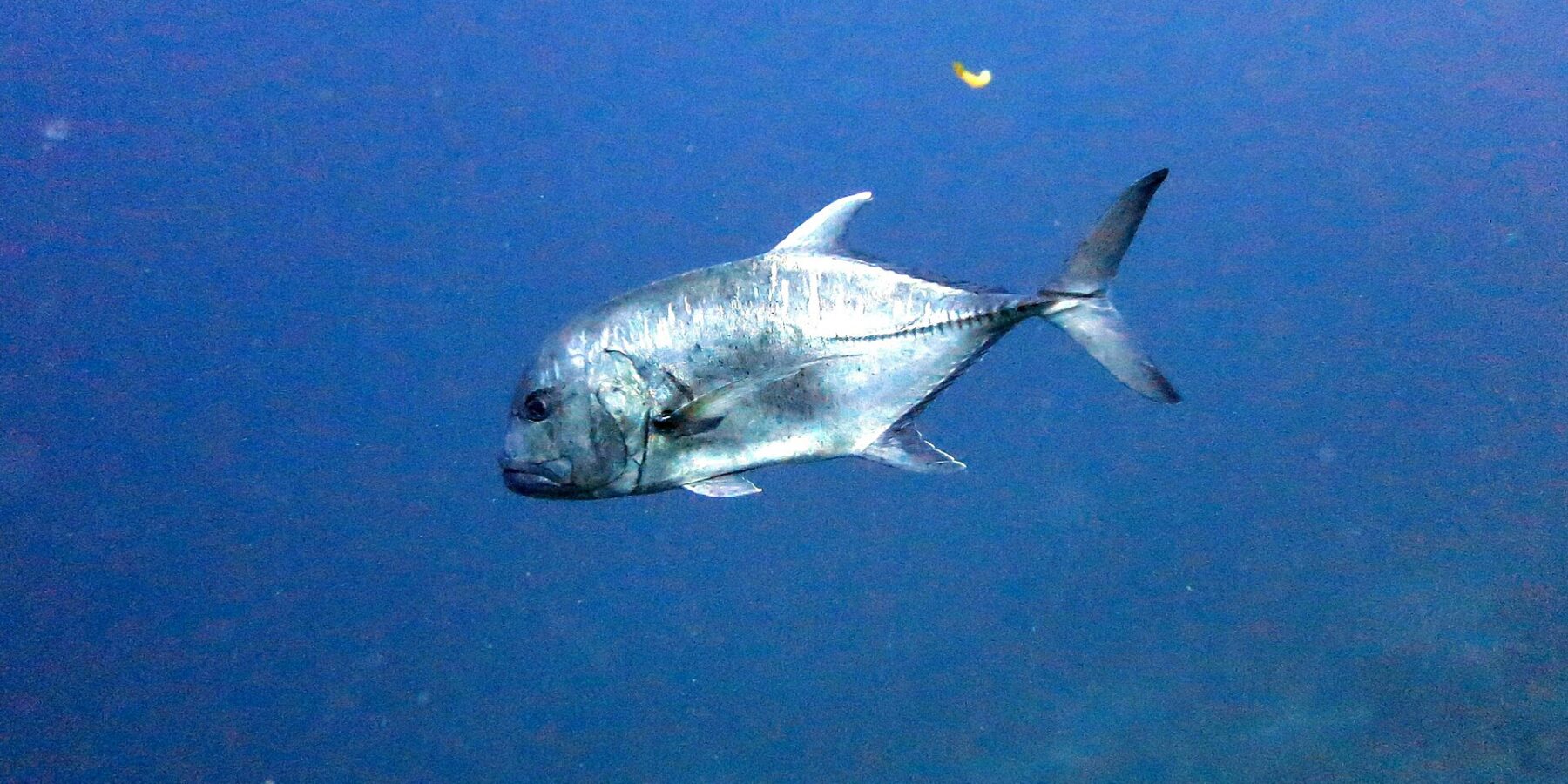
The giant trevally, or GT, is a large Indo-Pacific reef predator with a steep forehead that reaches 1.70 meters and 80 kilos. On our dive sites, it hunts in the current at Batu Bolong and Castle Rock, Kuda Rah Thila, Banana Reef or Chumphon Pinnacle, and in the blue off Ras Mohammed.
Where to dive to see the giant trevally?
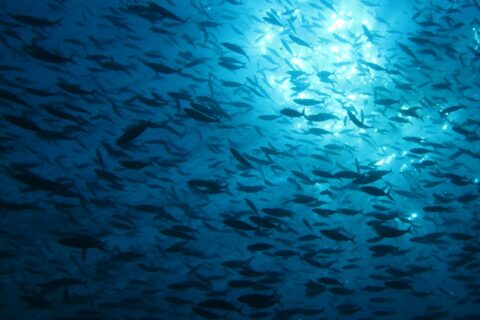
 IndonesiaPelagic
Castle Rock
KomodoPeak season from April to November: tornadoes of bigeye trevally that block out the light, giant trevally hunting through the fusiliers
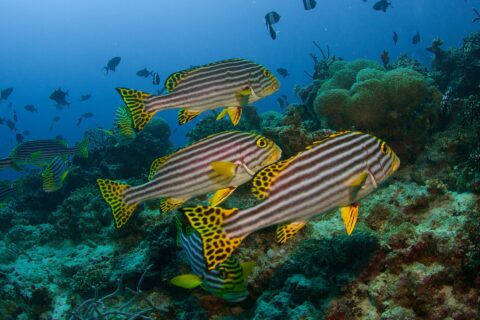
 MaldivesReef
Kuda Rah Thila
Ari and Rasdhoo atollsPeak season all year round: hunting in the current, off the arch
How do you identify a giant trevally?
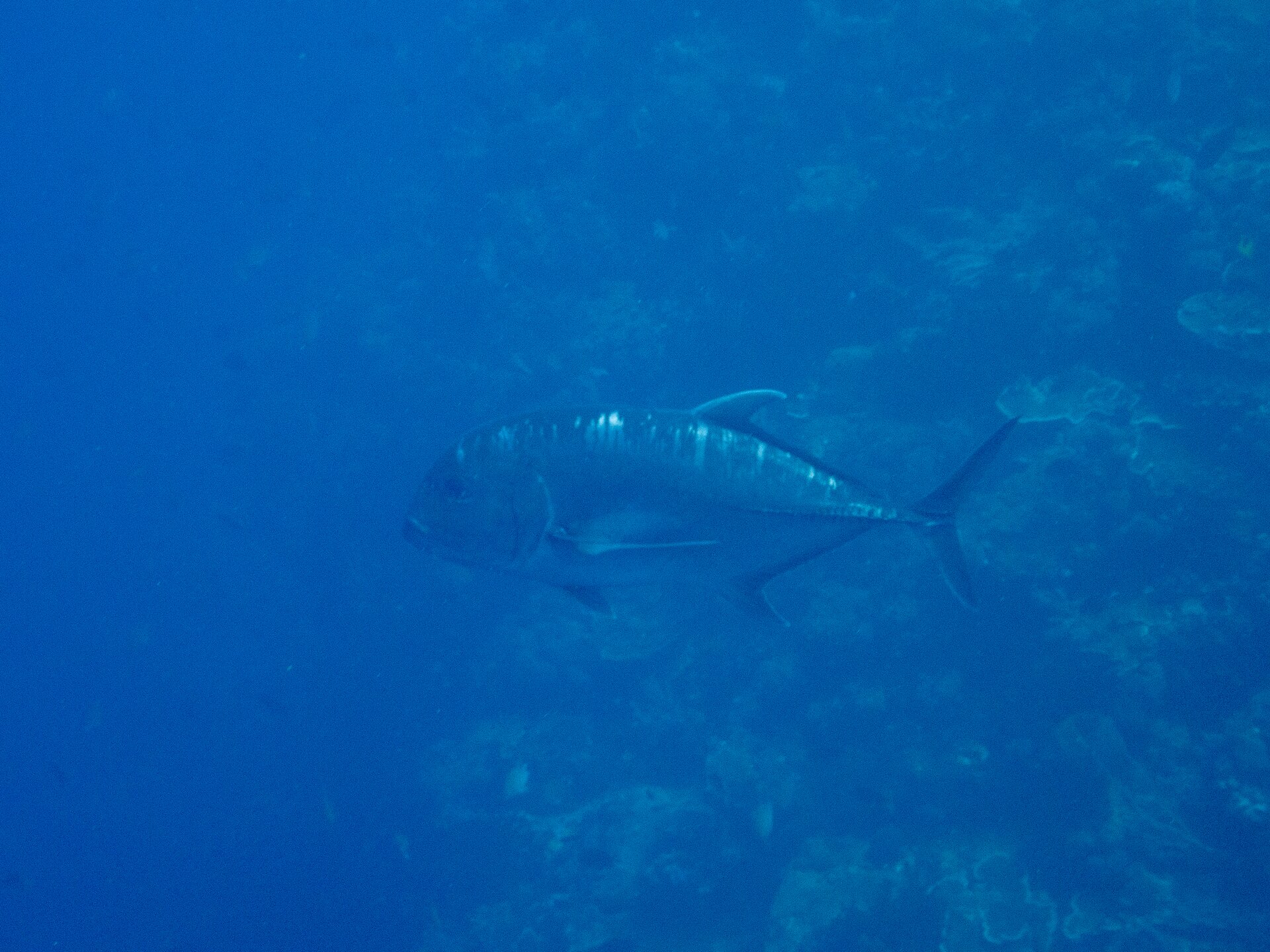
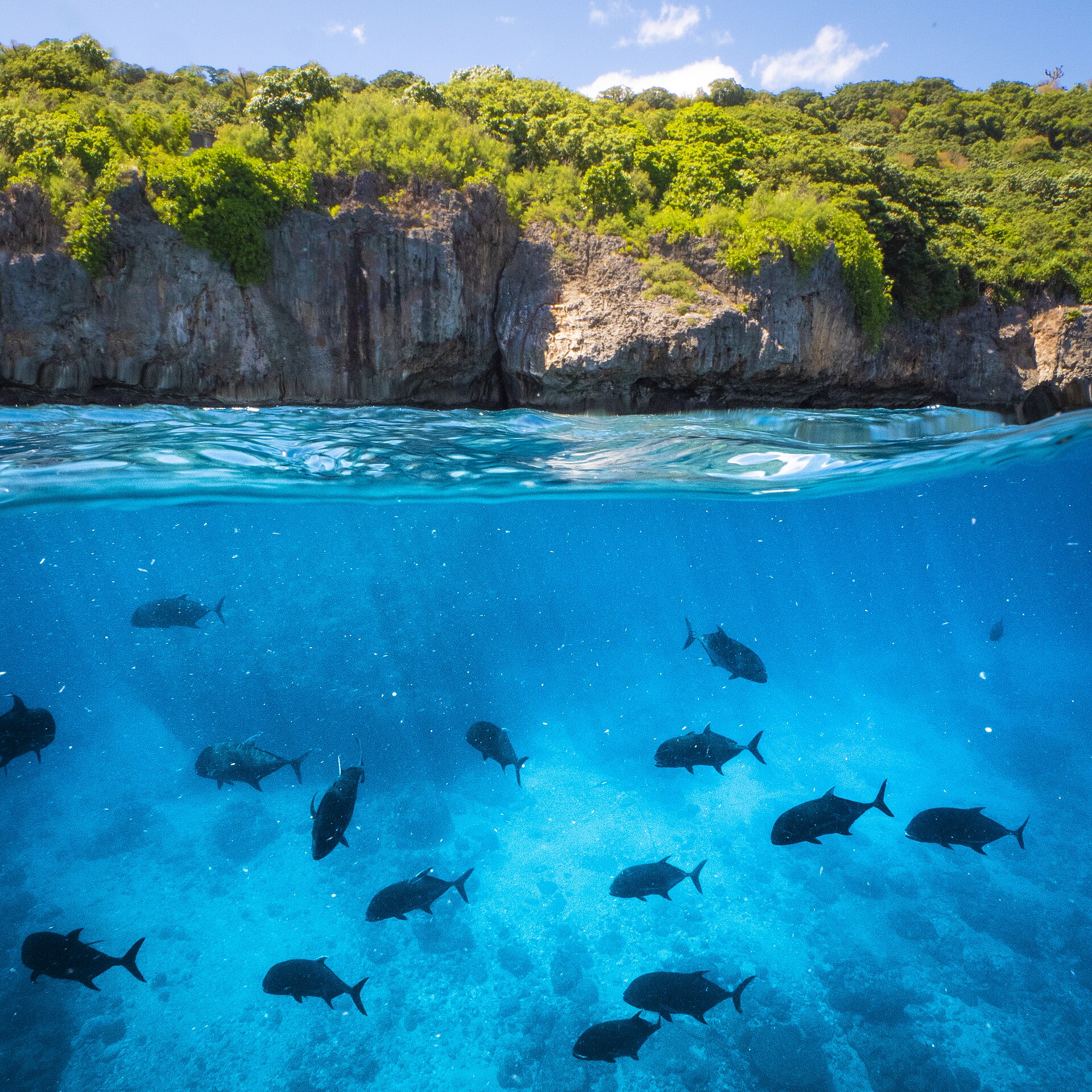
The giant trevally, known to divers and anglers as the GT, is a massive jack that averages one meter and reaches 1.70 meters and 80 kilos. Its very steep head profile gives it a characteristic rounded forehead. It is silvery to dark gray on the back, paler below, with gray to black fins, and males sometimes turn entirely black at maturity. Unlike the bigeye trevally, it has no black spot on the edge of the gill cover. A row of thick scales, the scutes, armors the rear flank down to the forked tail, and the chest is bare, except for a small patch of scales in front of the pelvic fins.
Giant trevally in pictures
How do giant trevally live?
The giant trevally lives throughout the tropical Indo-Pacific, from the Red Sea and East Africa to Hawaii and the Marquesas, and from southern Japan to northern Australia. Juveniles grow up in schools in estuaries, shallow bays and lagoons; adults move to outer reefs, lagoon slopes and atolls, from the surface to nearly 200 meters, and hunt alone or in pairs once they pass 80 centimeters. It feeds mainly on fish, but also on crustaceans such as crabs and spiny lobsters, cephalopods and mollusks, and hunts mostly at dawn and dusk. An opportunist, it follows Hawaiian monk seals to grab the prey they flush out, and leaps out of the water to catch terns. It spawns in large aggregations above the reefs, at specific phases of the moon.
Where and when can you see giant trevally?
The giant trevally appears on ten of our dive sites, most often hunting. In Komodo National Park, it hunts in the current at the corners of Batu Bolong and swoops on the fusiliers at Castle Rock, especially from April to November; in Raja Ampat, Cape Kri and Blue Magic count it among the hunters of the current. In the Maldives, it works the schools of fusiliers year-round off the arch of Kuda Rah Thila, with dogtooth tuna, and hunts in the current at Banana Reef with great barracuda. In Thailand, Chumphon Pinnacle is the best site on Koh Tao to see it, from January to October, hunting through the fusiliers on the edges of the pinnacle and around the satellite pinnacles. In the Philippines, it patrols the walls of Tubbataha, on the south side of the North Atoll, from March to June and especially in April and May. In the Red Sea, it hunts in the blue at Shark and Yolanda Reef, at Ras Mohammed, especially from May to October; in Tanzania, it is one of the hunters on the Leven Bank plateau.
Is the giant trevally endangered?
The giant trevally is listed as Least Concern on the IUCN Red List. It is a highly prized sport fish, and it is also caught for its flesh, which can nonetheless carry ciguatera, especially in very large fish. For divers, it remains harmless, but its bulk commands respect: a spearfisher rammed by a giant trevally came away with three broken ribs.
Our tip
Position yourself at the corners of the reef, where the current concentrates the schools of fusiliers: that is where it hunts. Stay tucked against the rock, without finning toward it: by staying still, you get to see it swoop on the schools. Don't feed it and don't hold anything out to it: at this size, a charging trevally can injure.