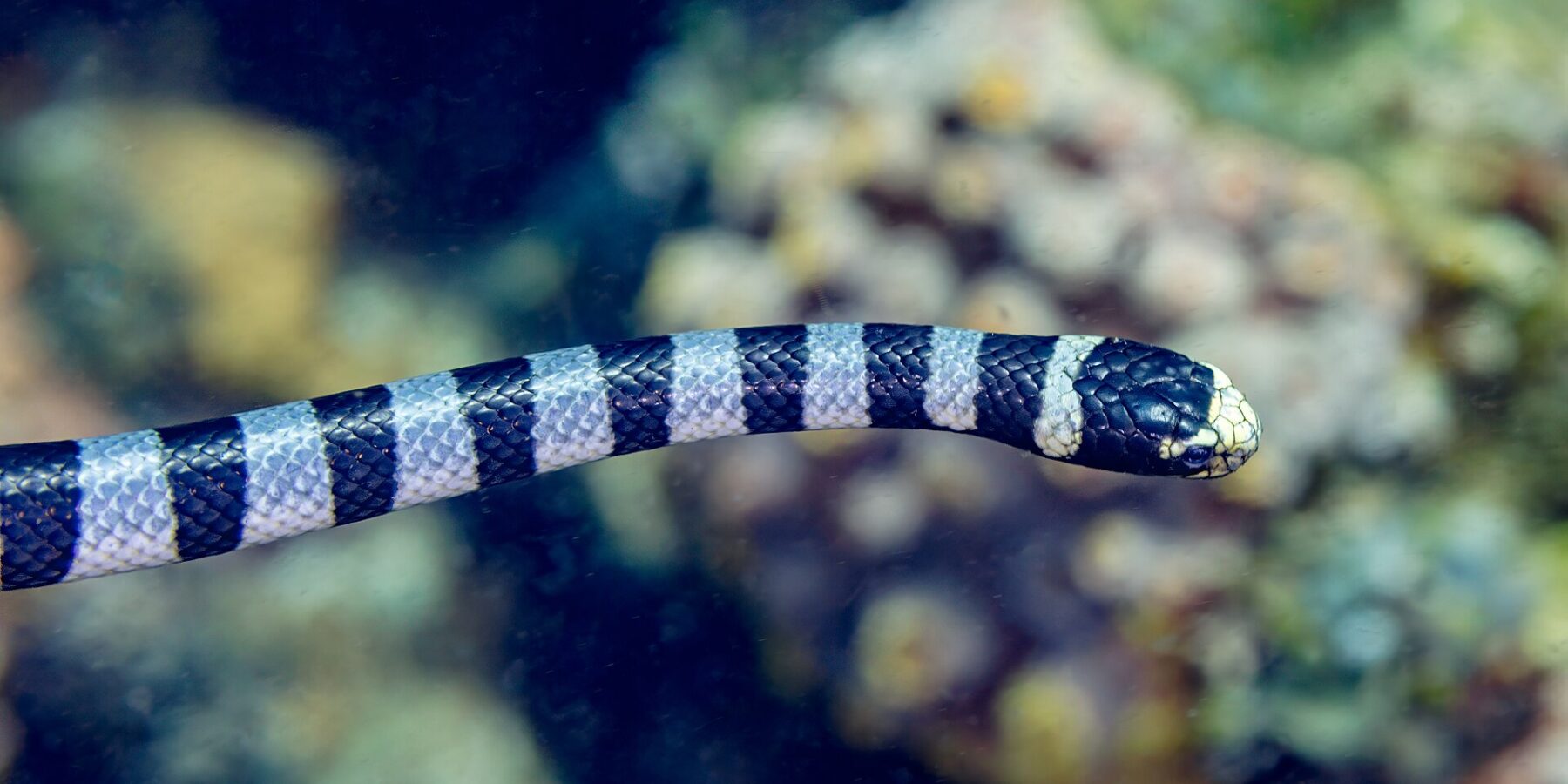
The banded sea krait is a sea snake banded black on blue-gray, with yellow lips and a paddle-shaped tail, 90 centimeters to 1.40 meters long; its venom is formidable, but it is placid and bites only when grabbed. You see it all year round at Apo Island and Gato Island.
Where to dive to see the banded sea krait?
 PhilippinesReef
Apo Island
Visayas: Cebu, Bohol and NegrosPeak season all year round: up to ten or so per dive at Rock Point West, and at Coconut Point
 PhilippinesPelagic
Monad Shoal and Kimud Shoal
Visayas: Cebu, Bohol and NegrosPeak season all year round: the sea snakes of Gato Island, the highest density in the country
How do you identify a banded sea krait?
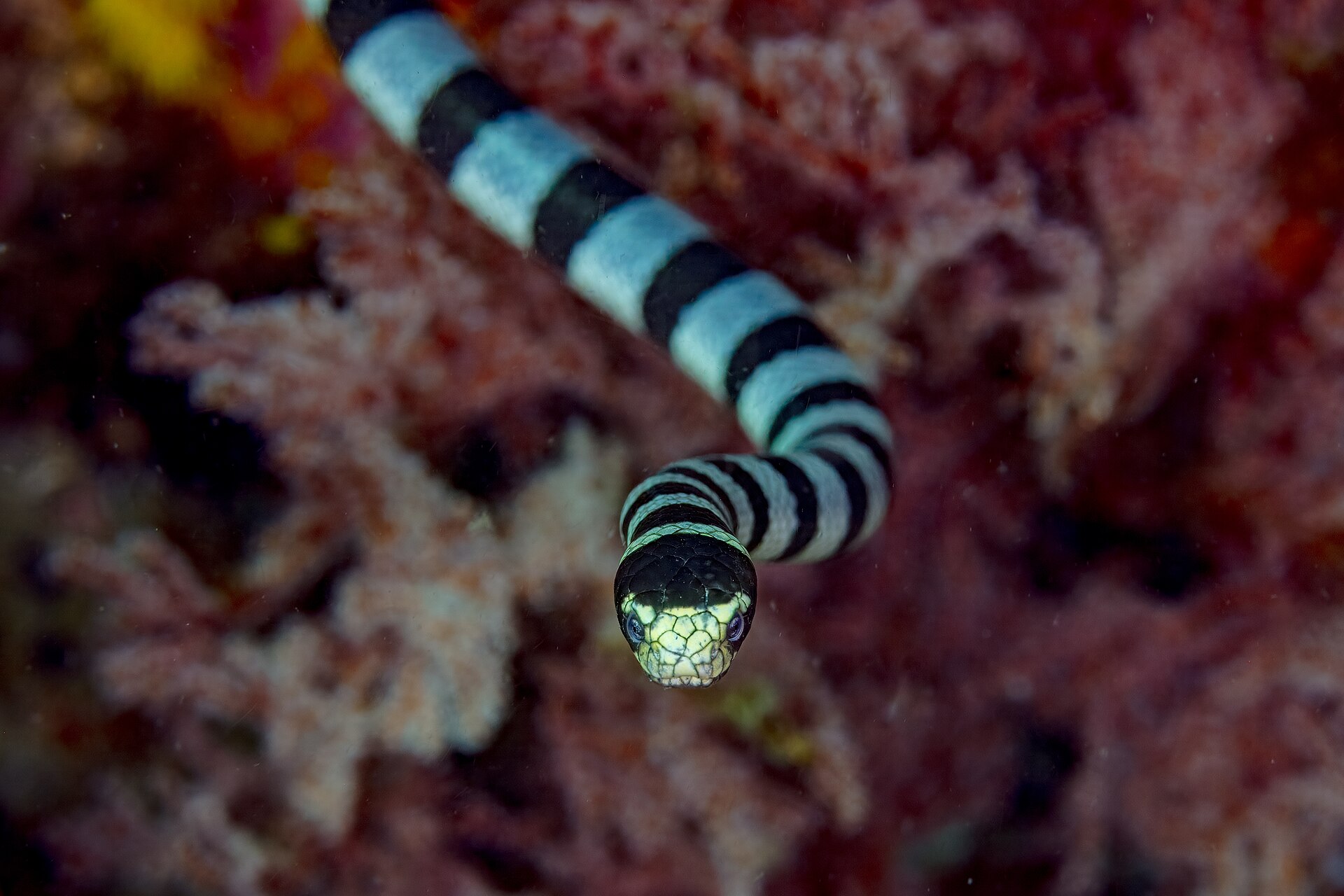
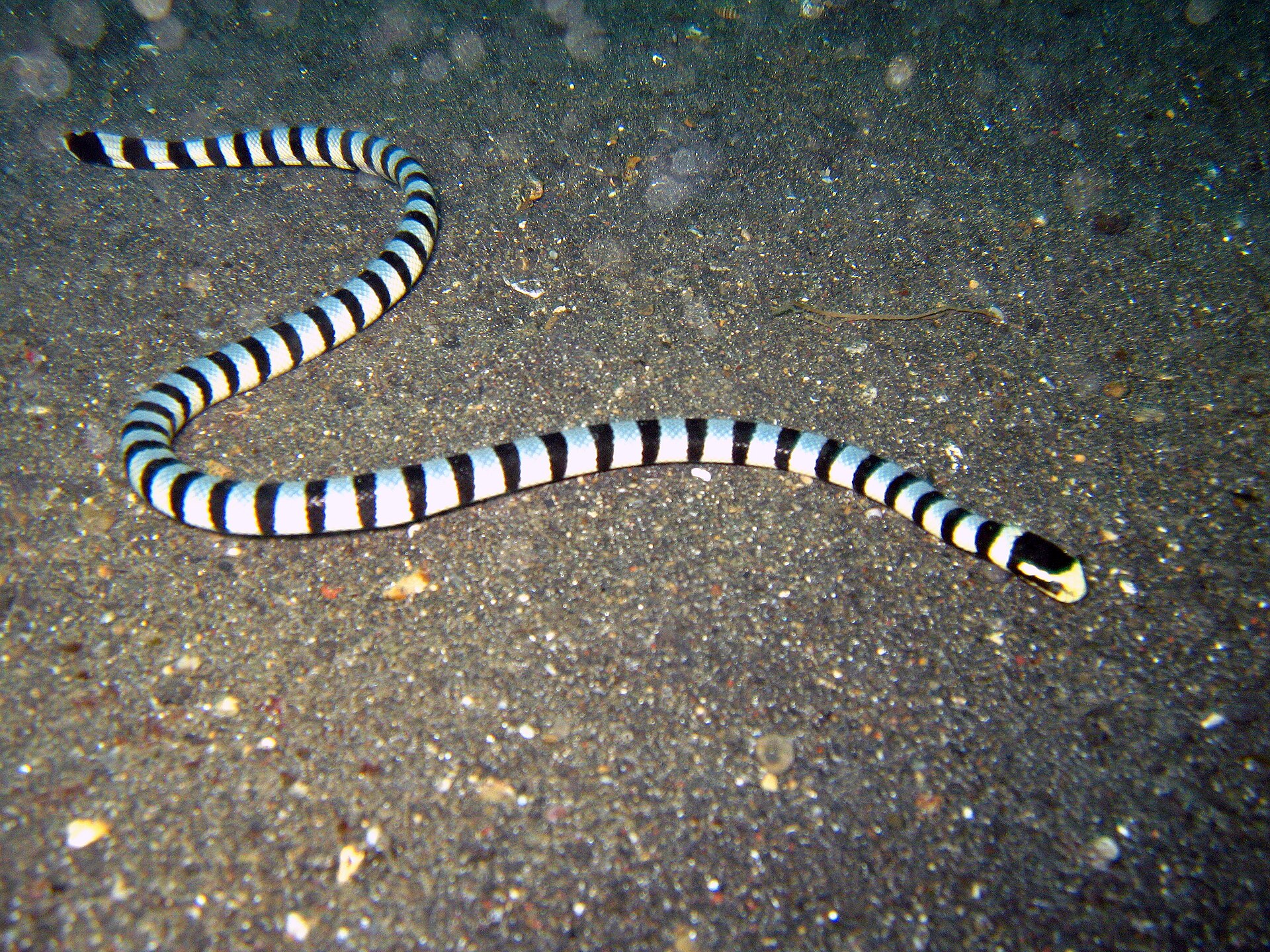
The banded sea krait, also called the yellow-lipped sea krait, is a sea snake of the family Elapidae, the cobra family. The body is almost cylindrical, blue-gray above and yellowish below, where wide ventral scales still let it crawl; it is ringed with 20 to 65 black bands of even width. The head is black, with a yellow snout and upper lip, and the yellow runs up on each side above the eye; the nostrils open on the snout. The tail is flattened like a paddle for swimming. Males measure nearly 90 centimeters on average, females 1.42 meters: they are a third larger.
Banded sea krait in pictures
How does the banded sea krait live?
It lives in the tropical coastal waters of the Indo-Pacific, from the east coast of India and the Bay of Bengal to Southeast Asia, the Philippines, Indonesia, New Guinea, the Solomon Islands, Vanuatu and Fiji, and from southern Japan to New Caledonia, with strays reaching Australia and New Zealand; it is the most widespread snake of its genus. It is amphibious: juveniles stay in the water, and adults spend half their time on land, where they return to digest, shed, mate and lay eggs, on the same islands, to which they stay faithful. At sea, it searches coral reefs and crevices for eels, morays and small fish, sometimes hunting cooperatively with jacks and goatfish; it can stay underwater for more than an hour, but it usually goes up to breathe every 10 to 20 minutes. It is oviparous: it breeds from September to December, and the female lays up to 10 eggs on land, in a crevice or under rotting vegetation.
Where and when can you see banded sea kraits in the Philippines?
Both dive sites where we list it are in the Visayas, and the banded sea krait is there all year round. At Apo Island, you see up to ten per dive at Rock Point West, and at Coconut Point. Around Monad Shoal and Kimud Shoal, Gato Island is where they gather: the highest density of sea snakes in the country. You meet them searching the coral, or rising to the surface to breathe.
Is the banded sea krait dangerous?
Its venom is one of the most potent of any snake: an alpha-neurotoxin close to the erabutoxins, with a median lethal dose of 0.45 milligrams per kilo in mice, enough to kill a human. But the banded sea krait is not aggressive, and bites are much rarer than with other venomous snakes: the known cases almost all involve fishermen untangling it from their nets. It readily makes its way into boat pipes. On a dive, the rule fits in one line: do not touch it, do not corner it, do not block its way. The IUCN lists it as Least Concern; in the Philippines, it is hunted for its skin and meat.
Our tip
Let it come and pass: it explores crevices without paying attention to divers, and it goes up to breathe every 10 to 20 minutes. Never touch it, do not grab it for a photo, and do not position yourself between it and the surface. At Apo Island, Rock Point West and Coconut Point show up to ten per dive.