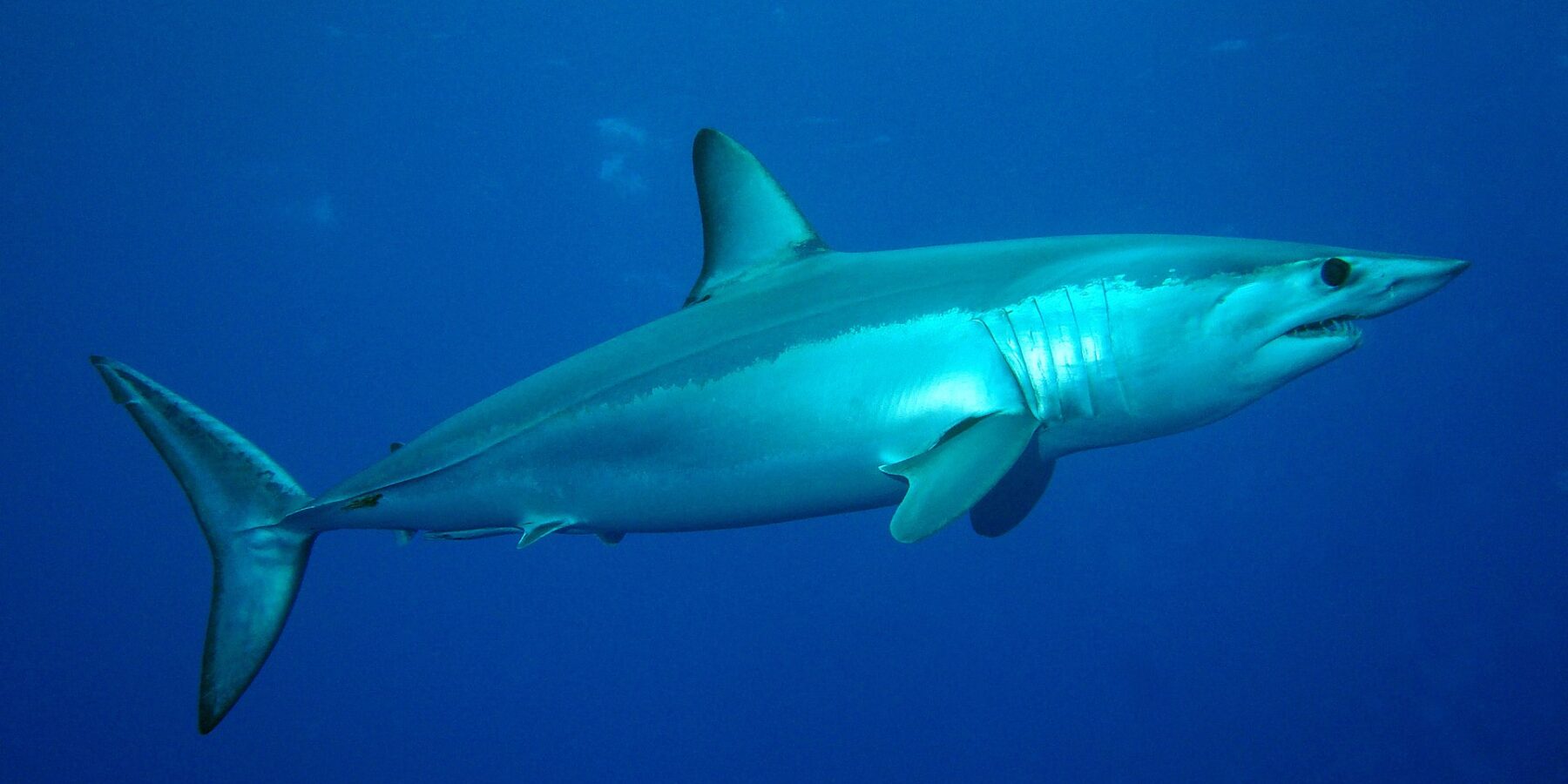
The mako shark is the fastest of all: a metallic blue spindle of 2.50 to 3.20 meters, capable of bursts of 74 km/h and leaps out of the water. It sometimes passes during the shark dives at Condor Bank, in the Azores. Fishing has decimated it, and the species is listed as Endangered.
Where to dive to see the shortfin mako shark?
 Azores
How do you identify a mako shark?
The shortfin mako is built like a spindle: a body thick in the middle and tapered at both ends, a conical, pointed snout, large black eyes and a mouth where the long, narrow, smooth teeth stay visible even when it is closed. The back is a deep metallic blue, the flanks silvery, the belly white; juveniles have a black snout tip. The tail is an almost symmetrical crescent, with a pronounced keel on each side of the caudal peduncle, like the tuna it hunts. Adults measure 2.50 to 3.20 meters and weigh 60 to 140 kilos. The larger females exceed 3.80 meters and 550 kilos, and the record is a 600-kilo individual caught off California in 2013.
How does the mako shark live?
The mako lives offshore, in temperate and tropical waters worldwide, most often from the surface down to 150 meters, and it rarely ventures into water colder than 16 °C. Like its cousin the great white shark, it is endothermic: a network of heat exchangers keeps its muscles 4 to 5 °C above the water temperature, which gives it bursts of 74 km/h, the fastest of any shark, and leaps several meters out of the water. It hunts squid, mackerel, tuna and swordfish, and sometimes sharks, dolphins or turtles. Females give birth to 4 to 18 pups of 70 centimeters after fifteen to eighteen months of gestation, every three years. Males mature at around eight years, females at around eighteen, and the species lives about thirty years.
Where and when can you see mako sharks in the Azores?
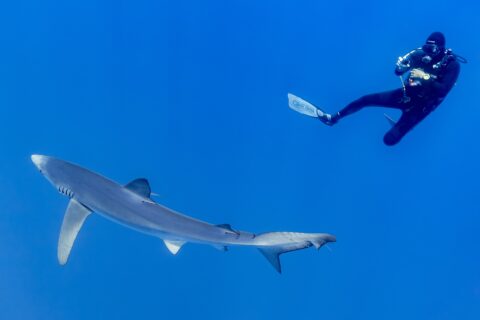
The mako shares the waters of the blue shark, and you meet it during the shark sessions at Condor Bank, 17 kilometers from Faial. From July to mid-October, the dive centers of Horta and Madalena attract sharks with a closed bait crate, and the mako sometimes passes in the blue among the blue sharks, more rarely and faster than they do. It is also reported in the blue at Princess Alice Bank. You don't go deeper than 10 meters, you stay on the line, and the Azores code of conduct limits the group to eight divers and one guide, with no feeding or contact.
Is the mako shark endangered?
Sought after for its meat and fins, and caught in large numbers by tuna and swordfish longliners, the mako has seen its North Atlantic population collapse. The IUCN moved it from Vulnerable to Endangered in 2019, and the same year it was listed on CITES Appendix II, which regulates its international trade. In the Mediterranean, it has almost disappeared. Its slow growth and late maturity, eighteen years for a female, make any return to fishing fatal: every mako seen alive at Condor Bank is worth more than its weight at market.
Our tip
It arrives fast and leaves just as fast: stay on the line, with your buddy, and don't try to follow it. More nervous than a blue shark, a mako keeps its distance: don't provoke it, and keep your hands by your sides. The guide alone decides to take the group out of the water if one becomes persistent.