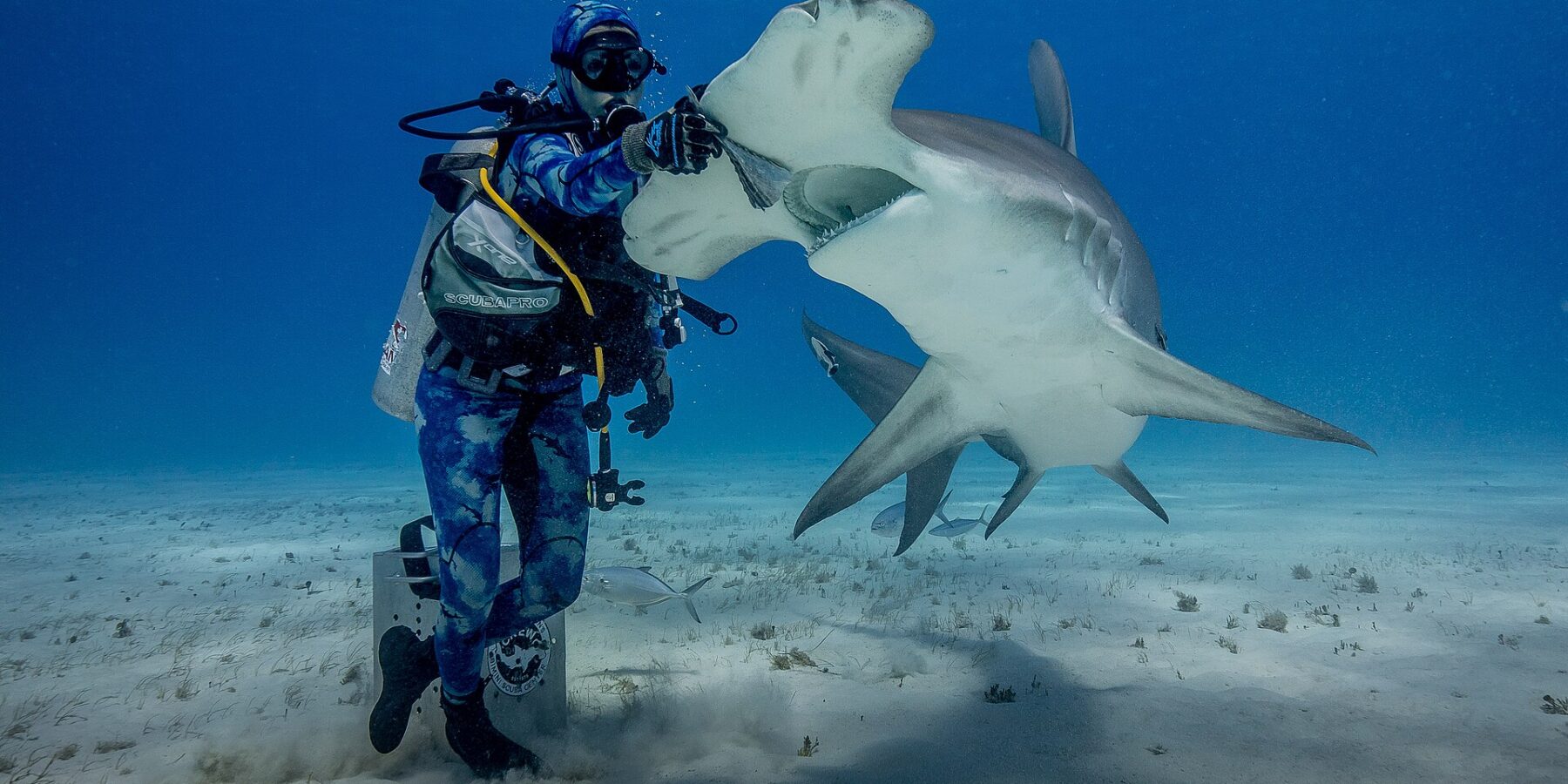
The great hammerhead is the largest of its family, usually 3.5 to 4.6 meters, with an almost straight-edged hammer and a tall, sickle-shaped dorsal fin. In Rangiroa, dozens of adult females return to Tiputa Pass every year, from December to March. The species is Critically Endangered.
Where to dive to see the great hammerhead?
 France
How do you identify a great hammerhead?
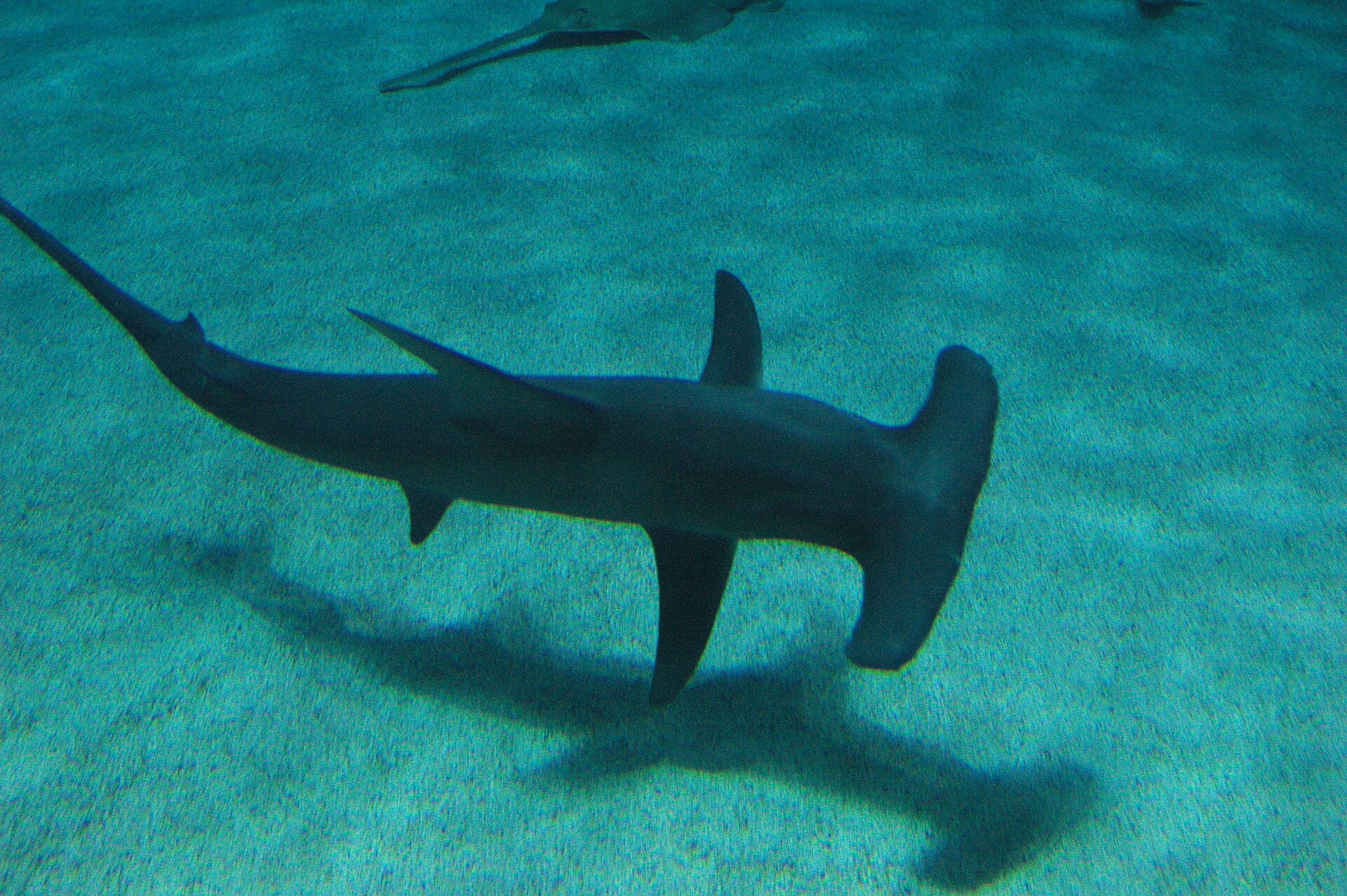
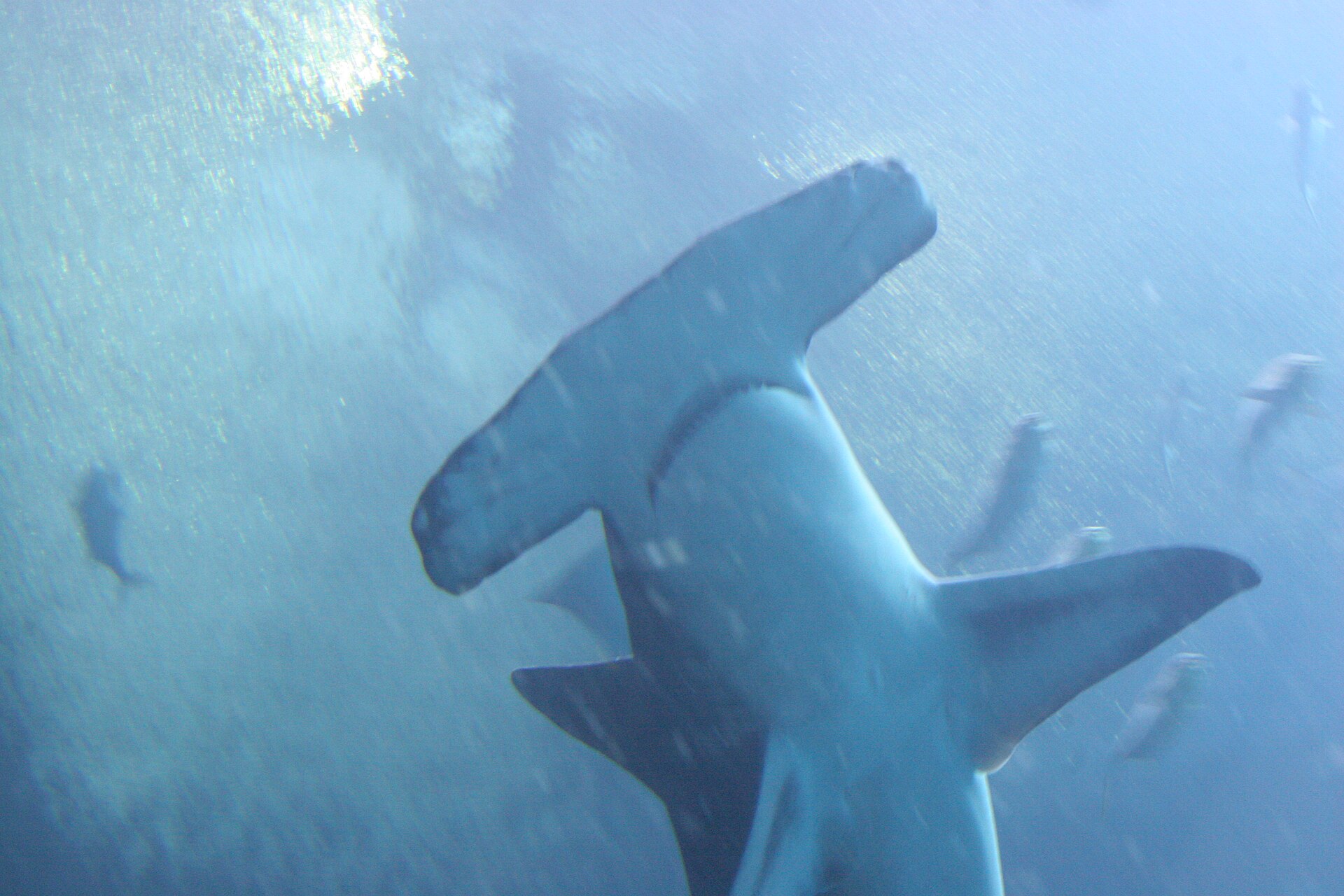
The great hammerhead is the largest of its family: 3.5 meters and over 230 kilos for a typical adult, 4.6 meters for large individuals, and a small part of the population, mostly females, much larger. The length record is 6.1 meters, and the weight record 580 kilos, a 4.4-meter female caught in Florida in 2006. The hammer measures 23 to 27% of the body length; its front edge is almost straight, with a notch in the middle, whereas it is arched in the scalloped hammerhead. The very tall, sickle-shaped first dorsal fin rises above the pectoral fins; the pelvic fins have a concave rear edge, straight in the scalloped hammerhead. The back is dark brown to light gray or olive, the belly white. It often swims tilted on its side.
Great hammerhead in pictures
How do great hammerheads live?
It is a solitary, nomadic predator of tropical waters worldwide, between 40° north and 37° south, from lagoons and coral reefs to continental shelves, from less than one meter to 80 meters deep. It eats crustaceans, cephalopods, fish and small sharks, but it is a ray specialist: it sweeps the bottom with its hammer to pick up the electric field of buried stingrays, then pins them to the ground with its head. One individual caught in Florida had 96 stingray barbs in and around its mouth. It hunts mostly at dawn and dusk. The species is viviparous: every two years, after eleven months of gestation, the female gives birth to 20 to 40 pups of 50 to 70 centimeters. Around divers, it tends to be shy or indifferent, sometimes curious.
Where and when can you see great hammerheads?
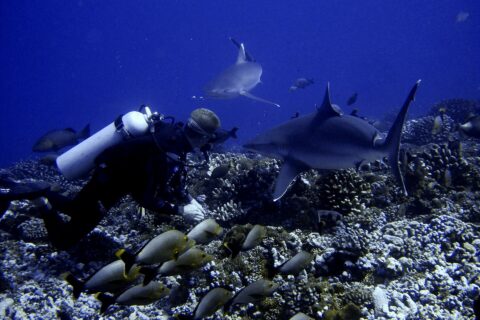
In French waters, the place to go is Tiputa Pass, at Rangiroa, from December to March, with the best chances from January to March. Adult females gather there during the austral summer, most often around the full moon, and patrol the step at the mouth of the pass, the Marche, at around 40 to 50 meters, on an incoming current; they also take advantage of gray reef sharks exhausted by mating and of squadrons of eagle rays. A study published in 2023 identified at least 55 individuals at Tiputa and Tikehau in 2020 and 2021, 54 of them females; about half stay up to six days a month, and 32 of them returned years apart, up to twelve years. Elsewhere, the species can be seen in winter at Bimini, in the Bahamas, from December to March, but at a site where guides feed the sharks, not as a natural encounter.
Is the great hammerhead endangered?
The great hammerhead has been listed as Critically Endangered by the IUCN since 2019, after an estimated decline of at least 80% over 75 years, and it is listed in CITES Appendix II. It is targeted for its fins and caught on longlines, in nets, on lines and in trawls; when caught as bycatch, it dies in more than 90% of cases in the fisheries of the northwest Atlantic and the Gulf of Mexico. Catches fell by 73% in the Indian Ocean between 1978 and 2003. The faithful females of Rangiroa, which only give birth every other year, are therefore precious: watch them without chasing them.
Our tip
At Tiputa, from December to March, book incoming-current dives around the full moon with a dive center that runs the Marche dive, and check that your certification allows you to descend to 45 or 50 meters. Stay settled on or hooked to the step and let the shark pass: following it into the blue at 50 meters, in the current, adds narcosis to the risk of getting separated. Keep an eye on your computer: deco stops come quickly at this depth.