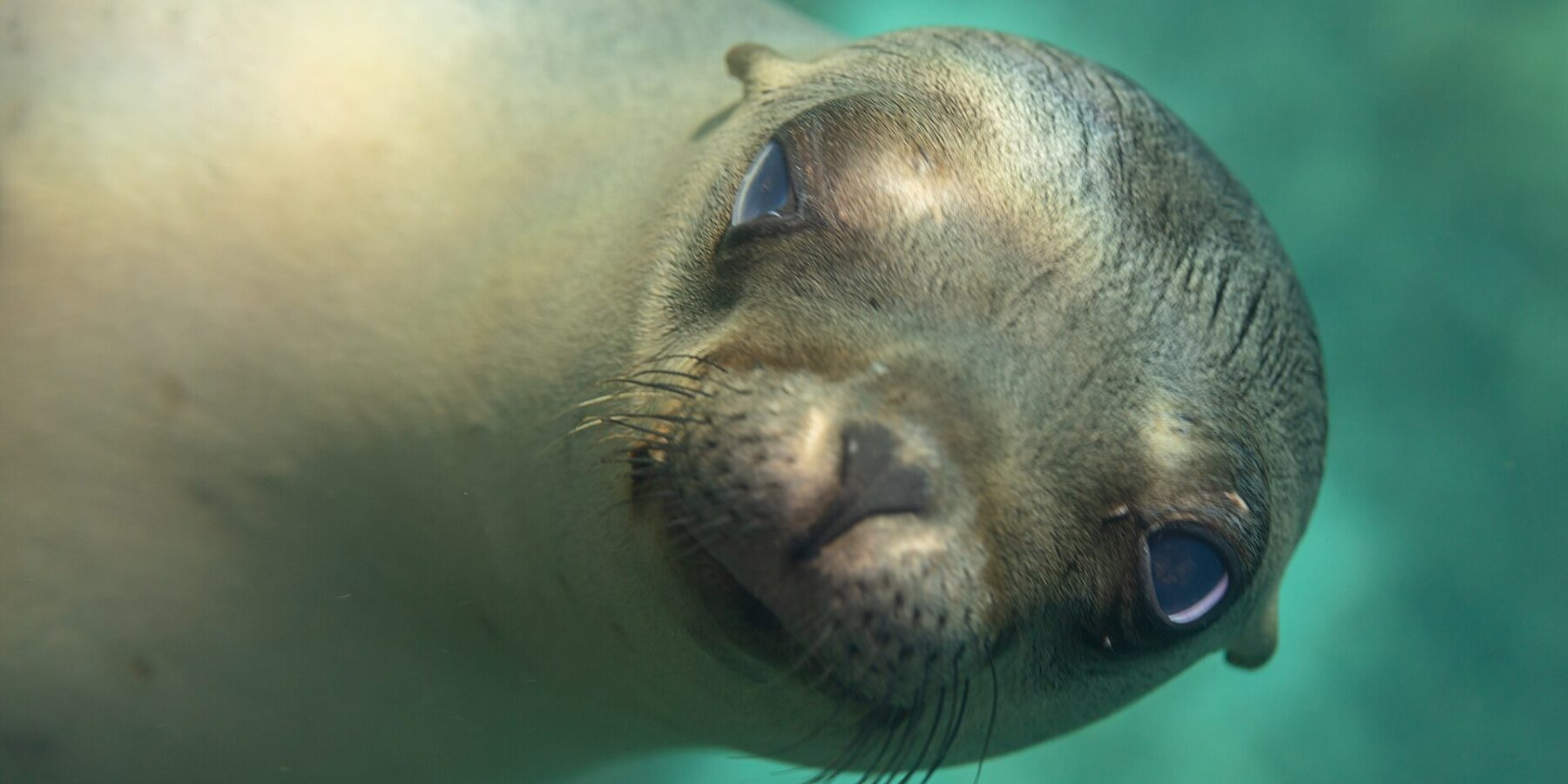
The California sea lion is a playful, acrobatic eared seal from the west coast of North America; the male reaches 2.70 meters and 350 kilos. In the Sea of Cortez, the young sea lions of Los Islotes, near La Paz, come to play with divers, but the site closes from June to the end of August.
Where to dive to see the california sea lion?
 Mexico
How do you identify a California sea lion?
The California sea lion is an eared seal: it has small external ear flaps, a flexible neck and long, powerful front flippers that drive it forward in strokes, the body gliding between beats. On the rocks, it tucks its hind flippers under its body and walks. Males and females look very different. Females measure about 2.10 meters and 100 kilos, with blond to tawny fur; males reach 2.50 to 2.70 meters and 350 kilos, sometimes much more, with dark brown to black fur, a thick neck and a forehead marked by a bony crest. Pups are born dark brown, at about 7 kilos, and molt at around 4 or 5 months. Its flexible spine lets it spin around in open water: underwater, it is an acrobat.
How does the California sea lion live?
It lives along the west coast of North America, from southeast Alaska to central Mexico, including the Gulf of California, where a population of some 31,000 animals stays all year without migrating. It hunts squid, anchovies, sardines and mackerel offshore and can spend two weeks at sea. From May to August, males hold a territory on the breeding beaches, without eating, for about thirty days, and attract up to fourteen females. Births take place in June and July, and the female then alternates trips to sea of two to five days with returns to nurse, for nearly a year. Males bark, and mothers and pups recognize each other by voice and smell. Very intelligent and not very fearful of humans once used to them, it is the sea lion of zoos and marine parks.
Where and when can you dive with California sea lions in Mexico?
Los Islotes, two islets north of Espíritu Santo Island, 45 minutes by panga from La Paz, are home to a colony of about 300 sea lions. The young ones come out to meet divers and swimmers, nibble fins, tug at mask straps and play with anything that moves, between 5 and 15 meters deep, in water at 20 °C in winter and 27 to 29 °C from August to October. The site is closed to swimming and diving from June to August 31, by decision of CONANP, because breeding males charge intruders; attacks have happened in years when the rule was not respected. You can also see sea lions on the rocks of Land's End, at Cabo San Lucas, and at Isla Coronado, near Loreto.
Is the California sea lion endangered?
The IUCN lists the California sea lion as Least Concern: the US population, protected since 1972, grew by 7% a year until it neared the carrying capacity of its habitat. The Gulf of California population, on the other hand, had fallen by 20% as of 2008. The threats are nets and fishing gear, in which it gets tangled, and feeding by humans, which makes it dependent and draws it closer to boats. On breeding sites, it is skittish and flees into the water if approached: that is why the Los Islotes rules forbid climbing on the rocks, touching and feeding.
Our tip
Stay away from the rocks and the big males, and let the young ones come to you: they will. Don't touch, don't feed, and never approach a pup on the beach. Outside the breeding season, still keep the guide in sight: you can tell a territorial male by his bark and his charge.